Terracotta: Enabling the Adoption of New DRAM Techniques via a Flexible DRAM Interface and Memory Controller
By Harsh Songara 1, Konstantinos Kanellopoulos 1, F. Nisa Bostancı 1, Konstantinos Marios Sgouras 1, Ataberk Olgun 1, İsmail Emir Yüksel 1, Andreas Kosmas Kakolyris 1, A. Giray Yağlıkçı 2, Onur Mutlu 1,3
1 ETH Zürich
2 CISPA
3 New York University
Abstract
DRAM is the dominant memory technology in modern systems, yet it continues to limit performance, energy efficiency, and system robustness. To mitigate such limitations, many prior works have proposed novel DRAM techniques that change how DRAM is operated to support in-DRAM computation, improve memory access latency and parallelism, and enhance DRAM maintenance and reliability. However, adopting these techniques one after another in current systems with rigid interfaces and memory controller hardware requires repeated and costly modifications to them, hindering the deployment of critical performance, energy efficiency, and robustness improvements.
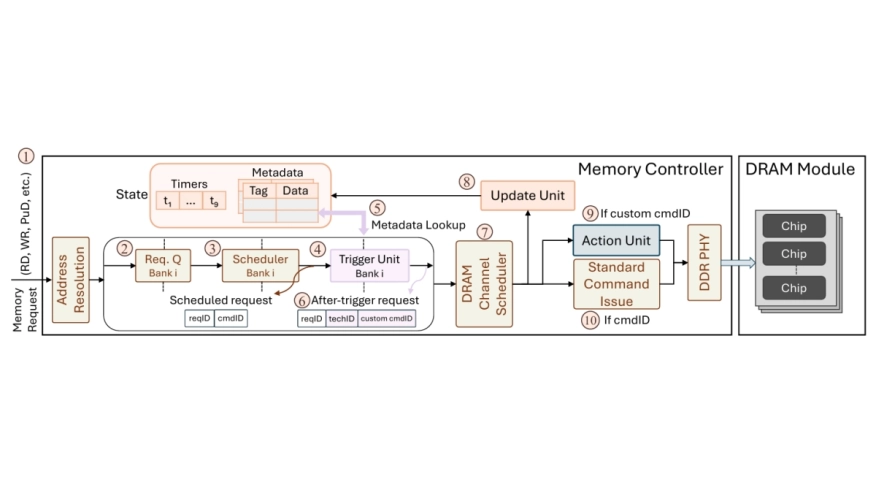
Our goal is to reduce the repeated DRAM interface and memory controller modifications that hinder or slow down the deployment of diverse DRAM techniques. We observe that the DRAM commands and memory controller structures across several DRAM techniques are similar. Our key idea is to leverage these similarities to compose a set of primitives that DRAM vendors and system designers can use to implement a wide variety of DRAM techniques. To this end, we propose Terracotta, a new framework that consists of two flexible components: (i) custom command extensions that enable DRAM vendors to define new commands within a single, standardized interface, and (ii) a programmable memory controller that system designers can easily and flexibly program to support new DRAM techniques post-silicon fabrication. Together, these two components enable the deployment of new DRAM techniques via configuration of the memory controller rather than repeated interface and controller modifications.
We design Terracotta for a DDR5-based system and comprehensively evaluate its performance, energy, and hardware complexity. We draw three key findings. First, for four DRAM techniques from four distinct domains including processing-using-DRAM, low-cost DRAM maintenance, subarray-level parallelism, and latency reduction, Terracotta retains almost all of the performance benefits (>96%) that custom implementations provide over a baseline system without these techniques. Second, a Terracotta based composition of two DRAM techniques from the domains of subarray-level parallelism and latency reduction outperforms the Terracotta-based implementations of the individual techniques, showing that Terracotta can enable system improvements by adding techniques without further interface and con troller modifications. Third, Terracotta’s flexibility incurs low DRAM energy overheads (0.6–3.2%) and low area and power overheads (0.03% and 0.56%, respectively) in a high-end server grade processor. Terracotta’s source code is freely available at https://github.com/CMU-SAFARI/Terracotta.
To read the full article, click here
Related Semiconductor IP
- Memory Interface
- External Memory Interface (EMIF)
- External Flash Memory Interface IP
- DDR1 DDR2 SDRAM Memory Controller
- SDRAM/SRAM/FLASH Memory Controller
Related Articles
- DDR3 memory interface controller IP speeds data processing applications
- Retention-Aware RISC-V ISA Extension and Memory Controller on FPGA for MLC NVM
- Automated Pre-Silicon Verification of High-Speed DDR5 and LPDDR5/6 Memory Controllers: Closed-Loop Timing, Mode Register, and PHY Synchronization in UVM
- Take a scalable approach to fabric interface controller design
Latest Articles
- Terracotta: Enabling the Adoption of New DRAM Techniques via a Flexible DRAM Interface and Memory Controller
- A Framework for Accelerating Transformer Inference on RISC-V for Edge AI
- An Interleaved Parallel Dependent Quantization Hardware Architecture for H.266/VVC
- A Formal Security Analysis of CAN XL
- A Secure dToF LiDAR SoC with Dual-Domain Fingerprinting and Event-Driven AFE Circuit Achieving Sensor-Level Attack Resilience