FPGA Acceleration of Fully Homomorphic Encryption with Adaptive Key Switching
By Zhihan Xu 1, Jayashree Adivarahan 1, Rajgopal Kannan 2 and Viktor K. Prasanna 1
1 University of Southern California, USA;
2 DEVCOM Army Research Office, USA
Abstract
Fully Homomorphic Encryption (FHE) enables privacy-preserving cloud services but incurs substantial computation overhead, making hardware acceleration essential. Among FHE operations, key-switching is a major performance bottleneck. Recent cryptographic advances introduce a novel key-switching method (i.e., KLSS) that reduces certain operational complexity but demands higher computational precision than the traditional Hybrid Key Switching (HKS) method. This trade-off leads to distinct computation and memory requirements, making the relative latency of KLSS and HKS highly dependent on hardware parallelism, FHE security parameters, and available on-chip memory capacity, particularly on FPGA platforms, where memory resources and parallelism must be carefully balanced.
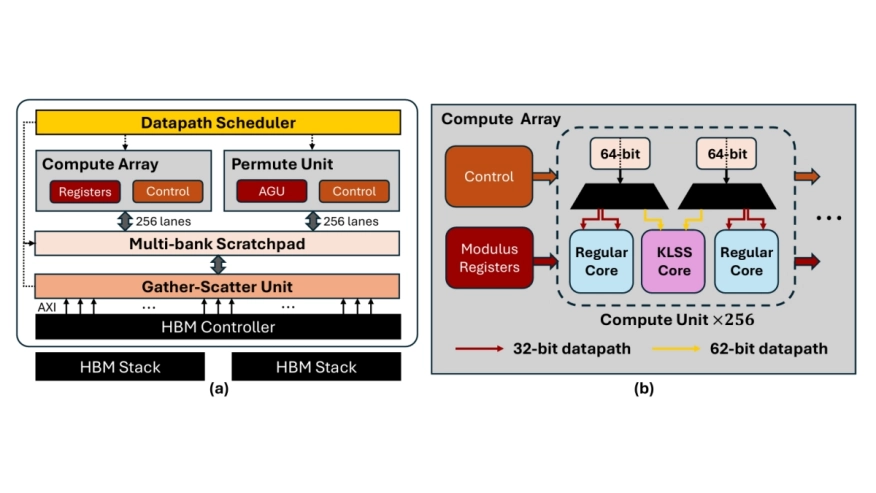
In this work, we first propose a memory-efficient KLSS datapath that eliminates off-chip ciphertext transfers. We then develop a performance model to analyze and compare the overheads of both KLSS and HKS. Our analysis reveals that an adaptive solution supporting both methods can achieve lower overall latency than a static method during FHE computation. Guided by the performance model, we design an adaptive FPGA-based FHE accelerator that dynamically selects between HKS and KLSS during computation. We implement the accelerator on an Alveo U280 and evaluate it across multiple FHE benchmarks. Experimental results demonstrate that our adaptive solution achieves a 1.84-3.31× speedup in bootstrapping latency and a 1.66-2.52× speedup in secure image classification compared to state-of-the-art FPGA accelerators.
Index Terms—FPGA Accelerator, Fully Homomorphic Encryption, CKKS, Key Switching, KLSS
To read the full article, click here
Related Semiconductor IP
- UALinkSec Security Module
- ECC Secure Accelerator - High-performance ECC IP with advanced physical security
- 802.11i Wireless Security Cores
- Quantum Safe, ISO 21434 Automotive-grade Programmable Hardware Security Module
- Embedded Hardware Security Module (Root of Trust) - Automotive Grade ISO 26262 ASIL-B
Related Articles
- Seven Key Advantages of Implementing eFPGA with Soft IP vs. Hard IP
- Hardware Security Requirements for Embedded Encryption Key Storage
- Enabling Composable Platforms with On-Chip PCIe Switching, PCIe-over-Cable
- Data Over Sound: Encryption is Key
Latest Articles
- Automated Pre-Silicon Verification of High-Speed DDR5 and LPDDR5/6 Memory Controllers: Closed-Loop Timing, Mode Register, and PHY Synchronization in UVM
- U-Sonic: An Open-Source 8-Channel Ultrasound Transmit IP in a 130 nm RISC-V SoC
- S-ALSA: Co-Design of Adiabatic Logic-based Sensing and Balanced Bit-Cells for Secure and Energy-Efficient MRAM
- MEGATRON: a 28nm Analog PCM CiM/Digital System-on-Chip for Edge GenAI at 57.5 TOPS/W and 1.52 Mparam/mm²
- Peregrino: A Full-Hardware Accelerator for the Complete Falcon Post-Quantum Digital Signature Scheme on Resource-Constrained Edge Devices