RoMe: Row Granularity Access Memory System for Large Language Models
By Hwayong Nam †, Seungmin Baek †, Jumin Kim †, Michael Jaemin Kim ‡, and Jung Ho Ahn †
Seoul National University †, Meta ‡
Abstract
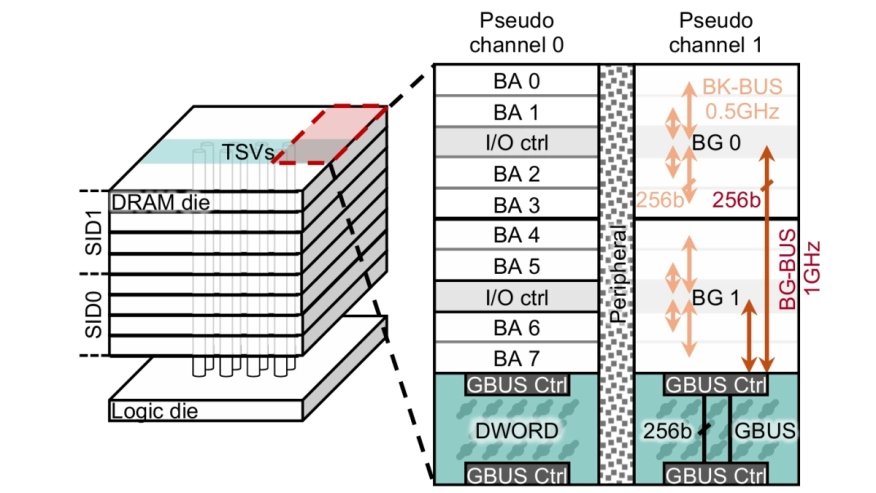
Modern HBM-based memory systems have evolved over generations while retaining cache line granularity accesses. Preserving this fine granularity necessitated the introduction of bank groups and pseudo channels. These structures expand timing parameters and control overhead, significantly increasing memory controller scheduling complexity. Large language models (LLMs) now dominate deep learning workloads, streaming contiguous data blocks ranging from several kilobytes to megabytes per operation. In a conventional HBM-based memory system, these transfers are fragmented into hundreds of 32B cache line transactions. This forces the memory controller to employ unnecessarily intricate scheduling, leading to growing inefficiency.
To address this problem, we propose RoMe. RoMe accesses DRAM at row granularity and removes columns, bank groups, and pseudo channels from the memory interface. This design simplifies memory scheduling, thereby requiring fewer pins per channel. The freed pins are aggregated to form additional channels, increasing overall bandwidth by 12.5% with minimal extra pins. RoMe demonstrates how memory scheduling logic can be significantly simplified for representative LLM workloads, and presents an alternative approach for next-generation HBM-based memory systems achieving increased bandwidth with minimal hardware overhead.
To read the full article, click here
Related Semiconductor IP
- HBM Memory Model
- HBM DFI Verification IP
- HBM 4 Verification IP
- HBM Synthesizable Transactor
- HBM DFI Synthesizable Transactor
Related Articles
- SkipOPU: An FPGA-based Overlay Processor for Large Language Models with Dynamically Allocated Computation
- SV-LLM: An Agentic Approach for SoC Security Verification using Large Language Models
- Assertain: Automated Security Assertion Generation Using Large Language Models
- LACE: Large Language Model Aided Multi-Agent Framework for Agile RISC-V Instruction Extension
Latest Articles
- Terracotta: Enabling the Adoption of New DRAM Techniques via a Flexible DRAM Interface and Memory Controller
- A Framework for Accelerating Transformer Inference on RISC-V for Edge AI
- An Interleaved Parallel Dependent Quantization Hardware Architecture for H.266/VVC
- A Formal Security Analysis of CAN XL
- A Secure dToF LiDAR SoC with Dual-Domain Fingerprinting and Event-Driven AFE Circuit Achieving Sensor-Level Attack Resilience