Overview
Produced by DRAM manufacturers such as Samsung and Micron, High Bandwidth Memory or HBM, provides users with high bandwidth, low power consumption and large memory size. HBM is most commonly used in data intensive applications such as AI, image processing, vector processing and others. AI algorithms such as deep neural networks (DNN) store inputs and massive weight parameters, activations as the input traverses the neural network. DNN training requires large quantity of activation information to be stored and retrieved very quickly for multi-pass processing. A 50-layer ResNet network may require millions of weight parameters and millions of activations to be stored per pass. Floating point (and its precision level) further significantly increases the size of the memory by 100’s of times. And for high performance, these different types of stored information must be fetched and fed into the neural network at high speed. Memory bandwidth is a major challenge in designing processing chips for data intensive applications. HBM helps to alleviate such problems. Chips such as GPU, application accelerators, vector processors require HBM controller to access the high bandwidth available from HBM. LeWiz offers HBM Controller IP core for designing ASIC and processing chips.
HBM is a JEDEC standard. It uses 3D stacking technology with through silicon vias to decrease the signal travel time (lowers the latency), increases memory density per area. Thus, HBM has smaller surface area and board space than other DRAM types. Due to its small surface area and high performance, HBM is a key integration for aerospace and commercial applications. HBM using the LeWiz HBM Controller can support error check and correction (ECC) with memory scrubbing capability – offering fault tolerant capability suitable for high-reliability and space applications. For radiation environment, space versions with different levels of tri-modular redundancy (TMR) are also available.
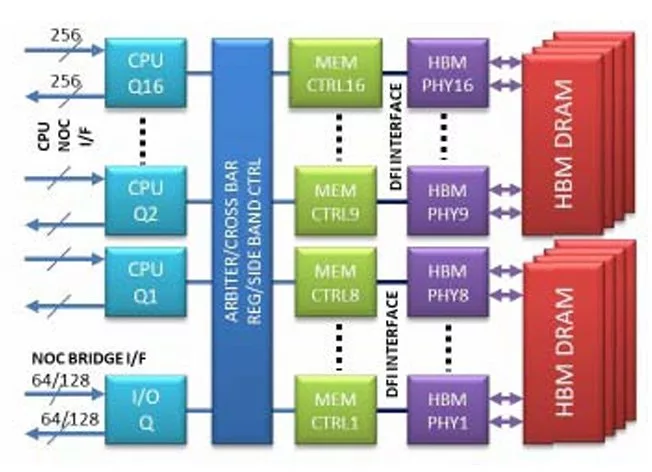
The HBM Controller has 16 parallel channels for data access. Each channel is 256-bit wide. In the backend it uses the DFI standard for interfacing to DRAM PHYs. In the front-end, it supports network-on-chip or standard, well-known bus AXI-stream for on-chip interface.
In addition to HBM, the IP core also supports DDRx DRAM types. Available in source code or netlist format. A test bench and the documents are also provides to help users in their application.
Learn more about HBM IP core
Toki, released as open source, is the first hardware-software framework that enables profiling the performance of HBM on FPGA accelerator cards by jointly considering (i) the execution of workloads on RISC-V soft cores instantiated on the FPGA and (ii) the injection of memory traffic from the host system via DMA over PCIe, providing insights that cannot be obtained with synthetic traffic generators alone.
This paper presents REACH, a controller microarchitecture that uses established inner codes to correct common errors and identify unresolved chunks, reserving a long outer code for known-erasure repair. Differential parity bounds write traffic, and a co-designed endpoint preserves 32 B transactions without an extra data burst.
A decade ago, a high-end server processor might have accessed 50 to 100 GB/s of memory bandwidth. At the time, that seemed impressive. Today, AI accelerators routinely consume 3 to 8 TB/s of memory bandwidth, roughly 30 to 100 times that of their predecessors.
As AI and high-performance SoCs increasingly rely on HBM, memory bandwidth alone is no longer enough to maximize performance. This article discusses why the intelligent data movement and cache efficiency are critical to unlocking the full benefits of HBM-based architectures.
LLM inference is increasingly memory-bound, and HBM cost per GB now dominates system cost. Today’s HBM stacks include short on-die ECC, which tightens binning, raises price, and locks reliability policy inside the device. This paper asks a simple question: can we tolerate a much higher raw HBM bit error rate (BER) and still keep end-to-end correctness and throughput, without changing the HBM PHY or the fixed 32B transaction size?
HBM4 is the latest generation of the High Bandwidth Memory (HBM) that has become analogous to the Artificial Intelligence (AI) boom that is everywhere in today’s world. HBM is also increasingly being used in other applications like Data centers, autonomous driving systems, servers, cloud computing just to mention few domains where bandwidth and performance in a key requirement.