MING: An Automated CNN-to-Edge MLIR HLS framework
By Jiahong Bi, Lars Schütze and Jeronimo Castrillon
Technische Universitat Dresden, Germany
Abstract
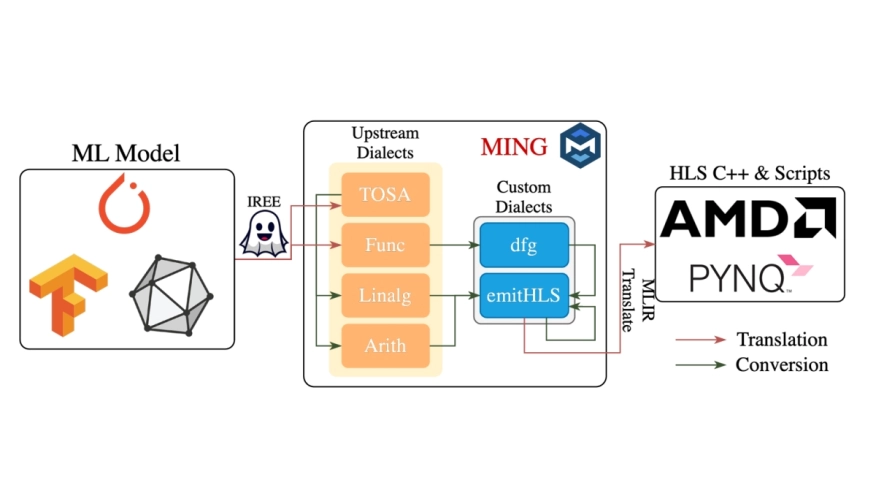
Driven by the increasing demand for low-latency and real-time processing, machine learning applications are steadily migrating toward edge computing platforms, where Field-Programmable Gate Arrays (FPGAs) are widely adopted for their energy efficiency compared to CPUs and GPUs. To generate high-performance and low-power FPGA designs, several frameworks built upon High Level Synthesis (HLS) vendor tools have been proposed, among which MLIR-based frameworks are gaining significant traction due to their extensibility and ease of use. However, existing state-of-the-art frameworks often overlook the stringent resource constraints of edge devices. To address this limitation, we propose MING, an Multi-Level Intermediate Representation (MLIR)-based framework that abstracts and automates the HLS design process. Within this framework, we adopt a streaming architecture with carefully managed buffers, specifically designed to handle resource constraints while ensuring low-latency. In comparison with recent frameworks, our approach achieves on average 15x speedup for standard Convolutional Neural Network (CNN) kernels with up to four layers, and up to 200x for single-layer kernels. For kernels with larger input sizes, MING is capable of generating efficient designs that respect hardware resource constraints, whereas state-of-the-art frameworks struggle to meet.
Index Terms — Hardware Architectures, Compilers, High Level Synthesis, Quantized Neural Network, Edge Computing
To read the full article, click here
Related Semiconductor IP
- nQrux® Root of Trust IP
- AXI to UCIe Bridge IP
- UCIe 2.x Controller IP
- SWI3S (SoundWire I3S Interface) Peripheral Controller Core IP
- OpenTitan-based RISC-V Secure Element
Related Articles
- An Automated Flow for Reset Connectivity Checks in Complex SoCs having Multiple Power Domains
- RISC-V Functional Safety for Autonomous Automotive Systems: An Analytical Framework and Research Roadmap for ML-Assisted Certification
- CHIA: An open-source framework for principled, agentic AI-driven hardware/software co-design research
- Automated Estimation of MBIST Area and Test Time in Heterogeneous Memory IPs via Stacked Ensemble Framework
Latest Articles
- Automated Pre-Silicon Verification of High-Speed DDR5 and LPDDR5/6 Memory Controllers: Closed-Loop Timing, Mode Register, and PHY Synchronization in UVM
- U-Sonic: An Open-Source 8-Channel Ultrasound Transmit IP in a 130 nm RISC-V SoC
- S-ALSA: Co-Design of Adiabatic Logic-based Sensing and Balanced Bit-Cells for Secure and Energy-Efficient MRAM
- MEGATRON: a 28nm Analog PCM CiM/Digital System-on-Chip for Edge GenAI at 57.5 TOPS/W and 1.52 Mparam/mm²
- Peregrino: A Full-Hardware Accelerator for the Complete Falcon Post-Quantum Digital Signature Scheme on Resource-Constrained Edge Devices