InjectV: Modeling Fault Injection Attacks in RISC-V Simulation Environment
By Niccolò Lentini 1, Giorgio Fardo 1,2, Stefano Di Carlo 1, Alessandro Savino 1
1 Politecnico di Torino, Turin, Italy
2 Univ. Grenoble Alpes, CEA, List, Grenoble, France
Abstract
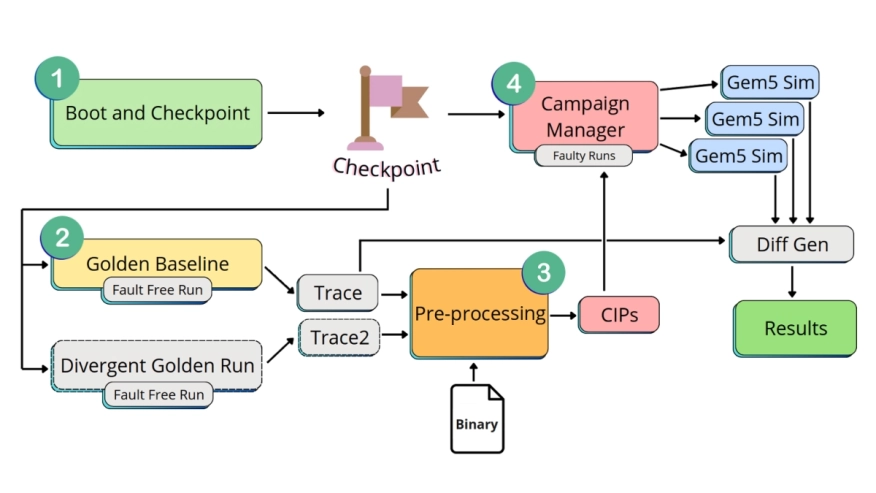
Fault Injection Attacks (FIAs) are a significant threat to hardware security, capable of compromising systems by inducing malicious faults in computation or storage. Evaluating resilience against such attacks is challenging due to the high cost, complexity, and limited availability of physical fault experiments, particularly during pre-silicon development. Architectural-level simulation offers a developer-oriented, white-box perspective for systematic vulnerability assessment. This paper introduces InjectV, a fault injection attack framework for RISC-V platforms built on the gem5 simulator. InjectV enables precise, guided fault injection at security-critical execution points, such as control-flow decisions, counters, and comparisons, allowing systematic exploration of attack vectors. It currently supports transient fault attacks in registers and memory, broadening its ability to simulate diverse attack scenarios. Experimental results on security benchmarks from the FISSC suite, including hardened variants of the VerifyPIN application, demonstrate InjectV's ability to effectively identify fault-injection points, achieving a 95.8% time-saving advantage over traditional fault injection approaches.
To read the full article, click here
Related Semiconductor IP
- RISC-V Debug & Trace IP
- RISC-V IOPMP IP
- Gen#2 of 64-bit RISC-V core with out-of-order pipeline based complex
- 64-bit RISC-V core with in-order single issue pipeline. Tiny Linux-capable processor for IoT applications.
- Multi-core capable RISC-V processor with vector extensions
Related Articles
- DRsam: Detection of Fault-Based Microarchitectural Side-Channel Attacks in RISC-V Using Statistical Preprocessing and Association Rule Mining
- Fault Injection in On-Chip Interconnects: A Comparative Study of Wishbone, AXI-Lite, and AXI
- Multi Chip, Multi Environment Simulation, Bringing Software Closer to Hardware and Saving Money
- A Novel Modeling and Verification Environment for Rapid IP Prototyping
Latest Articles
- Terracotta: Enabling the Adoption of New DRAM Techniques via a Flexible DRAM Interface and Memory Controller
- A Framework for Accelerating Transformer Inference on RISC-V for Edge AI
- An Interleaved Parallel Dependent Quantization Hardware Architecture for H.266/VVC
- A Formal Security Analysis of CAN XL
- A Secure dToF LiDAR SoC with Dual-Domain Fingerprinting and Event-Driven AFE Circuit Achieving Sensor-Level Attack Resilience