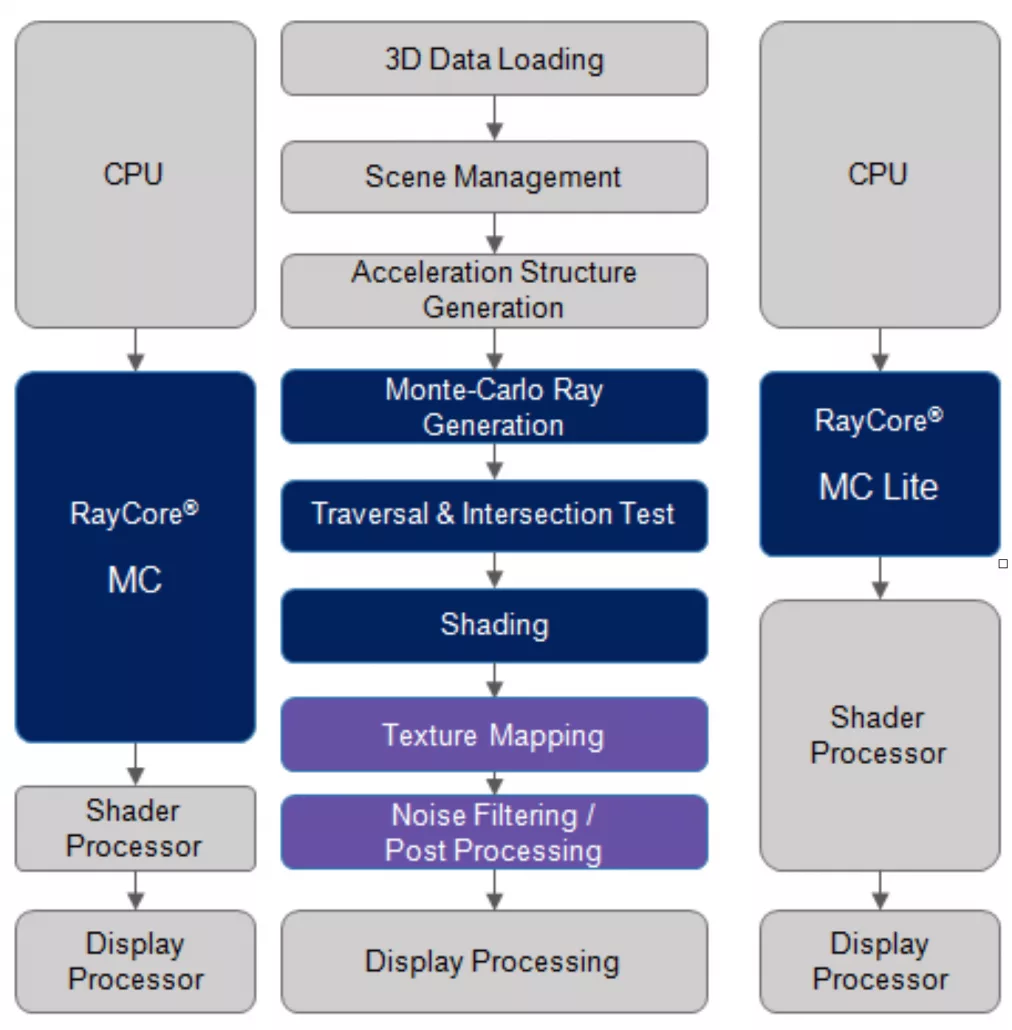
Overview
RayCore MC is the World’s best real-time path tracing GPU IP.
It’s path tracing and soft shadow techniques present the highest quality of photo-realistic images in 3D graphics.
RayCore MC allows you with ease to gain awesome graphic effects such as depth of field, glossy reflection, global illumination, motion blur, and soft shadow.
It is a fully hardwired logic that enables fast rendering process and low power consumption.
RayCore MC is ideal for mobile and embedded applications.
For reference, path tracing is a revolutionary next-generation rendering technique that makes it easy to create photo-realistic 3D graphic images by expressing the effects of light in more natural and detailed way.
Learn more about GPU IP core
Siliconarts signed a Ray-Tracing GPU IP 'Raycore' license agreement with Verisilicon, the world's No. 7 semiconductor IP company and No. 1 in China.
Silicon Arts releases GPU ray tracing RayCore RC1000 core into the Intel Solutions Marketplace. Open source release of ray tracing examples, apis, and drivers on Github with FPGA macro
SiliconArts today announced a development agreement for its RC-MC, its next generation RayCore graphics architecture with Pixilica, a RISC-V developer.
SiliconArts has become a full member of the Khronos® Group standards consortium to support the development and ratification of ray tracing extensions to the Vulkan® cross-platform 3D API.
SILICONGATE LDA, the leading supplier of Power Management IP for ASIC/SoC, brought to the 54rd DAC its latest platform for IoT. The new platform keeps the previous simple integration and modularity adding extended performance and new building blocks.
Seemingly out of nowhere -- well, South Korea actually -- a four-year old startup recently burst on the scene with a ray-tracing chip, the RayCore.