The European Cyber Resilience Act introduces mandatory cybersecurity requirements for products with digital elements, fundamentally reshaping the design criteria for semiconductors and embedded systems. It obliges manufacturers to ensure security by design, vulnerability handling, lifecycle support, and demonstra ble compliance from development through operation. For tomorrow’s SoC and custom ASIC designs, this means that cybersecurity can no longer be treated as an add-on at software level – it must be anchored in hardware. Robust root-of-trust architectures, secure key storage, cryptographic acceleration, secure boot, lifecycle manage ment, and tamper resistance become essential building blocks.
A dedicated secure element – available as silicon chiplet, IP, or fully integrated within custom SoC and ASIC solutions, provides the hardware-based trust anchor required to meet regulatory expectations while protecting intellectual property, sensitive data, and system integrity across the entire product lifecycle.
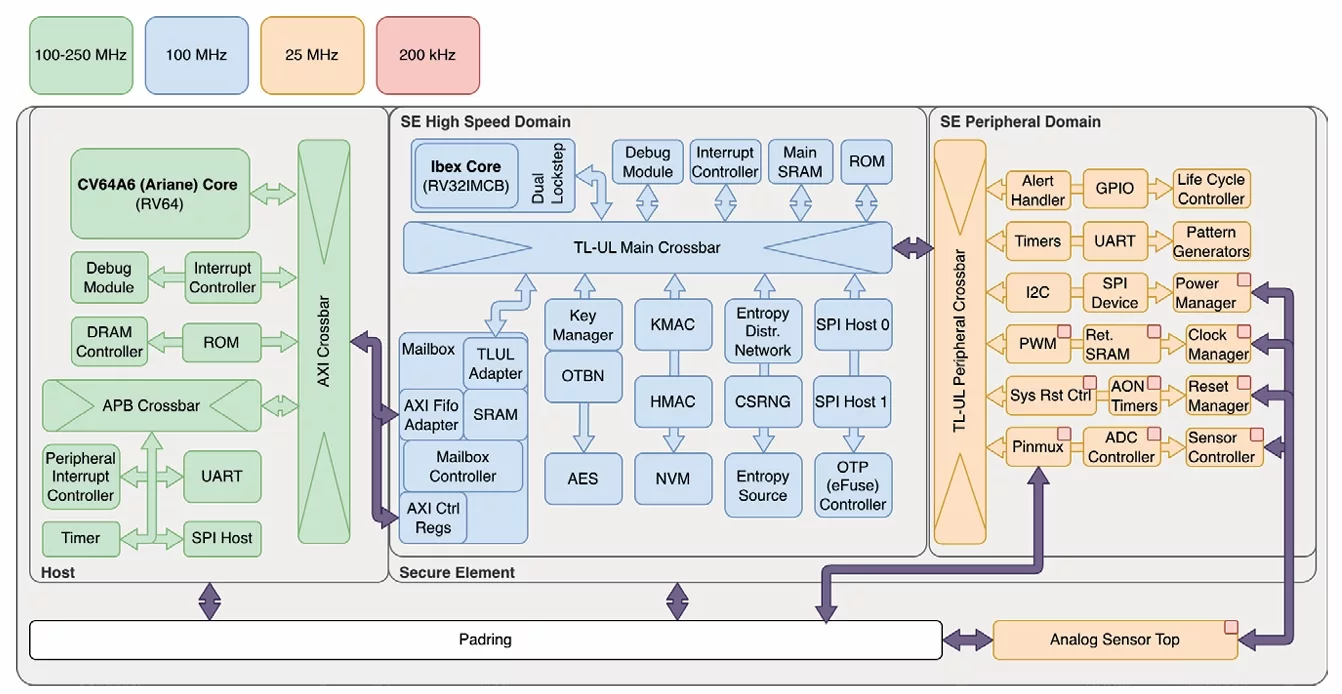
Fraunhofer’s OpenTitan-based RISC-V Secure Element delivers precisely this: robust security features to safeguard your hardware devices against attacks. It supports both classical and post-quantum cryptography, ensuring resilience against current and future threats. With secure key storage, secure boot, secure update, and device authentication, your devices remain up to date and protected from unauthorized access. The Secure Element also includes active monitoring for real time threat detection and life-cycle management.
Fully sourced within the European Union for the highest pos sible level of technological sovereignty, the Secure Element is available as verified hard IP or as a packaged and tested stand alone chip in GlobalFoundries 22FDX® technology. It can also be deployed in an FPGA environment for rapid prototyping or software development purposes.
Based on this development, Fraunhofer offers turnkey custom chip design services for tailored solutions according to applica tion-specific requirements.
Cryptographic Algorithms
- AES-128/192/256 with ECB/CBC/CFB/OFB/CTR
- HMAC / SHA2-256
- KMAC / SHA3-224, 256, 384, 512, [c]SHAKE-128, 256
- SLH-DSA (SPHINCS+) post-quantum signature accelerator
- Programmable big number accelerator for RSA, ECC as well
- as ML-DSA (Dilithium) and ML-KEM (Kyber)
- Cryptographically secure random number generator (CSRNG)compliant to NIST SP-800, BSI AIS31
Communication
- Host SPI
- Device SPI
- I²C
- UART
- GPIO
- Secure Debug JTAG Interface
- Mailbox interface for AXI bus connecting to larger SoC
- systems
Memories
- 2 MB MRAM
- 4 kB eFuse OTP
- 64 kB Boot ROM
- 256 kB SRAM
Ecosystem
- Deployable as standalone microcontroller or SoC component
- Manufactured in GlobalFoundries 22FDX® technology andpackaged in the EU
- Small volume production possible
- Application and customer specific instruction set extensions and co-processors possible
- Cryptographic agility with hardware support for more algorithms, e.g. Falcon (FN-DSA) or FrodoKEM
Services
- Integration support and customer specific modifications
- FPGA Implementation available for testing and prototyping
- Chip development support
- Foundry services and chip packaging
- Application development support
- Documentation and certification support