An AUTOSAR-Aligned Architectural Study of Vulnerabilities in Automotive SoC Software
By Srijita Basu 1, Haraldsson Bengt 2, Miroslaw Staron 1, Christian Berger 1, Jennifer Horkoff 1, Magnus Almgren 1
1 Chalmers University of Technology and University of Gothenburg, Sweden
2 Scania CV AB, Sweden
Abstract
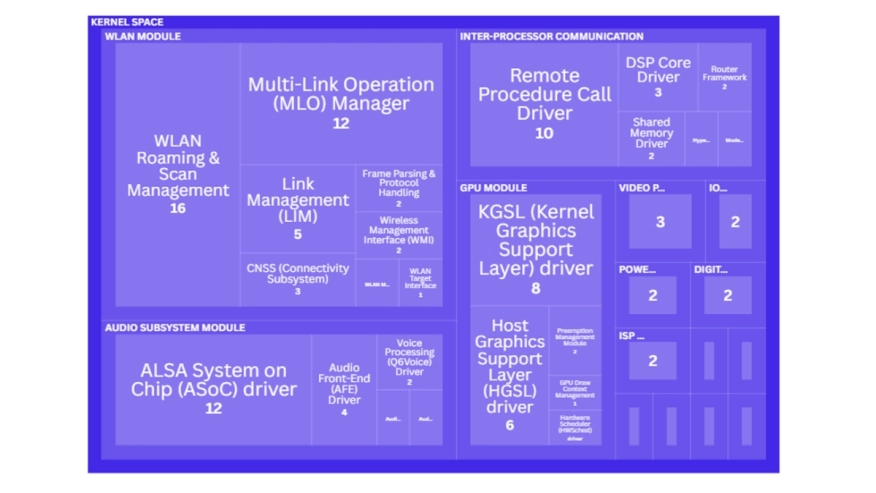
Cooperative, Connected and Automated Mobility (CCAM) are complex cyber-physical systems (CPS) that integrate computation, communication, and control in safety-critical environments. At their core, System-on-Chip (SoC) platforms consolidate processing units, communication interfaces, AI accelerators, and security modules into a single chip. AUTOSAR (AUTomotive Open System ARchitecture) standard was developed in the automotive domain to better manage this complexity, defining layered software structures and interfaces to facilitate reuse of HW/SW components. However, in practice, this integrated SoC software architecture still poses security challenges, particularly in real-time, safety-critical environments. Recent reports highlight a surge in SoC-related vulnerabilities, yet systematic analysis of their root causes and impact within AUTOSAR-aligned architectures is lacking. This study fills that gap by analyzing 180 publicly reported automotive SoC vulnerabilities, mapped to a representative SoC software architecture model that is aligned with AUTOSAR principles for layered abstraction and service orientation. We identify 16 root causes and 56 affected software modules, and examine mitigation delays across Common Weakness Enumeration (CWE) categories and architectural layers. We uncover dominant vulnerability patterns and critical modules with prolonged patch delays, and provide actionable insights for securing automotive CPS platforms, including guides for improved detection, prioritization, and localization strategies for SoC software architectures in SoC-based vehicle platforms.
Keywords: Architecture · Automotive · SoC · Vulnerability
To read the full article, click here
Related Semiconductor IP
- NPU IP
- JPEG XL Encoder
- I2C Master/Slave Controller Core
- NVMe Validation Test Suite
- Hybrid Memory Cube Verification IP
Related Articles
- RISCover: Automatic Discovery of User-exploitable Architectural Security Vulnerabilities in Closed-Source RISC-V CPUs
- The Growing Imperative Of Hardware Security Assurance In IP And SoC Design
- Bigger Chips, More IPs, and Mounting Challenges in Addressing the Growing Complexity of SoC Design
- Hardware vs. Software Implementation of Warp-Level Features in Vortex RISC-V GPU
Latest Articles
- Terracotta: Enabling the Adoption of New DRAM Techniques via a Flexible DRAM Interface and Memory Controller
- A Framework for Accelerating Transformer Inference on RISC-V for Edge AI
- An Interleaved Parallel Dependent Quantization Hardware Architecture for H.266/VVC
- A Formal Security Analysis of CAN XL
- A Secure dToF LiDAR SoC with Dual-Domain Fingerprinting and Event-Driven AFE Circuit Achieving Sensor-Level Attack Resilience