ElfCore: A 28nm Neural Processor Enabling Dynamic Structured Sparse Training and Online Self-Supervised Learning with Activity-Dependent Weight Update
By Zhe Su and Giacomo Indiveri
Institute of Neuroinformatics University of Zurich and ETH Zurich
Abstract
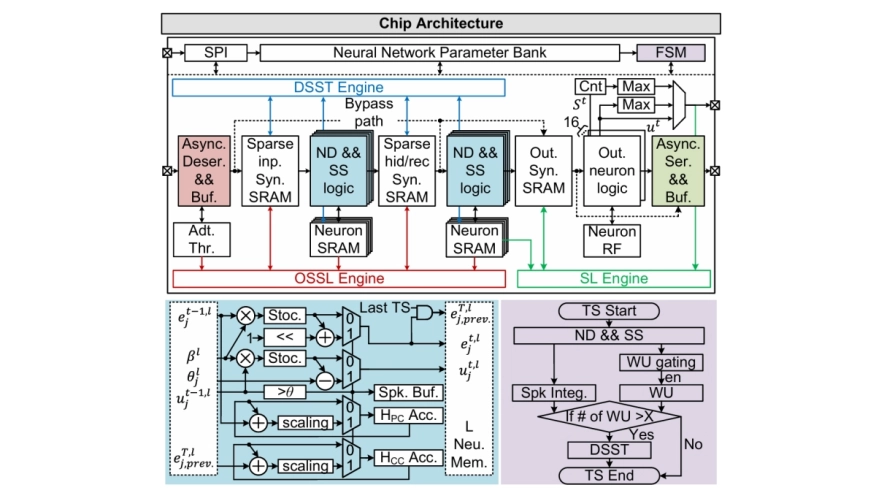
In this paper, we present ElfCore, a 28nm digital spiking neural network processor tailored for event-driven sensory signal processing. ElfCore is the first to efficiently integrate: (1) a local online self-supervised learning engine that enables multi layer temporal learning without labeled inputs; (2) a dynamic structured sparse training engine that supports high-accuracy sparse-to-sparse learning; and (3) an activity-dependent sparse weight update mechanism that selectively updates weights based solely on input activity and network dynamics. Demonstrated on tasks including gesture recognition, speech, and biomedical signal processing, ElfCore outperforms state-of-the-art solutions with up to 16× lower power consumption, 3.8× reduced on-chip memory requirements, and 5.9× greater network capacity efficiency.
Index Terms—self-supervised learning; dynamic structured sparse training; sparse weight update
To read the full article, click here
Related Semiconductor IP
- Neural network processor designed for edge devices
- IP Platform for Multiprotocol IoT Gateway
- IP Platform for Bluetooth 5.2
- IP Platform for BLE 5.2 and 802.15.4 IoT Sensors
- IP Platform for AI-Enabled IEEE 802.15.4 Smart Sensors
Related Articles
- A MAC-less Neural Inference Processor Supporting Compressed, Variable Precision Weights
- MultiVic: A Time-Predictable RISC-V Multi-Core Processor Optimized for Neural Network Inference
- How to optimize programmability and speed in network processor design
- SoC silicon is first-time success following simulation and validation of novel array processor
Latest Articles
- Terracotta: Enabling the Adoption of New DRAM Techniques via a Flexible DRAM Interface and Memory Controller
- A Framework for Accelerating Transformer Inference on RISC-V for Edge AI
- An Interleaved Parallel Dependent Quantization Hardware Architecture for H.266/VVC
- A Formal Security Analysis of CAN XL
- A Secure dToF LiDAR SoC with Dual-Domain Fingerprinting and Event-Driven AFE Circuit Achieving Sensor-Level Attack Resilience