Arm delivers record first-quarter for total revenue
Arm Q1 FYE27 quarterly earnings mark record royalty and licensing revenue for a first quarter.
July 29, 2026 -- Today, Arm (NASDAQ: ARM) published a letter to its shareholders containing the company’s results for its first quarter of fiscal year 2027, which ended June 30, 2026. The infographic below provides the key highlights for the quarter:
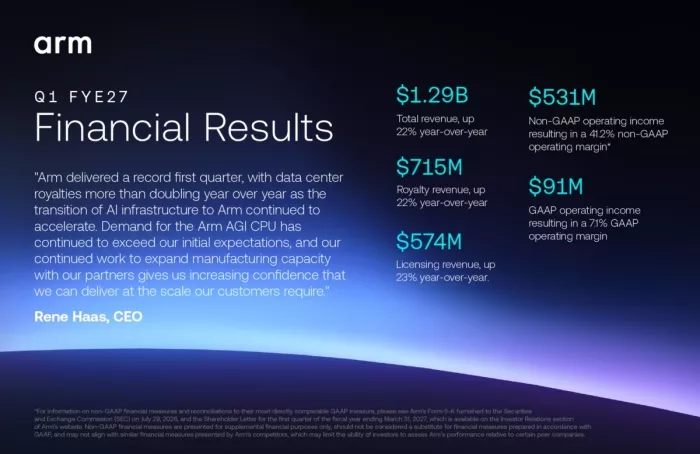
Here are what the results mean and how they were achieved:
- Total revenue for Arm in Q1 FYE27 increased 22% year over year to $1.29 billion, representing another record quarter for revenue. This was driven by record first-quarter licensing and royalty revenue, with data center royalties more than doubling year over year and the continued adoption of Arm technology with higher royalty rates per chip, such as Armv9 architecture and Arm Compute Subsystems (CSS).
- Since its launch in March 2026, Arm has made strong progress with the Arm AGI CPU:
- Customer demand has accelerated beyond initial expectations and now exceeds $2 billion across FYE27 and FYE28.
- Initial product has been delivered to multiple customers.
- Arm continues to add new customers, including multiple in US and China, while the overall value of the pipeline continues to strengthen.
- Arm has secured the manufacturing capacity required to support the $1 billion opportunity outlined in the previous quarter across FYE2027 and FYE2028.
- Ecosystem adoption of Arm Neoverse – which is the foundation for the Arm AGI CPU and other leading hyperscale cloud and data center platforms – continues to expand, with shipments now surpassing 1.5 billion cores. The most recent 500 million shipments took place in the past nine months, reflecting Arm’s growing market share and increasing value capture.
- Momentum for the Arm compute platform extends across the broader AI data center ecosystem. Analyst firm IDC recently reported that spending on Arm-based accelerated server platforms has nearly doubled in the past two quarters and surpassed x86 platforms, underscoring the industry’s transition toward Arm for AI infrastructure. Recent milestones reinforce that the world’s leading AI infrastructure providers are building the next generation of AI infrastructure on Arm:
- NVIDIA announced that Vera has entered full production. Built on Arm, Vera delivers up to 50% higher CPU performance and 2x greater energy efficiency than comparable x86 systems and will serve as the CPU foundation for NVIDIA’s next-generation AI infrastructure, with deployments planned across leading AI cloud providers and server platforms.
- Google stated that its Arm-based Axion CPU will be a core component of its AI infrastructure strategy, highlighting its role as the host CPU for Google’s TPU AI systems.
- AWS announced a multi-year agreement with Meta to deploy tens of millions of Arm-based Graviton5 cores to power agentic AI workloads.
- Microsoft expanded Azure Cobalt 200 virtual machines built on Arm Neoverse CSS.
- Qualcomm announced plans to enter the AI data center CPU market with its Arm-based Dragonfly C1000.
- Arm’s platform advantage grows as agentic AI expands beyond the data center into edge devices, including on-the-go AI PCs and high-performance agentic platforms, and the physical world, including vehicles, robots, industrial systems and autonomous machines. This plays directly to Arm’s strengths in delivering efficient, high-performance compute across billions of devices. Recent milestones reinforce Arm’s expanding opportunity, as AI drives the transition to the next generation of personal computing and intelligent machines.
- NVIDIA introduced RTX Spark, the first agentic PC platform built on Arm CSS, which enables sophisticated agents and larger AI models to run locally, bringing agentic AI directly to developers and creators.
- Systems based on RTX Spark are expected to be available later this year from leading OEMs including Acer, ASUS, Dell, HP and Lenovo, demonstrating broad support for this new category of Arm-based computing.
- The same OEMs are continuing to expand the Windows on Arm ecosystem with new Qualcomm Snapdragon-powered AI PCs.
- NVIDIA recently expanded its physical AI platform with Cosmos 3 and the Isaac GR00T humanoid robotics platform, powered by Jetson Thor, which combines an Arm-based CPU built with NVIDIA Blackwell GPU.
- Arm’s software ecosystem – which supports more than 22 million developers – continues to expand, with recent investments making it easier for developers to build, deploy and optimize software on Arm across cloud, edge and physical AI.
- Arm introduced Arm Performix – with support from Microsoft, MongoDB, Redis and SAP – which helps developers and AI agents analyze and optimize workloads running on Arm-based infrastructure.
- The Arm MCP Server – which integrates Arm expertise into leading AI developer environments – surpassed 10,000 Docker downloads.
- As AI becomes part of every cloud, every device and every industry, the ecosystem is increasingly converging on a common compute platform that Arm believes will define the next decade of computing. Whether customers adopt Arm through IP, CSS or silicon, they are building on the same platform, software ecosystem, and developer community.
The full letter to shareholders is available on the Arm investor relations website (https://investors.arm.com/financials/quarterly-annual-results). Information about the Arm earnings conference call can be found here.
Related Semiconductor IP
- NPU IP
- JPEG XL Encoder
- I2C Master/Slave Controller Core
- NVMe Validation Test Suite
- Hybrid Memory Cube Verification IP
Related News
- Arm delivers fourth consecutive billion-dollar revenue quarter, extending record-breaking momentum
- BOS Semiconductors Joins Arm Total Design for Physical AI
- TIER IV joins Arm Total Design for Physical AI to accelerate ready-to-use Autoware solutions through Open AD Kit
- Electronic System Design Industry Logs Record First-Quarter Revenue Growth, ESD Alliance Reports
Latest News
- GF unveils roadmap to deliver the world’s most advanced FD-SOI platform for Physical AI
- GlobalFoundries marks Dresden expansion milestone, announces next-generation platform for Physical AI
- TSMC September 2026 Revenue Report
- Lattice Collaborates with Arm to Advance Secure, Adaptable AI Data Center Infrastructure
- ZLG Selects CAST CAN XL and TSN IP for Next-Generation Vehicle-Network Development and Test Tools