Arm brings the ecosystem together to build and define the next phase of physical AI
By Drew Henry, Executive Vice President, Physical AI, Arm
- Arm Total Design expands to physical AI, bringing together expertise across the technology stack to reduce integration complexity and accelerate autonomous system development
- A Robotics Capability Framework is one of the ecosystem’s first initiatives, providing a starting point for a common language to define and advance robotic systems
- More than 80 companies across the physical AI ecosystem are joining Arm Total Design for Physical AI
September 8, 2026 -- As agentic AI expands what intelligent systems can do, physical AI is bringing that intelligence into the industries that mine materials our world depends on, grow the food that sustains it, manufacture products and move people and goods around the globe. These industries represent trillions of dollars in global economic activity and a $200B annual compute opportunity in the 2030s¹, yet they remain among the hardest industries to transform.
 Unlocking that opportunity means enabling intelligent machines to sense, reason and act by bringing together AI models, software, compute, sensors and actuators into complete systems that can be trusted and deployed at scale. No single company can solve this alone. We need greater collaboration across an increasingly complex ecosystem, with common foundations that reduce fragmentation while giving innovators flexibility to differentiate.
Today, we’re taking steps to advance both. We announced Arm Total Design for Physical AI, bringing together more than 80 companies spanning the physical AI technology stack, including AWS, ECARX, Hugging Face, Liquid AI, NXP, PlusAI, PSYONIC, QNX, Qwen, Siemens, Unitree Robotics, and others, to accelerate physical AI development. And as one of the ecosystem’s first collaborative initiatives, we’re introducing a Robotics Capability Framework as a starting point for a common language to define and advance robotic capabilities.
Extending Arm Total Design to accelerate innovation across the physical AI stack
Autonomous vehicles and robotics are tackling many of the same challenges across perception, AI, real-time control, safety and efficient computing. OEMs and partners need to reduce integration risk, optimize workloads and move from proof of concept to deployment faster. As we’ve seen with Arm Total Design for Cloud AI, bringing partners across the technology stack together through a highly collaborative model can help solve these challenges.
Arm Total Design for Physical AI brings together expertise including software stacks, AI models, sensors, compute hardware, virtual platforms and digital twins to enable earlier development and validation of solutions. We’re already seeing the impact of this collaborative approach in automotive, where Arm, AWS, Google, HERE, RemotiveLabs and Siemens collaborated on an integrated digital cockpit reference solution, enabling developers to develop, test, and validate complex automotive software on Arm Zena CSS before silicon is available.
Inviting the robotics ecosystem to shape a common language
As outlined in a new manifesto from our chief architect Richard Grisenthwaite, robotics is advancing rapidly, but the industry still lacks a common way to describe, compare and communicate the capabilities of increasingly intelligent machines. This fragmentation makes robotic systems harder to design, integrate, and scale. As SAE Levels created a shared vocabulary for driving automation, robotics needs a common language of its own – and Arm is uniquely placed to convene the industry to tackle this challenge.
A Robotics Capability Framework will define levels of increasing sophistication for robotic systems that connect real-world use cases with the behavior, outputs and system requirements of a robot including latency, compute placement, memory and power constraints, determinism and safety. Its initial structure was informed by perspectives and feedback from across the robotics ecosystem, and we’ll continue to shape the framework alongside companies like Anaxi Labs, ANYbotics, FMC³ Robotics, Fourier, GALBOT, Gravis Robotics, Lenovo, McKinsey, Robotec.ai and others. We invite the broader industry to contribute its expertise and help shape how the framework develops from here.
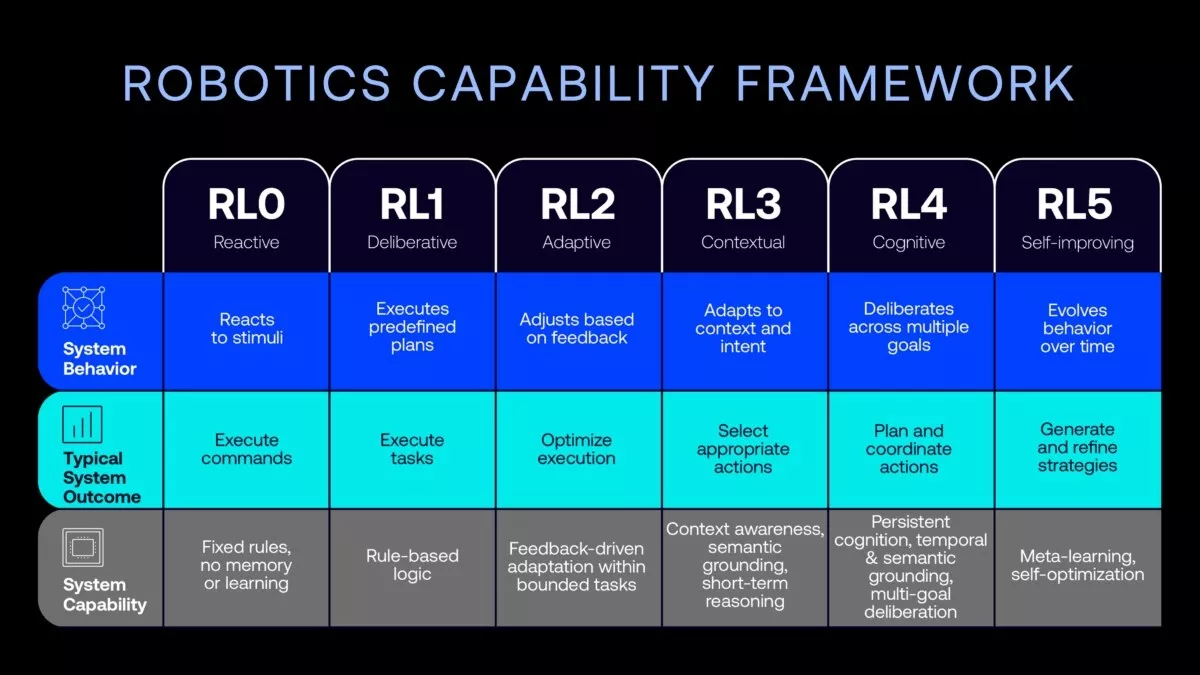
A Robotics Capability Framework maps stages of autonomy, from reactive systems to context-aware, cognitive and self-improving robots.
Scaling physical AI requires an ecosystem approach
As AI becomes increasingly agentic, the next frontier is bringing that intelligence into the physical world. This will be one of the largest compute opportunities of our time and realizing it will take more than breakthrough technology. It requires a common foundation that allows the ecosystem to innovate, differentiate and scale.
Arm is bringing that ecosystem together to help shape what comes next and accelerate the path from technology breakthroughs to deployment at scale, unlocking the next major wave of AI-driven economic growth.
Learn more about Arm Total Design for Physical AI and how to get involved with a Robotics Capability Framework.
¹Based on Arm estimates
Related Semiconductor IP
- UMC 55nm ULP 3.3V Temperature Sensor
- High-Throughput Multi-Channel DMA Controller
- Configurable Multi-Channel DMA Controller
- Fixed-Channel Multi-Channel DMA Controller
- Verification IP for MIPI SoundWire
Related News
- onsemi to Acquire Synaptics to Enable the Next Generation of Intelligent Systems for Physical AI
- Fractile raises $220M to build the next generation of inference hardware
- NVIDIA Joins the Windows on Arm Ecosystem, Driving Arm-Based AI Notebook Penetration to 34.2% by 2029, Says TrendForce
- Menta Contributes to the Successful Completion of the European Processor Initiative and Confirms its Role in Shaping Future Computing Architectures
Latest News
- Alliance for Open Media Sees Rapid AV2 Adoption Across the Video Ecosystem Just Four Months After Release
- Rambus and ChipAgents Collaborate to Accelerate Chip Design with Agentic AI
- Server CPU Shipments Projected to Grow Over 40% YoY in 2027, with Arm-Based Products Continuing to Gain Market Share
- UMC and AP Memory Collaborate to Enable Advanced Power Delivery Solutions for AI and HPC Systems
- Cadence AI Super Agents Enable Nokia to Accelerate Electronic System Design on Millennium M2000 Supercomputer