NVMe 2.0 Explained: What’s New and Why It Matters

Non-Volatile Memory Express (NVMe) has become the dominant protocol for high-performance storage across client SSDs, enterprise drives, and hyperscale data centers. With NVMe 2.0, the specification expands beyond traditional block-based SSD access with new command sets, broader media support, improved transport organization, and enhancements for modern deployments. This post explores what is new in NVMe 2.0, why these additions matter, and how they impact storage architects, implementers, and verification teams.
Why Was NVMe 2.0 Needed?
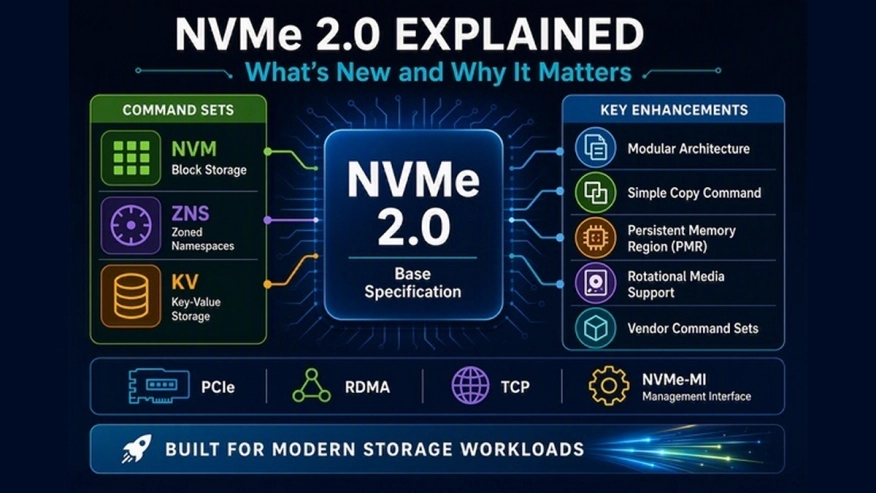 NVMe 1.4, while powerful, centered on a largely monolithic base specification - a single large document covering the PCIe transport, queuing model, admin and I/O commands, and command-set behavior together. As the ecosystem expanded beyond SSDs into new domains (computational storage, key-value stores, zoned namespaces), the single-spec model became unsustainable:
- Specification bloat: Adding every new feature to one document made it unwieldy for implementers who only needed a subset.
- New transport needs: NVMe was no longer PCIe-only. Fabric transports such as RDMA and TCP had grown important enough to require separate, dedicated NVMe transport specifications.
- Diverse command sets: As NVMe evolved, emerging command sets such as Zoned Namespaces (ZNS) and Key-Value (KV) storage required independent specifications and lifecycle management rather than being maintained as extensions within a single evolving specification family.
- Industry velocity: Cloud, edge, automotive, and AI/ML workloads demanded faster iteration on specific features without revising the entire specification.
Some Key Enhancements in NVMe 2.0
1. Modular Specification Architecture
NVMe 2.0 breaks the monolithic spec into a family of focused documents:
| Document | Purpose |
| NVMe Base Specification | Core architecture, admin commands, queuing model |
| NVMe Command Set Specifications | NVM (block), ZNS, KV command sets - each independent |
| NVMe Transport Specifications | PCIe, RDMA, TCP - each independent |
| NVMe Management Interface (NVMe-MI) | Out-of-band device management |
Why it matters: An implementer building a ZNS SSD over TCP can focus primarily on the Base specification, ZNS command set, and TCP transport specification instead of navigating one large monolithic document. Under NVMe 1.4, a single errata or feature addition required revising the entire specification, coordinating across all stakeholders.
Under 2.0:
- A new transport can be standardized as an independent document instead of being folded into one monolithic specification.
- A new command set, such as computational storage or other emerging models, can evolve through its own specification.
- Spec revisions are scoped - a change to ZNS doesn't require re-review of the NVM command set or TCP transport.
2. Zoned Namespaces (ZNS) - Independent Command Set
ZNS evolved through the NVMe technical proposal process and became an independent command set specification in the NVMe 2.0 family.
- Exposes the internal zone structure of flash to the host.
- Reduces write amplification and over-provisioning.
- Gives the host direct control over data placement.
- Result: Higher endurance, reduced write amplification, more predictable latency, and potentially lower cost per GB for suitable workloads.
3. I/O Command Set Independence and Namespace Types
- NVMe 2.0 formalizes the concept of I/O command sets as independent, pluggable modules.
- Each namespace is now associated with a specific command set identifier (NVM, ZNS, KV).
-
Controllers can advertise support for multiple command sets simultaneously.
- Enables future command sets to be added without revising the base specification.
4. Simple Copy Command
- Enables offloaded data copy within a namespace without host-side data movement.
- Reduces host CPU and memory usage during copy-heavy tasks such as garbage collection, deduplication, and snapshots.
- The device performs the copy operation without requiring the host to read and rewrite the payload data across PCIe.
5. Rotational Media Support
- NVMe 2.0 broadens the architecture so that rotational media such as HDDs can be represented within the NVMe ecosystem.
- Helps enable a more common NVMe-based command interface across flash and rotational media.
- Helps simplify software stacks by using a more consistent NVMe-based interface across different media types.
6. Vendor-Specific I/O Command Sets
- NVMe 2.0’s command set model provides a cleaner path for vendor-specific or future command-set extensions.
- Vendors can introduce proprietary capabilities while maintaining alignment with the broader NVMe architecture.
- Keeps the ecosystem open while allowing differentiation.
7. Persistent Memory Region (PMR) Enhancements
- NVMe 2.0 carries forward and refines Persistent Memory Region support.
- Defines clearer behavior for host access to controller-side persistent memory.
- PMR can be used by software designed to exploit controller-resident persistent memory for applications such as metadata acceleration, journaling, or write-ahead logging.
Who Benefits from NVMe 2.0?
- Cloud and hyperscalers: ZNS reduces TCO through lower write amplification and over-provisioning.
- Database and KV Stores: Native KV command support reduces unnecessary block-layer translation.
- Storage vendors: Modular spec allows focused implementation and faster time-to-market.
- Enterprise IT: Modular specifications and command-set flexibility simplify the adoption of new NVMe capabilities while maintaining long-term scalability.
- Automotive and edge: Leaner implementations by adopting only the needed command set and transport.
Verification Challenges
NVMe 2.0 adds verification complexity because the protocol is no longer tied to one monolithic specification or one block-oriented command model. A controller may support different combinations of base functionality, command sets, namespace types, transports, multipath behavior, and optional features, so verification must cover both individual features and their interactions.
- Command set selection: Ensuring the controller correctly advertises and enables supported I/O command sets such as NVM, ZNS, and vendor-specific command sets.
- Namespace association: Verifying that each namespace is mapped to the correct command set identifier and that unsupported commands are rejected with the appropriate status.
- ZNS behavior: Checking zone state transitions, sequential write rules, zone append handling, reset behavior, and error cases for invalid zone operations.
- Feature interaction: Covering combinations such as Simple Copy, PMR behavior, and rotational media support across different controller configurations.
Cadence’s NVMe Verification IP addresses these challenges with configurable host and subsystem models, protocol checkers, constrained-random traffic, error injection, coverage, and debug support. The VIP helps teams validate NVMe 2.0 features such as command set independence, namespace management, ZNS behavior, PRP/SGL handling, and transport-specific scenarios across IP, SoC, and system-level environments. In addition, the NVMe VIP testsuite provides reusable building blocks that make it easier for users to create targeted verification scenarios, configure traffic patterns, exercise feature-specific behavior, and inject error conditions as needed for their environment. As NVMe evolves toward modular, workload-specific storage architectures, comprehensive verification support is essential for compliance, interoperability, and faster time-to-market.
More information on Cadence NVMe Verification IP is available at Simulation VIP for NVMe | Cadence.
Reach out to Cadence Verification IP experts at talk_to_vip_expert@cadence.com with any questions.
Explore Cadence IP:
Related Semiconductor IP
- Simulation VIP for NVMe
- NVMe IP core -- Directly connect PCIe SSD without external memory
- NVMe Verification IP
- NVMe Host Controller
- NVMe 2.3 Verification IP
Related Blogs
- NVMe 2.0 Specifications: Support for Fabrics and Multi-Domain Subsystems
- NVMe® 2.0 Specifications: Enabling Efficient Boot Over NVMe Transports
- Controller Memory Buffer (CMB): NVMe 2.0’s On-Controller Memory Feature
- TSMC 40nm Yield Explained!
Latest Blogs
- Tape-Out Readiness Checklist: Engineering Decisions That Prevent Costly Respins
- How Cadence DSPs Put In-Cabin AI Audio On-Chip in SemiDrive's X10
- The Fastest Path to Scalable Photonic Systems: Using Proven IP for both PIC and EIC designs
- Building Trusted AI Agents from the Silicon Root of Trust
- Heterogeneous Computing in Space