How Cache Coherency Simplifies AI Software

There was a time when adding hardware simply to make software more efficient was considered wasteful. Every additional hardware feature consumed valuable area, increased power, and added to the design and verification effort. With transistor budgets tightly constrained, hardware was reserved for capabilities that delivered clear performance or functional benefits, while software teams were expected to absorb much of the system’s complexity.
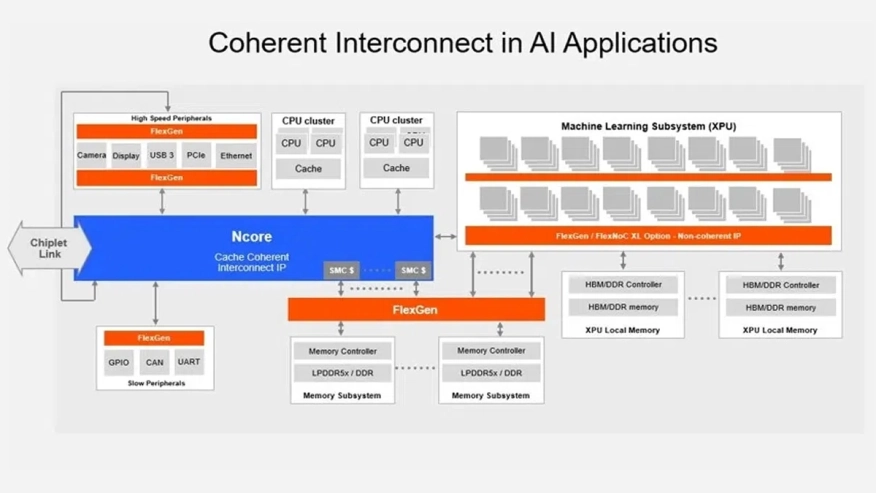 This tradeoff is changing. As software has become a larger portion of product development, designing systems-on-chip (SoCs) to reduce software complexity has become a deliberate architectural choice.
In an AI system, an accelerator may write data to memory and a CPU may then read it, or control information may be shared between them. As CPUs and accelerators exchange more shared data, software tracks whether each processing element is working from the current version or from data that has changed.
Managing shared-data coordination in software adds complexity and can create difficult-to-debug errors, which is why cache coherency is becoming widely adopted in chip hardware. Engineers are turning to cache coherency, a chip-level technology that keeps shared information current, whether it is in memory or cache, so the CPU sees the correct version. By moving more of that management into the coherent interconnect and memory system, the architecture helps make software simpler, more reliable, and faster to develop.
To read the full article on Semiconductor Engineering, click here.
Explore Arteris IP:
- FlexNoC Interconnect IP
- CodaCache Last-Level Cache IP
- FlexGen Smart Network-on-Chip (NoC) IP
- FlexWay Interconnect IP
Related Semiconductor IP
- FlexNoC Interconnect IP
- CodaCache Last-Level Cache IP
- FlexGen Smart Network-on-Chip (NoC) IP
- FlexWay Interconnect IP
- FlexGen Multi-Die Smart Network-on-Chip (NoC) IP
Related Blogs
- Cache Coherency Is the New Normal
- Trillions of Cycles per Day: How SiFive Boosts IP and Software Validation with Synopsys HAPS Prototyping System
- How Time Sensitive Networking powers the Software Defined Vehicle
- How 224G SerDes Unifies Today’s AI Fabrics
Latest Blogs
- Protecting Edge AI with RISC-V CHERI: See how easily memory-safe security can be added to an AI application (part 1)
- Mastering Semiconductor Chip Design: Tools, Techniques, and Best Practices
- Strategies for FPGA to ASIC Migration for Product Teams
- Two AI Brains Are Better Than One
- Your FPGA prototype runs. Can you see inside it?