How AI and Edge Computing Are Accelerating RISC-V Adoption

The development of processors is changing quickly. Historically, improvements have been achieved primarily through an increase in computing power. Instead of pure performance, the emphasis is now on optimizing data movement, memory access, and power usage, while maintaining efficiency, in the context of AI workloads.
One of the critical problems in today’s computing is that transporting data can be more costly in energy and time than computing. With the growing complexity of AI models, SoC designers have shifted their focus toward optimizing memory hierarchies, increasing bandwidth in interconnects, and architecting based on workloads for improved efficiency.
The change is also contributing to RISC-V. It supports a wide range of applications, such as AI, real-time, and embedded, and its open ISA, flexibility, and low licensing requirements, along with the ability to support sovereign semiconductor ecosystems, making it an ideal fit for today’s embedded, real-time, and AI applications.
With the growing demand for edge AI, heterogeneous computing, and application-specific architectures, RISC-V is anticipated to become a more significant part of future SoC designs and semiconductor innovation.
The trend is also reflected in recent market projections. According to The SHD Group’s 2026 RISC-V Market report, RISC-V SoC shipments are expected to reach 35.9 billion units by 2031, growing at a projected Compound Annual Growth Rate (CAGR) of 31.7%. The report highlights increasing demand for workload-specific architectures and heterogeneous chips as major factors driving this growth.
How Modern Workloads Are Reshaping SoC Architecture
Modern AI workloads are quite different from traditional workloads and demand parallel processing, high memory bandwidth, and communication among multiple engines. Consequently, memory bandwidth, interconnecting efficiency, and data movement can often become a limiting factor in system performance, beyond just compute. Modern SoCs split workloads into the CPUs, GPUs, NPUs, DSPs, and specialized accelerators, while the embedded software and firmware take care of workload data flow and task coordination. Incorporating intelligent workload partitioning, optimized memory architectures, and efficient communication between the diverse processing elements becomes more important as the performance benefits become greater; hence, system-level optimization is becoming one of the main differentiators in AI-based designs.
Enabling Workload-Aware Processor Design
As opposed to proprietary architectures like ARM and x86, RISC-V offers an open, very customizable ISA that gives designers the ability to add workload-specific instructions and domain-specific improvements. For AI applications, with ever-changing tensor dimensions, data flows, and memory access patterns, this flexibility is particularly beneficial.
RISC-V also makes it easier to incorporate CPUs, DSPs, NPUs, and even dedicated accelerators into heterogeneous SoCs, allowing for more efficient system-level optimization and hardware bring-up. Moreover, the RISC-V Vector Extension (RVV) provides scalable vector processing of varying sizes, with software maintainability. This enables architects to make optimal trade-offs in the performance, power, and silicon area for specific workloads without significant changes to the software, which makes RISC-V ideal for next-generation AI and embedded computing systems.
Processor Requirements in Embedded and Edge AI Systems
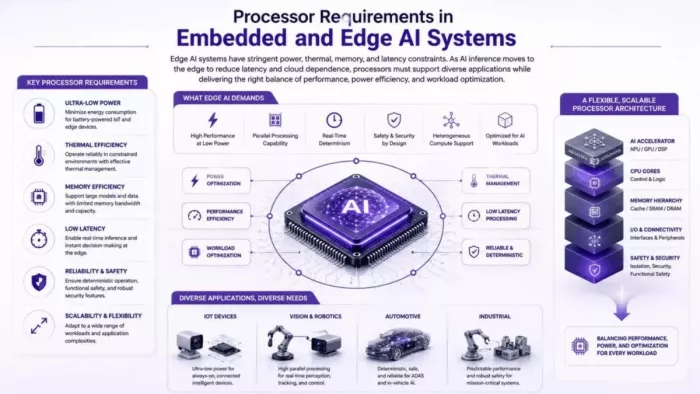
Edge AI systems are subjected to vastly different requirements compared to cloud and datacenter deployments, with very tight power, thermal, memory, and latency requirements. With AI inference shifting to the edge to decrease latency and dependence on the cloud, processor architectures need to accommodate a variety of applications.
The Internet of Things (IoT) devices need to consume ultra-low power, vision and robotics systems must support high parallel processing requirements, and automotive and industrial applications must be deterministic, predictable, and provide robust safety features. But these wide-ranging demands are pushing towards the adoption of a flexible, scalable processor architecture capable of effectively balancing performance, power usage, and optimization for workloads.
Engineering Considerations for RISC-V-Based SoC Platforms
Configurable architecture offers more flexibility and optimization of workloads but also results in more complexity with design and verification. The SoCs of today incorporate CPUs and vector engines, accelerators, high bandwidth memory, and custom interconnects, making them a system-level challenge to validate.
These activities of pre-silicon validation, FPGA prototyping, emulation, software bring-up, and board-level testing are essential steps to identify integration, performance, and software issues early in the silicon deployment lifecycle. As RISC-V designs get increasingly diverse, the software tools, compiler optimizations, and performance analyses of workloads are as important as the design itself in maximizing the benefits of the new designs.
The Future of RISC-V-Based SoCs
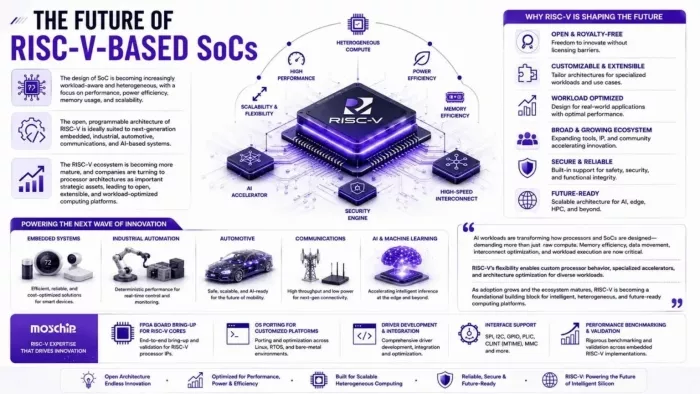
The design of SoC is becoming increasingly workload-aware and heterogeneous, with a focus on performance, power efficiency, memory usage, and scalability. If applications are becoming more specialized, then flexible processor architectures are essential to satisfy the requirements.
The open, programmable architecture of RISC-V is ideally suited to next-generation embedded, industrial, automotive, communications, and AI-based systems. The RISC-V ecosystem is becoming more mature, and companies are turning to processor architectures as important strategic assets, which is leading to a trend of open, extensible, and workload-optimized computing platforms.
To conclude, the design of processors and SoCs is being transformed by the introduction of AI workloads, which focus as much on memory efficiency, data movement, interconnect optimization, and workload execution as they do on raw compute power. Consequently, contemporary architecture needs to be more workload-aware and optimized for heterogeneous computing.
The flexibility of RISC-V to customize processor behavior, add specialized accelerators, and optimize architecture for specialized workloads is driving its momentum. As more companies integrate RISC-V and the ecosystem continues to mature, RISC-V is becoming an important building block for future embedded, AI, and heterogeneous computing platforms. Its openness, scalability, and adaptability make it a key component of the future of intelligent silicon design.
MosChip brings strong expertise across product engineering and hardware design services for RISC-V-based platforms. The expertise spans FPGA board bring-up for RISC-V cores, OS porting for customized RISC-V platforms, and enablement across Linux, RTOS, and bare-metal environments. MosChip also supports driver development, integration, and porting for interfaces including SPI, I2C, GPIO, PLIC, CLINT (MTIME), and MMC. In addition, we support performance benchmarking and validation for RISC-V implementations across embedded systems.
Related Semiconductor IP
- RISC-V Debug & Trace IP
- RISC-V IOPMP IP
- Gen#2 of 64-bit RISC-V core with out-of-order pipeline based complex
- 64-bit RISC-V core with in-order single issue pipeline. Tiny Linux-capable processor for IoT applications.
- Multi-core capable RISC-V processor with vector extensions
Related Blogs
- How Cadence and TSMC Are Accelerating AI Silicon Design at Advanced Nodes
- How Synopsys and NVIDIA Are Accelerating Semiconductor Scaling in the AI Age
- How Standards Are Unleashing the Power of DPUs for Cloud Computing
- How the SiFive HiFive Premier P550 is Accelerating Linux Ecosystem Adoption
Latest Blogs
- Tape-Out Readiness Checklist: Engineering Decisions That Prevent Costly Respins
- How Cadence DSPs Put In-Cabin AI Audio On-Chip in SemiDrive's X10
- The Fastest Path to Scalable Photonic Systems: Using Proven IP for both PIC and EIC designs
- Building Trusted AI Agents from the Silicon Root of Trust
- Heterogeneous Computing in Space