DDR5 MRDIMM Gen2: The Missing Link in Scaling AI Infrastructure

AI systems continue to grow exponentially in size and complexity. Today, most attention is focused on GPUs and high-bandwidth memory (HBM). Yet many AI deployments are becoming constrained by a less visible bottleneck in the memory subsystem attached to the host CPU. To address this, the industry is moving away from fixed, server-centric designs toward more flexible AI factory scale-up and scale-out topologies and disaggregated architectures. This is where GPUs and TPUs, together with HBM and LPDDR, dominate AI training and inference accelerators. CPUs remain the infrastructure managers of large-scale AI systems. They load datasets, preprocess inputs, manage model checkpoints, coordinate communications across accelerators, and stream data to GPUs.
Memory bandwidth across the entire data center infrastructure has become critical for achieving optimal performance. MRDIMM is the next-generation DRAM module that enables ever-expanding large-scale AI models. AI accelerators require continuous access to data to deliver peak performance, but CPU memory bandwidth often becomes the bottleneck during data preparation and scheduling. MRDIMM helps maintain efficient and steady data from storage to the AI accelerator by increasing memory throughput, which significantly improves AI efficiency.
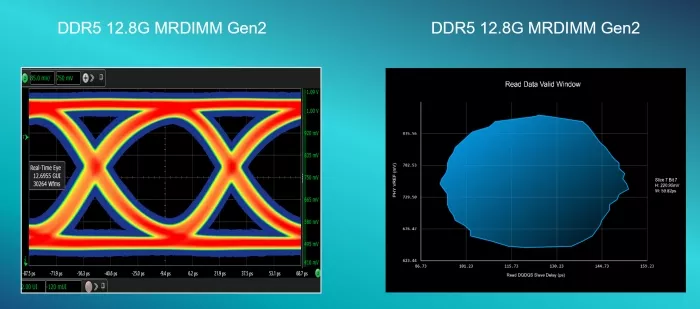
Today, DDR5 RDIMM is the most prolific memory used in enterprise computing and the data center. MRDIMM has emerged as the next-generation server memory designed to fit into a standard RDIMM socket. MRDIMM enables a significantly higher memory bandwidth and capacity per server slot without changes in the platform form factor. It achieves this by using a multiplexed architecture that effectively doubles the data rate of the underlying DRAM. DDR5 MRDIMM Gen1 supports speeds up to 9.2 GT/s, while MRDIMM Gen2 supports up to 12.8 GT/s, significantly boosting memory performance.
Cadence leads the market with its DDR5 MRDIMM 12.8 Gbps Gen2, TSMC N3P IP system solution, establishing a new benchmark for industry-leading PPA. Key industry leaders have already adopted this solution, which is now also available in the TSMC N2P and N5/N4P process nodes.
The Cadence memory system solution pairs a fully featured, enterprise-class controller with a highly optimized DDR5 MRDIMM Gen2 PHY, targeting complex, demanding multichannel applications.
The controller supports UDIMM, RDIMM, and MRDIMM configurations through a common enterprise architecture, and delivers advanced capabilities across four dimensions:
- Enterprise-class reliability, availability, and serviceability (RAS)
- Security
- Enterprise-class performance
- PPA-optimized configurations and floorplans
For more information on our industry-leading DDR5 RDIMM and MRDIMM, LPDDR6/5X, HBM4E, and GDDR7 solutions, contact Cadence.
Explore Cadence IP:
Related Semiconductor IP
- DDR5 MRDIMM PHY and Controller
- LPDDR PHY and Controller
- HBM4E PHY and controller
- GDDR7 PHY
- MRDIMM DDR5 & DDR5/4 PHY & Controller
Related Blogs
- Arm in the agentic era: Scaling the converged AI data center
- The Missing Layer in AI Systems Design is Predictable, Scalable Data Movement
- Pasteur’s Magic Quadrant in AI: The Fusion of Fundamental Research and Practical
- The role of AI processor architecture in power consumption efficiency