Overview
Single-core neural network accelerator offering from 0.5 to 4 TOPS Optimized for machine learning inference applications
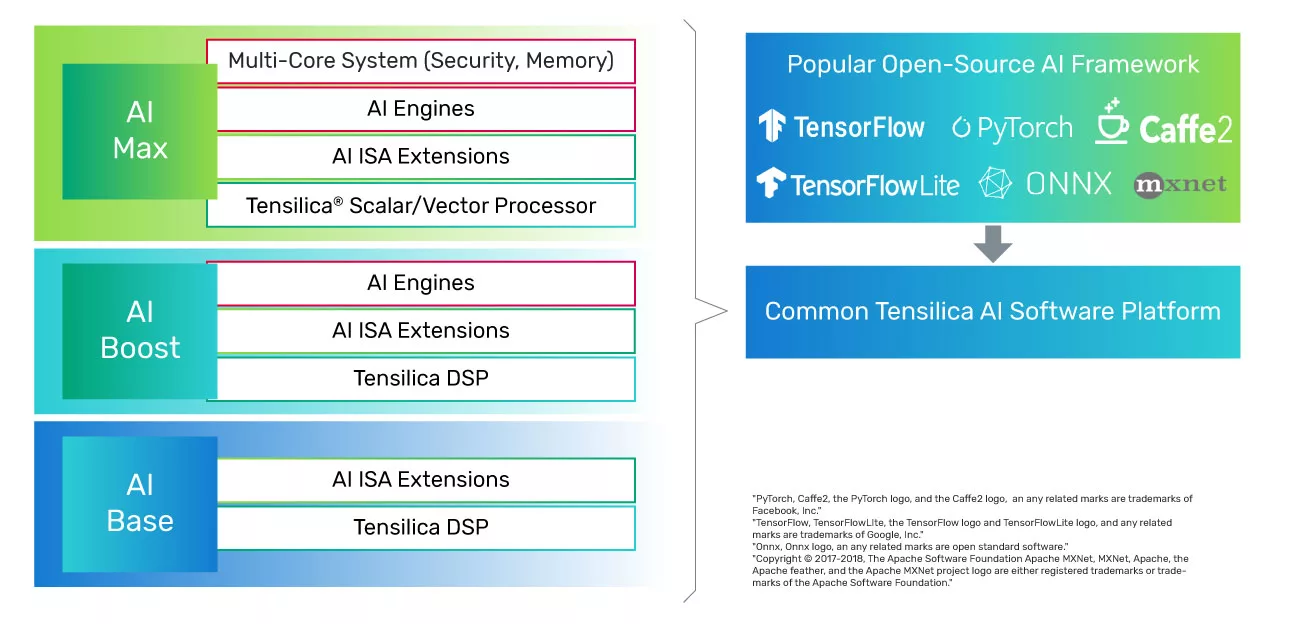
The Cadence® Tensilica® NNA 110 accelerator incorporates a custom hardware accelerator engine (NNE) coupled with a Tensilica Vision P6 or P1 DSP. The specialized compute block inside the NNA 110 hardware leverages features like random sparsity, tensor compression / decompression to provide an overall best in-class embedded AI accelerator solution.
A single-core NNA 110 accelerator supports 256 to 2K MAC 8x8-bit MAC computations and has various user-defined configurable options. The NNA 110 accelerator can run all neural network layers, including but not limited to convolution, fully connected, LSTM, LRN, and pooling operations. The accompanying Tensilica DSP in NNA 110 can run any operation that is not native to the accelerator, thereby making NNA 110 a highly flexible and robust future-proof offering. NNA 110 solution deliverables comprises of turnkey soft RTL IP, software compiler toolchain, and an accurate simulator for benchmarking.
Learn more about NPU IP core
SemiDrive, an automotive semiconductor company building SoCs and MCUs for the software-defined vehicle, has licensed and integrated Cadence Tensilica HiFi 5s DSPs into its X10 next-generation AI cockpit SoC, where they form the audio and voice subsystem. X10 has secured production collaborations with several leading automakers.
Cadence AI Super Agents bring engineering trusted autonomy to semiconductor workflows, enabled by NVIDIA Open Agent Safety Platform.
Expanded partnership spans TSMC A14 certification, silicon-proven IP on TSMC N3P/N2P, wafer-scale 3D-IC for hundreds of chiplets, and agentic AI flows
New AI agent leverages core EDA technologies to both create RTL from specifications and upgrade RTL with signoff‑grade quality and performance, validated in early trials with Honda
The joint effort brings Cadence’s highly optimized Tensilica DSP architecture into the next-generation ADSP product family from ADI, enabling richer audio experiences, enhanced voice interactions, and greater system intelligence for future automotive platforms.
Complete x8 subsystem solution in TSMC N3 process demonstrates industry readiness for mass production and de-risks adoption for AI/HPC customers