S2C Named Andes Technology’s 2026 Partner of the Year
本月,头部数字EDA企业思尔芯宣布,荣获RISC-V处理器IP领导厂商Andes晶心科技(Andes Technology)颁发的“2026年度最佳合作伙伴”奖项。该荣誉旨在表彰思尔芯在RISC-V生态共建、原型验证平台支撑及联合市场拓展中与Andes晶心深度协同、持续创造客户价值的突出表现。
AndesCore™ AX66 64-bit multicore CPU IP is a high-performance quad decode 13-stage superscalar out-of-order processor based on An…
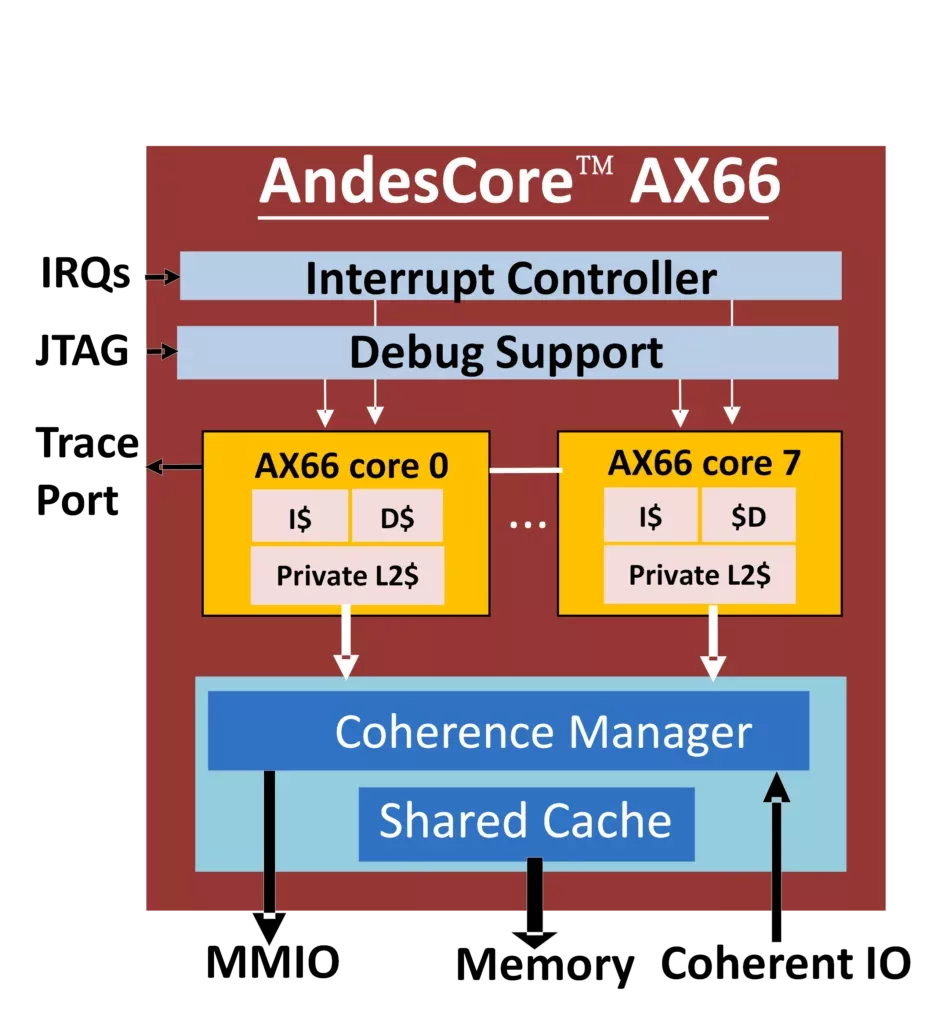
AndesCore™ AX66 64-bit multicore CPU IP is a high-performance quad decode 13-stage superscalar out-of-order processor based on AndeStar™ V5 architecture. It supports RISC-V standard “G (IMA-FD)”, “C” 16-bit compression, “B” bit manipulation, Vector and Vector Cryptography, Hypervisor and AIA, and Andes performance enhancements. It features MMU for Linux based applications, TAGE branch prediction for accurate branch execution, 4 wide instruction decode, 8 independent functional pipelines (4 integer, 2 Fp/Vector, 2 load/store), level-1 instruction/data caches and private level-2 cache for low-latency accesses. The AX66 symmetric multiprocessor supports up to eight cores and a level-3 cache controller with instruction and data prefetch. Coherence Manger ensures data coherence among CPU accesses and IO transactions from cacheless bus masters. Other features include ECC for cache memory soft error protection, CHI interface for cache coherent multi-cluster, StackSafe™, and PowerBrake and WFI for power management.
AndeStar™ V5 Architecture
| Key Features | Benefits |
|---|---|
| RISC-V RV64 GCB + Vector/Vector Crypto, Hypervisor/AIA |
|
| Andes Extended Instructions | Andes exclusive performance and functionality enhancements |
| MMU and Sv39/Sv48 virtual memory translation | For Linux and advanced operating systems with protection between kernel and user program |
| 64-bit CPU architecture | Enabling software to utilize the memory spaces far beyond the 4G byte limit of 32-bit CPUs |
|
Full privilege protections with or without hypervisor |
CPU Core
| Key Features | Benefits |
|---|---|
| >9.5 specint2006/Ghz (estimated) | Superior performance |
| 13-stage out-of-order 4 wide superscalar pipeline | Superior performance-efficiency, while allowing for high speeds |
|
Extensive branch predication features
|
|
|
MMU (Memory Management Unit):
|
|
| Physical Memory Protection (PMP), configurable up to 16 regions | Basic read/write/execute memory protection with minimum cost |
| 16 programmable physical memory attributes (PPMA) regions |
Configurable memory attributes:
|
|
RISC-V Vector support with 128bit VLEN
|
|
| Performance monitors | Program code performance tuning |
| StackSafe™ hardware stack protection | Easy identification of stack size threshold during development Hardware error detection of stack overflow and underflow at runtime |
| PowerBrake technology | Performance throttling to digitally reduce power consumption |
Memory Subsystems
| Key Features | Benefits |
|---|---|
|
Level-1 I-Cache & D-Cache
Private Level-2 I/D Unified Cache
Shared Level-3 cache
|
Accelerating accesses to slow memories Further accelerate performance with optional larger 2nd level private cache Larger 3rd level share cache |
| Optional ECC error protection with SRAM interface | Code and data integrity protection |
| Bus maneger port: AXI with 128 or 256 bit data, I/D joint or separate bus | High throughput with wide data path |
| Core/bus clock ratio of N:1 | Simplified SoC integration |
Multicore Cache Coherence
| Key Features | Benefits |
|---|---|
|
|
Advanced Interrupt Architecture (AIA)
| Key Features | Benefits |
|---|---|
|
Implements RISC-V AIA specification v1.0
|
|
Debug Support
| Key Features | Benefits |
|---|---|
| Implements RISC-V debug specification v1.0 | Supported by industry debug tool suppliers |
| JTAG Debug Port | Industry-standard support |
| Embedded Debug Module with up to 8 triggers | Flexible configurations to tradeoff between gate count and debugging capabilities |
| Exception redirection support | Entering debugger upon selected exceptions without using breakpoints |
| RISC-V Trace 1.0 Instruction Trace interface | Supported by Andes tools |
Note: some files may require an NDA depending on provider policy.

RVA23, Multi-cluster, Hypervisor and Android is a CPU IP core from Andes Technology Corp. listed on Semi IP Hub.
Engineers should review the overview, key features, supported foundries and nodes, maturity, deliverables, and provider information before shortlisting this CPU IP.
Yes. Buyers can compare this product with similar semiconductor IP cores or IP families based on category, provider, process options, and structured technical specifications.