Vendor: CAST Category: SENT

Peripheral Sensor Interface (PSI5) Host Controller

Configurable automotive Peripheral Sensor Interface (PSI5) host controller that implements the ECU side of PSI5 communication systems

Overview

The PSI5-HOST IP core is a configurable automotive Peripheral Sensor Interface (PSI5) host controller that implements the ECU side of PSI5 communication systems. The core supports PSI5 Specification v2.3 and is backward compatible with PSI5 v1.3.

PSI5-HOST enables robust communication between ECUs and automotive sensors using low-cost two-wire communication over sensor power lines.

The core supports both synchronous and asynchronous modes, ECU-to-sensor downstream communication using tooth-gap or pulse-width encoding, and sensor-to-ECU Manchester-coded upstream messaging.

The PSI5-HOST architecture incorporates several safety-oriented features, including programmable watchdog timing slots monitoring, receive frame timestamps, and data protection using CRC or parity according to the PSI5 specification. These features allow smooth PSI5-HOST integration into ISO 26262-oriented automotive systems.

Access to the PSI5-HOST registers is provided through an AMBA APB register interface. The silicon-proven PSI5-HOST core is designed to industry best practices and has been rigorously verified. Optional functional safety documents and dedicated diagnostic features help developers integrate the core into ISO 26262 safety-related automotive designs.

Key features

Supported Protocols and Modes

  • PSI5 v2.3 and PSI5 v1.3 protocols
  • 125kbps and 189kbps upstream modes
  • Synchronous and asynchronous communication

PSI5 Transmission

  • Configurable support for up to 8 independent PSI5 channels
  • Up to 6 timing slots per channel
  • Support for both 125kbps and 189kbps upstream modes per different channels at a time
  • Tooth-gap or pulse-width mode downstream communication
  • Manchester decoding and error detection

Safety Oriented Features

  • Parity-protected control/status registers and data buffer
  • Programmable glitch filters, CRC, and parity handling
  • Receive data slot timing monitor (Watchdog)
  • 24-bit timestamp generation with internal or external time base
  • Programmable RX glitch filter

Configurable Receive Data Memory

  • Off-core SRAM or internal, flop-based design options
  • Up to 32 receive frames per channel, pre-synthesis configurable
  • One common memory block, shared between all implemented channels
  • Can operate as FIFOs or random access buffers

Host Integration and Control Interfaces
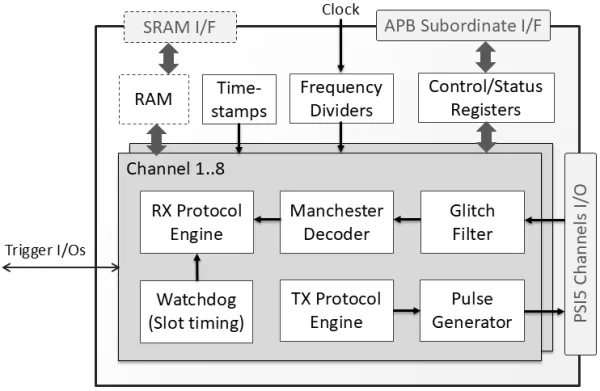
  • APB2/APB3/APB4/APB5 configurable CSR interface
  • Low-power operation with clock gating
  • Configurable number of Trigger IOs
  • Programmable interrupt architecture

Block Diagram

What’s Included?

  • Verilog RTL source code, or targeted FPGA netlist
  • Simulation and Synthesis scripts
  • Comprehensive user documentation and IP-XACT register descriptions
  • Options:
    • UVM Testbench
    • ISO 26262 ASIL-D certification package, comprising a Safety Manual (SAM) and FMEDA documents

Specifications

Identity

Part Number
PSI5-HOST
Vendor
CAST
Type
Silicon IP
Application
Automotive

Files

Note: some files may require an NDA depending on provider policy.

Provider

HQ: USA

Learn more about SENT IP core

From Classical CAN and CAN FD to CAN XL: Functional Safety and Security for Next-Generation In-Vehicle Communication

This article reviews the functional-safety attributes of Classical CAN and CAN FD, then explains how CAN XL preserves and extends them. It also discusses higher-layer safety protocols, fault-tolerant CAN XL controller implementations, and CANsec, the CAN XL security extension inspired by the MACsec model. Finally, it highlights how the CAST CAN XL controller IP and CANsec acceleration IP can support the efficient deployment of safety- and security-capable in-vehicle networks.

Time Sensitive Networking for Aerospace

This white paper highlights the integration of Time-Sensitive Networking (TSN) in the aerospace industry. It provides an overview of TSN standards and profiles and the IEEE P802.1DP standard relevant to aerospace applications. It also discusses key topics such as time synchronization, latency, resource management, and reliability in the context of TSN.

JESD204 Frame Mapping explained from converter samples to lanes

The JESD204 Transport Layer oversees converter data mapping onto a set of JESD204 Lanes. The nature of these lanes is dependent on the version of the JESD204 standard and a function of the PCS and over the years despite the Serdes technology changing with ever increasing line rates, the function and features of the Transport Layer remained the same

Integrating PQC into StrongSwan: ML-KEM integration for IPsec/IKEv2

Integrating PQC into a widely deployed IKEv2 implementation is an important step toward making secure communication future-proof. We integrated ML-KEM, the NIST-standardized module-lattice KEM, into StrongSwan’s IKEv2 stack using our own KiviPQC-KEM hardware accelerator.

VESA Adaptive-Sync V2 Operation in DisplayPort VIP

In a computer system, both the GPU as well as the monitor have a certain rate at which they render or update an image, respectively. The rate is nothing but the frequency at which the image is refreshed (updated in the image it shows/displays), usually expressed in hertz, and can vary based on the content displayed on the screen.

Frequently asked questions about SENT IP cores

What is Peripheral Sensor Interface (PSI5) Host Controller?

Peripheral Sensor Interface (PSI5) Host Controller is a SENT IP core from CAST listed on Semi IP Hub.

How should engineers evaluate this SENT?

Engineers should review the overview, key features, supported foundries and nodes, maturity, deliverables, and provider information before shortlisting this SENT IP.

Can this semiconductor IP be compared with similar products?

Yes. Buyers can compare this product with similar semiconductor IP cores or IP families based on category, provider, process options, and structured technical specifications.

×
Semiconductor IP