
Vendor: NTLab Category: Voltage Reference

Power management unit (0.9V, 1.8V, 3.3V output voltages, 1.2V reference voltage and 10uA/1uA reference currents)

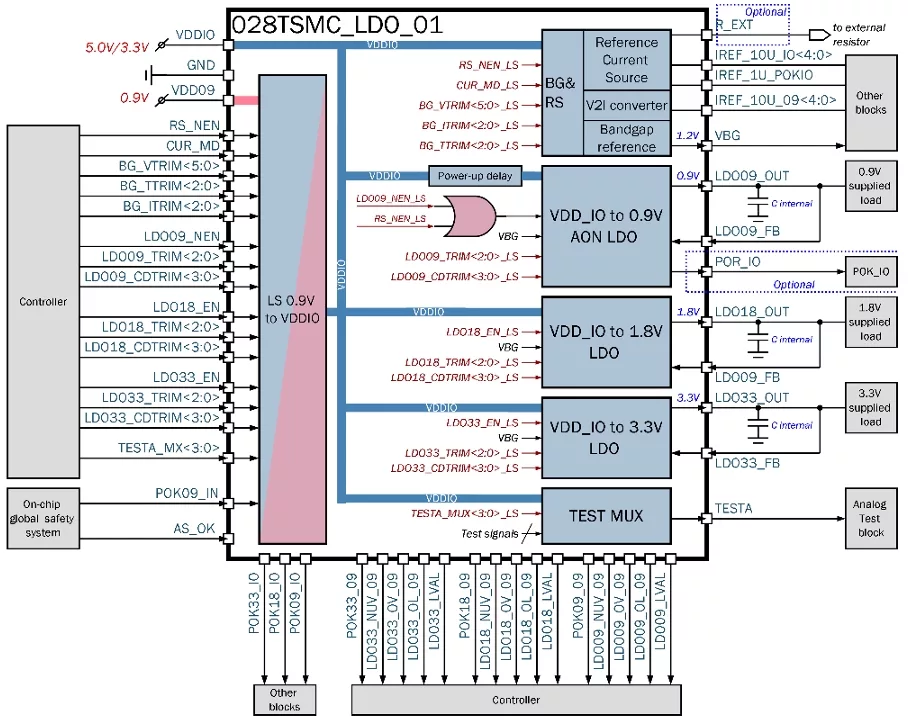
028TSMC_LDO_01 is a Power management unit, designed to supply integrated circuits with stable and precise voltage.

TSMC 28nm Pre-Silicon View all specifications

Overview

028TSMC_LDO_01 is a Power management unit, designed to supply integrated circuits with stable and precise voltage. IP includes Bandgap block, and 3 LDOs: always-ON LDO to convert IO voltage 5.0V/3.3V to 0.9V and supply digital circuits with load up to 5mA; LDO to convert IO voltage 5.0V/3.3V to 1.8V and supply analog circuits with load up to 100mA; LDO to convert IO voltage 5.0V to 3.3V and supply analog circuits with load up to 100mA. Bandgap is a voltage reference source, where voltage is formed independently from temperature and power supply variations, and where typical reference voltage is 1.2V. Bandgap includes also Voltage-to-Current (V2I) converter to generate required nominal values of reference current to analog blocks. Each of LDOs has an option of output voltage adjustment. The block operates directly from two main power supplies: IO voltage VDDIO, which can be 5.5V or 3.3, depending on application, and core voltage VDD09 supply.

Key features

  • TSMC 28nm eFlash technology
  • Bandgap output voltage 1.2V
  • Bandgap output voltage accuracy without trimming ±3% @5.0V
  • Embedded Bias block with output reference current without trimming (option with external resistor): 10µA ±5%
  • Always-ON LDO: 0.9V output voltage
  • 5.0V/3.3V to 1.8V LDO
  • 5.0V to 3.3V LDO
  • Quiescent current in operation full mode: 210uA@5.0V
  • Quiescent current in always-on mode (standby current): 103uA@5.0V
  • Analog IO supply voltage 5.0V (3.3V option)
  • Automotive IO supply voltage 5.0V (3.3V option)
  • Core supply voltage 0.9V

Block Diagram

Applications

  • Supply voltage sensitive circuits
  • Power solutions
  • Automotive systems

What’s Included?

  • Schematic or NetList
  • Abstract view (.lef and .lib files)
  • Layout (optional)
  • Behavioral model (for functional verification)
  • Extracted view (optional)
  • GDSII
  • DRC, LVS, antenna report
  • Test bench with saved configurations (optional)
  • Documentation

Silicon Options

Foundry Node Process Maturity
TSMC 28nm 28nm 280 nm Pre-Silicon

Specifications

Identity

Part Number
028TSMC_LDO_01
Vendor
NTLab
Type
Silicon IP

Files

Note: some files may require an NDA depending on provider policy.

Provider

HQ: Lithuania

Learn more about Voltage Reference IP core

Analog and Power Management Trends in ASIC and SoC Designs

The design of modern Application Specific Integrated Circuits (ASICs) and Systems on a Chip (SoCs) in advanced process nodes can be differentiated by the on-die integration of analog functions, such as power management. Vidatronic offers this white paper to give some historical background on this trend and delve specifically into the integration of power management. Vidatronic IP solutions and the benefits they bring to ASIC and SoC designers are discussed.

How to specify and integrate successfully a measurement analog front-end including its power computation engine in an energy metering IC

Based on the system specification of a typical smart meter, this article demonstrates the importance of carefully selecting the power metering IP solution so that its specification matches the standard requirements and copes with the application challenges. This article then pinpoints thoroughly the various issues that must be taken into account for the selection of the Silicon IP and helps identify the possible trade-offs between the performance of the Mixed-signal Front-end (MFE) and that of the Power and energy Computation Engine (PCE).

Silicon Qualified SuperViC: the only way to safe SoC integration

System integrators often encounter problems on application boards too late in the design cycle, when bringing together Virtual Components (ViCs of silicon IPs) into a system. Some ViC performances may be degraded at higher levels (SoC and PCB), and thus the final system does not perform as well as expected. In other words, assembling high-performance ViCs together does not guarantee high-performance SoCs or systems when fundamental integration aspects are not addressed or key issues are violated during the integration process.

Analog IP Reuse in Nano Technologies

Presented in this paper is a tool that automatically migrates analog designs from one process to another while keeping circuit and layout topologies.

Frequently asked questions about Voltage Reference IP cores

What is Power management unit (0.9V, 1.8V, 3.3V output voltages, 1.2V reference voltage and 10uA/1uA reference currents)?

Power management unit (0.9V, 1.8V, 3.3V output voltages, 1.2V reference voltage and 10uA/1uA reference currents) is a Voltage Reference IP core from NTLab listed on Semi IP Hub. It is listed with support for tsmc Pre-Silicon.

How should engineers evaluate this Voltage Reference?

Engineers should review the overview, key features, supported foundries and nodes, maturity, deliverables, and provider information before shortlisting this Voltage Reference IP.

Can this semiconductor IP be compared with similar products?

Yes. Buyers can compare this product with similar semiconductor IP cores or IP families based on category, provider, process options, and structured technical specifications.

×
Semiconductor IP