ZLG Selects CAST CAN XL and TSN IP for Next-Generation Vehicle-Network Development and Test Tools
Standards-compliant IP supports CAN XL tools and deterministic Ethernet switches for OEM R&D, production, and testing
The JPEG-LS-D core implements a efficient and low-power, lossless and near-lossless image decompression engine that is compliant …
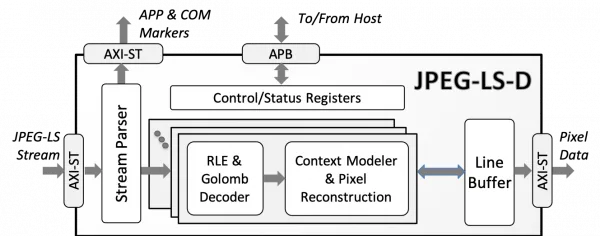
The JPEG-LS-D core implements a highly efficient and low-power, lossless and near-lossless image decompression engine that is compliant to the JPEG-LS, ISO/IEC 14495-1 standard.
The decoder core can decompress any JPEG-LS stream or JPEG-LS payload of image container formats, such as DICOM (Digital Imaging and Communications in Medicine). It accepts compressed streams of images with up to 16-bit per color samples and up to four color components, in all widely used color subsampling formats. Supporting oversize image dimension parameters, the core can decode images with resolutions exceeding 64k x 64k pixels.
The easy-to-use JPEG-LS-D core operates on a standalone basis, parsing marker segments and decompressing coded data with no assistance from a host processor. The decoder reports the image format (i.e., resolution, subsampling format, and color sample depth) to the system, so that the decoded images are properly further processed and/or displayed. Application (APP) or comment (COM) marker segments—which are typically used to embed metadata in the compressed stream—are also passed to the system via a dedicated interface.
SoC integration is straightforward thanks to standardized AMBA® interfaces. The core accepts compressed data and outputs pixel data, frame format information, and APP or COM marker segments via AXI4-Stream interfaces, and it provides access to its control and status registers via a 32-bit APB interface. A wrapper that bridges the AXI-Stream interfaces to AXI4 can optionally be delivered with the core.
The core is designed with industry best practices, and its reliability has been proven through both rigorous verification and silicon validation. The deliverables include a complete verification environment and a bit-accurate software model.
Note: some files may require an NDA depending on provider policy.

Lossless & Near-Lossless JPEG-LS Decoder is a Image Conversion IP core from CAST listed on Semi IP Hub.
Engineers should review the overview, key features, supported foundries and nodes, maturity, deliverables, and provider information before shortlisting this Image Conversion IP.
Yes. Buyers can compare this product with similar semiconductor IP cores or IP families based on category, provider, process options, and structured technical specifications.