Overview
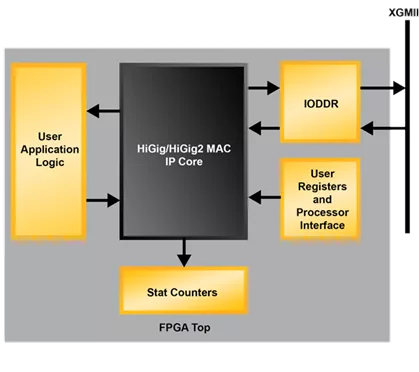
The HiGig™ MAC transmits and receives data between a host processor and a HiGig™ / Ethernet network that enables networking customers to add features like quality of service (QoS), port trunking, mirroring across devices, and link aggregation at higher layers of the OSI network model. The HiGig™ MAC ensures that the Media Access rules specified in the 802.3ae IEEE standard and HiGig™ Protocol definitions are met while transmitting a frame of data over Ethernet. On the receive side, it extracts the different components of a frame and transfers them to higher applications through a FIFO interface.
The HiGig™ / Ethernet MAC IP core is a user-configurable IP core, which allows the configuration of the IP and generation of a netlist and simulation file for use in designs. Please note that generating a bitstream may be prevented or the bitstream may have time logic present unless a license for the IP is purchased. The HiGig™ MAC IP core from Lattice supports the LatticeECP3 and LatticeSC/M FPGA families.
HiGig™, HiGig2™ are trademarks of Broadcom Corporation.
Learn more about Ethernet IP core
Combining Arm® AGI CPU server platforms with Lattice FPGAs and AMI firmware creates a solution that provides advanced security, manageability, connectivity, and flexibility for next-generation AI data center infrastructure.
Lattice Prompt pairs with AI agentic tools developers already use, combining them with Lattice design tools, knowledge base, and documentation to turn natural language inputs into validated responses, dramatically accelerating FPGA development while optimizing design performance and capability.
First announced on May 4, 2026, the acquisition creates the industry's most complete secure management and control platform.
The acquisition brings together Lattice’s industry-leading low power FPGAs with AMI’s industry‑leading platform firmware and infrastructure manageability solutions for cloud and AI to create a complete portfolio of secure management and control solutions.
The collaboration demonstrates a real-time AI sensor fusion architecture that integrates TI mmWave radar and camera sensors using NVIDIA Holoscan Sensor Bridge running on Lattice’s low power FPGA. The FPGA acts as a companion chip delivering synchronized sensor data directly into GPU-accessible memory to enable low-latency and robust perception for robotics and industrial edge AI applications.
Sets new standard for secure control FPGAs with full CNSA 2.0-compliant post-quantum cryptography, crypto-agility, and hardware Root of Trust for next-generation infrastructure