Overview
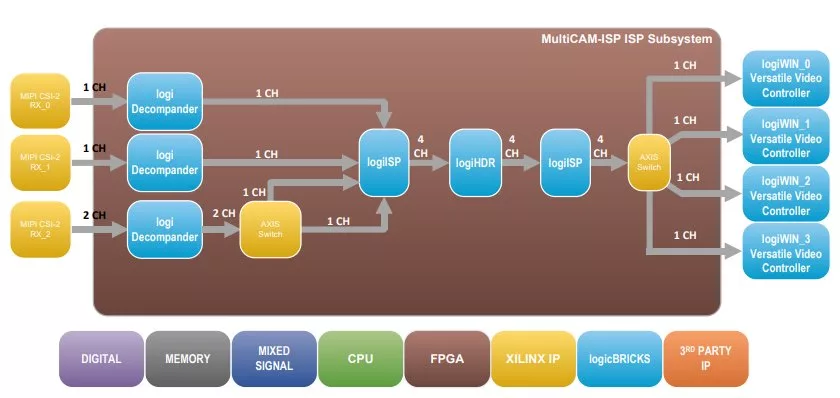
Xylon offers a complete logicBRICKS IP suite for implementing High-Dynamic Range (HDR) Image Signal Processing (ISP) pipelines in embedded designs based on Xilinx FPGA, SoC, MPSoC or ACAP programmable devices. HDR ISP pipelines enable crisp camera video under altering and rough lighting conditions in next-generation multi-channel embedded systems for use in automotive, surveillance, medical and similar video and vision AI applications.
logicBRICKS ISP IP cores enable parallel processing of multiple Ultra HD video inputs in different Xilinx devices, ranging from the small Xilinx Artix® FPGAs to the latest Xilinx Versal™ Adaptive Compute Acceleration Platform (ACAP) devices.
The logiREF-MULTICAM-ISP demonstrates these capabilities and shows how, in comparison to simple instantiation of multiple ISP pipelines within a single programmable device, Xylon’s logicBRICKS ISP pipeline allows for tremendous savings of up to 50 % of valuable programmable logic.
Learn more about ISP Image Signal Processor IP core
Xylon has introduced its latest FMC expansion board designed to bring high-speed automotive connectivity to advanced video and vision AI systems. The new logiFMC-GMSL3/2-96726A 12-channel FMC+ mezzanine card enables seamless interfacing of up to twelve video cameras with FPGA and adaptive SoC platforms.
Over three decades, Xylon has consistently driven innovation in embedded systems, developing advanced solutions for automotive, defense, industrial automation, medical and other key sectors.
Xylon ISP Studio is a powerful PC-based tool designed to simplify and accelerate HDR Image Signal Processing (ISP) pipeline development and tuning on AMD FPGA and adaptive SoC platforms.
Xylon has introduced the logicBRICKS Vision AI Framework, designed to simplify AI development on AMD Versal™ and Zynq™ UltraScale+™ SoCs.
The updated logiHSSL IP Core introduces a "reduced IP configuration," supporting one HSSL target device and one streaming data channel. Based on Xylon's experience, this configuration meets the needs of the vast majority of logiHSSL IP users.
Xylon just upgraded company’s logicBRICKS High Dynamic Range (HDR) Image Signal Processing (ISP) IP Suite with the new RGB-IR image processing module.