Overview
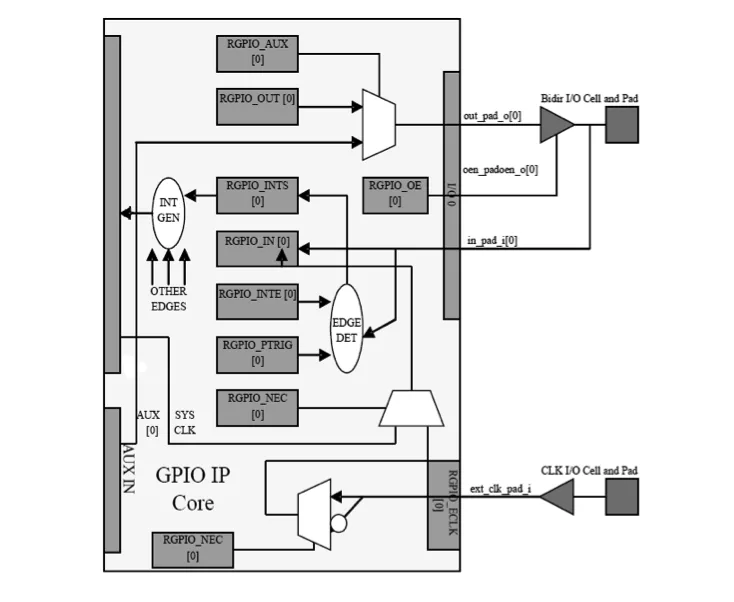
The GPIO core is used to create functions in a system that are not implemented with dedicated controllers, and require simple input and/or output software-controlled signals.
The number of general-purpose I/O signals is user selectable ranging from 1 to 32. For more I/O signals, several GPIO cores can be used in parallel. Each GPIO signal can be programmed individually as an input, an input in interrupt mode, an output, a bi-directional I/O, or as driven by an auxiliary input. GPIO signals programmed as inputs can be registered at the rising edge of the system clock or at a user-programmed edge of the external clock.
The GPIO core is rigorously verified, silicon-proven and available in RTL source or as a targeted FPGA netlist.
Learn more about GPIO IP core
Standards-compliant IP supports CAN XL tools and deterministic Ethernet switches for OEM R&D, production, and testing
Now place a MACsec engine between an existing MAC and PHY with new xMII bridges; handle key management with new MKA stack and drivers
Humanoid robots are moving from research demos toward real products, and the network inside them is becoming the hard problem. Single Pair Ethernet and Time-Sensitive Networking are emerging as the answer, and CAST already builds the IP cores that make it deterministic.
Autonomous hardware TCP/IP stack delivers reliable, high-throughput, low-latency networking for AI and HPC clusters, hyperscale data centers, SmartNICs, and NVMe-over-TCP systems
Production-proven xSPI, HyperBus, and Xccela controller adds AES encryption, AMBA® power-state management, and programmable delay tuning
As SoC architectures adopt AMBA® 5 fabrics and components, many proven IP blocks still rely on AMBA® 4 or earlier interfaces. That creates a common integration problem: how do designers connect newer AMBA® 5 system components to existing IP without redesigning the IP or replacing verified blocks?