Ethernet MAC 10/100/1G Quality-of-Service
The Ethernet Quality-of-Service (QoS) Controller IP supports 1M, 10M, 1G and 2.5G speeds implementing the link layer of an Open S…
Overview
The Ethernet Quality-of-Service (QoS) Controller IP supports 1M, 10M, 1G and 2.5G speeds implementing the link layer of an Open Systems Interconnection (OSI) Ethernet system. The silicon-proven configurable and scalable IP is shipping in volume and has been successfully implemented in a wide range of Ethernet applications including professional and consumer audio/video, automotive, industrial and a range of consumer, and datacenter applications. The ASIL B Ready ISO 26262 certified Ethernet QoS Controller IP is available with an automotive safety package.
The Ethernet QoS Controller IP is designed to support real-time networking, as well as the original IEEE Audio Video Bridging (AVB) and follow-on Time Sensitive Networking (TSN) specifications. In addition, advanced features such as data center bridging, segmentation & UDP offloading features required in today’s designs are provided as easy configuration options.
Typical design of configurable IP results in multiple layers that are bridged during configuration, resulting in many unnecessary latencies due to double buffering of data as it crosses from one layer to another. The coreConsultant configuration tool removes the latencies at configuration time, thus providing high-performance IP.
The Ethernet QoS Controller IP can be coupled with standards compliant, full-duplex inline MACsec Security Modules enabling designers to quickly integrate security in their system for a fast time-to-market and reduced risk.
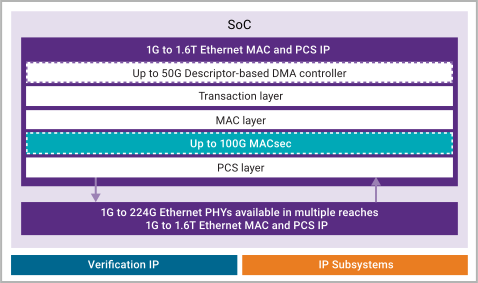
The Ethernet IP solutions consist of configurable Controllers and silicon-proven PHYs supporting speeds of up to 100G, MACsec Security Modules, Verification IP, IP Prototyping Kits, Software Development Kits and Interface IP Subsystems.
Key features
- Compliant with IEEE specifications including:
- IEEE 802.3 for Ethernet MAC, Gigabit Media Independent Interface (GMII), Media Independent Interface (MII), Ten Bit Interface (TBI)
- IEEE 1588-2008 for precision networked clock synchronization
- IEEE 802.1AS-2011and IEEE 802.1AS-REV with IEEE 802.1-Qav-2009 for Audio Video (AV) traffic
- IEEE 802.1Qbv Enhancements for scheduled traffic
- IEEE 802.1Qbu & IEEE802.3br for frame preemption
- IEEE 802.3az-2010 for Energy Efficient Ethernet (EEE)
- Compliant with Arm AMBA specifications including:
- AMBA 2.0 for AHB manager, AHB subordinate, and APB subordinate ports
- AMBA 3.0 for AXI manager and subordinate and 3 APB subordinate ports
- AMBA4 AXI and ACE protocol specification, February 2013, Arm Ltd for 4 AXI and 4 APB interface
- Additional reference standards:
- RGMII/RTBI specification version 2.6 from HP/Marvell
- RMII specification version 1.2 from RMII consortium
- SGMII specification version 1.8 from Cisco/Marvell
- SMII specification version 2.1 from Cisco for SMII
- Reverse Media Independent Interface (RevMII) by Dmitriy Gusev
- Comprehensive deliverables packaged in an IP-XACT compatible .run file
- Includes Synopsys’ coreConsultant tool for easy configuration
- Easy integration with Synopsys MACsec Security Modules
Block Diagram
Specifications
Identity
Files
Note: some files may require an NDA depending on provider policy.
Provider
Learn more about Ethernet IP core
Verification of UALink (UAL) and Ultra Ethernet (UEC) Protocols for Scalable HPC/AI Networks using Synopsys VIP
PCIe 6.x and 112 Gbps Ethernet: Synopsys and TeraSignal Achieve Optical Interconnect Breakthroughs
Ethernet Evolution: Trends, Challenges, and the Future of Interoperability
How Ultra Ethernet And UALink Enable High-Performance, Scalable AI Networks
Integrating Ethernet, PCIe, And UCIe For Enhanced Bandwidth And Scalability For AI/HPC Chips
Frequently asked questions about Ethernet IP cores
What is Ethernet MAC 10/100/1G Quality-of-Service?
Ethernet MAC 10/100/1G Quality-of-Service is a Ethernet IP core from Synopsys, Inc. listed on Semi IP Hub.
How should engineers evaluate this Ethernet?
Engineers should review the overview, key features, supported foundries and nodes, maturity, deliverables, and provider information before shortlisting this Ethernet IP.
Can this semiconductor IP be compared with similar products?
Yes. Buyers can compare this product with similar semiconductor IP cores or IP families based on category, provider, process options, and structured technical specifications.