Vendor:
IP Cores, Inc.
Category:
Random Number Generator
Cryptographically Secure Pseudo Random number Generator IP Core
The PRNG1 core implements a cryptographically secure pseudo-random number generator per NIST publication SP800-90.
Overview
The PRNG1 core implements a cryptographically secure pseudo-random number generator per NIST publication SP800-90.
Basic core is small (6,500 gates) and uses an external 256-bit entropy seed to generate 16 bytes (128 bits) of random data at a time (128 bits of security strength). Versions of the core are available supporting higher security strengths (192 and 256 bits), larger amounts of generated bits (up to 219), and different internal datapath widths for size/performance tradeoff. The core includes the AES1 core.
The design is fully synchronous and available in both source and netlist form. Test bench uses vectors in plain text format.
PRNG1 core is supplied as portable Verilog (VHDL version available) thus allowing customers to carry out an internal code review to ensure its security.
Basic core is small (6,500 gates) and uses an external 256-bit entropy seed to generate 16 bytes (128 bits) of random data at a time (128 bits of security strength). Versions of the core are available supporting higher security strengths (192 and 256 bits), larger amounts of generated bits (up to 219), and different internal datapath widths for size/performance tradeoff. The core includes the AES1 core.
The design is fully synchronous and available in both source and netlist form. Test bench uses vectors in plain text format.
PRNG1 core is supplied as portable Verilog (VHDL version available) thus allowing customers to carry out an internal code review to ensure its security.
Key features
- Generates cryptographically secure pseudo-random numbers
- Uses the CTR_DRBG algorithm per NIST publication SP800-90
- Generates 128-bit data blocks with 8, 16, 32, 64 or 128-bit wide data interface
- Provides security strength of 128,192 and 256 bits
- Self-contained; does not require external memory
- Available as fully functional and synthesizable Verilog or VHDL, or as a netlist for popular programmable devices and ASIC libraries
- Deliverables include Verilog test bench and test vectors
Block Diagram
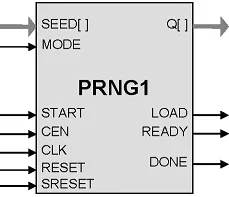
PRNG1 block diagram
Applications
- Secure wireless communications, including 802.11i, 802.15.3, 802.15.4 (ZigBee), MBOA, 802.16e
- Electronic financial transactions
- Content protection, digital rights management (DRM), set-top boxes
- Secure RFID
- Secure Smart Cards
What’s Included?
- HDL Source Licenses
- Synthesizable Verilog RTL source code
- Testbench (self-checking)
- Test vectors
- Expected results
- User Documentation
- Netlist Licenses
- Post-synthesis EDIF
- Testbench (self-checking)
- Test vectors
- Expected results
Specifications
Identity
Part Number
PRNG1
Vendor
IP Cores, Inc.
Type
Silicon IP
Files
Note: some files may require an NDA depending on provider policy.
Provider
IP Cores, Inc.
HQ:
USA
IP Cores, Inc specializes on IP cores for semiconductors, primarily in the security and cryptography area with a sprinkle of DSP. Whether your needs are in 802.16e, P1619, 802.1AE, content protection, or FFT, our cryptographic and DSP cores usually are the smallest, fastest, and lowest-cost choices on the market.
Learn more about Random Number Generator IP core
How random is random?
Brian Bailey
The Silent Guardian of AI Compute - PUFrt Unifies Hardware Security and Memory Repair to Build the Trust Foundation for AI Factories
At the scale of the Vera Rubin platform, yield, calibration, and security failures compound across tens of thousands of devices. A single unified hardware anchor at the silicon level is not optional, it is architectural necessity. A physical unclonable function-based hardware root-of-trust, PUFrt, jointly developed by eMemory and PUFsecurity, was designed precisely for this role: a fully integrated implementation of the Caliptra 2.0 open standard that simultaneously manages cross-die memory repair and hardware root of trust across the full platform.
A Comprehensive Post-Quantum Cryptography (PQC) Solution based on Physical Unclonable Function (PUF)
This article provides an in-depth analysis of the specific PPA challenges introduced by PQC and elucidates how PUF-PQC leverages its unique dualtrack strategy to deliver a robust and flexible Hardware Root of Trust (HRoT) across diverse application scenarios. Furthermore, it demonstrates the integration of Physical Unclonable Function (PUF) with a NIST SP 800-90B compliant True Random Number Generator (TRNG) to serve as critical components of PUFrt (Root of Trust), ensuring the security of post-quantum key generation starting from the entropy source.
X100 - Securing the System - RISC-V AI at the Edge
For years, SiFive has been delivering a range of security capabilities that are optimized for deployment throughout the system, tightly coupled to products from its broad portfolio of processors. Building on the prior blogs that centered on performance and effective coupling of accelerators, I wanted to focus this blog on security and its role in the growing popularity of the SiFive Intelligence X100 product family.
Tailoring Root Of Trust Security Capabilities To Specific Customer Needs
A Root of Trust is the foundation on which all secure operations of a computing system depend. It contains the keys used for cryptographic functions and enables a system-wide secure boot process. It is inherently trusted and therefore must be secure by design.
Frequently asked questions about Random Number Generator IP cores
What is Cryptographically Secure Pseudo Random number Generator IP Core?
Cryptographically Secure Pseudo Random number Generator IP Core is a Random Number Generator IP core from IP Cores, Inc. listed on Semi IP Hub.
How should engineers evaluate this Random Number Generator?
Engineers should review the overview, key features, supported foundries and nodes, maturity, deliverables, and provider information before shortlisting this Random Number Generator IP.
Can this semiconductor IP be compared with similar products?
Yes. Buyers can compare this product with similar semiconductor IP cores or IP families based on category, provider, process options, and structured technical specifications.