CPU-less QUIC Offload IP core for FPGA Acceleration
QUIC Client 10Gbps IP Core (QUIC10GC-IP) is engineered from the ground up to simplify the QUIC protocol with TLS 1.3 security int…
Overview
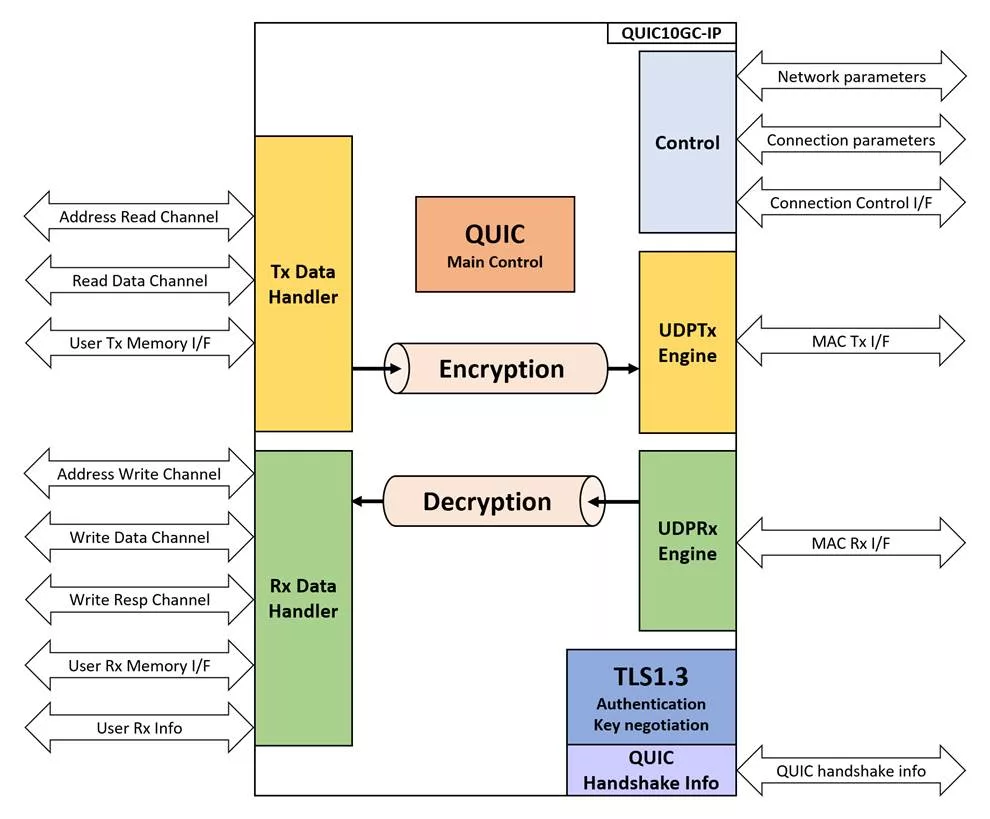
QUIC Client 10Gbps IP Core (QUIC10GC-IP) is engineered from the ground up to simplify the QUIC protocol with TLS 1.3 security into pure hardware logic for FPGA-based client applications. This IP core fully offloads the CPU from handling TLS 1.3 handshakes, encrypting/decrypting payload data, and managing both QUIC and UDP/IP layers within Single IP Core. Get ready to leverage the next generation of network protocols with the QUIC10GC-IP core today!
In today’s digital landscape, traditional TCP/IP protocols struggle with head-of-line blocking, causing data delays and inefficiencies. Our QUIC10GC IP Core overcomes these challenges by leveraging the QUIC protocol, ensuring uninterrupted data transmission and enhanced network efficiency. It handles security tasks, congestion control, and data recovery without needing a CPU, maintaining high throughput. QUIC10GC IP is the ideal solution for creating a seamless, secure, and high-performance network. Experience the future of your networking applications with QUIC10GC IP, where speed, security, and reliability converge.
Key features
- 10Gbps QUIC engine conforming to RFC9000
- Supports the Client-side QUIC operation
- Supports TLS1.3 cipher suite: TLS_AES_128_GCM_SHA256
- Key exchange: X25519
- Derive key: HKDF with SHA256
- Encryption/decryption: AES128GCM
- Certificate type: RSA2048
- Signature algorithm: rsa_pss_rsae_sha256
- Supports four streams (StreamIDs #0-3) compliant with the QUIC standard
- Includes integrated UDP/IP and ARP protocol controllers
- Requires an IP core clock frequency of 220 MHz as a minimum recommended frequency
- Supports unaligned AXI4 protocol for user data interface
- Utilizes a ring buffer technique for user memory management interface
- Supports 32-bit MAC interface using AXI4-Stream protocol, operating at 322.266 MHz
- Customized service options:contact us
- Increase the number of supported streams
- Increase user buffer size
- Extend certificate size
- Enable 0-RTT session resumption
Block Diagram
Applications
- Autonomous Drone and Vehicle Control over 5G/6G Networks: High-speed, real-time data transmission is essential for precise drone or vehicle operation. QUIC ensures reliable communication, even in areas with high network instability, making it ideal for this application.
- Telemedicine and Remote Surgery: In scenarios like remote surgeries, low latency and high reliability are vital to ensure patient safety. QUIC’s reduced latency and robust performance make it a superior choice for transmitting critical medical data seamlessly.
- Real-time video Edge Computing: QUIC10GC-IP is utilized within an edge device responsible for capturing real-time video and transmitting it over the network to a server for analysis. This scenario underscores the importance of secure data transmission, particularly when handling sensitive information.
Specifications
Identity
Files
Note: some files may require an NDA depending on provider policy.

Provider
Learn more about Ethernet IP core
Enabling the Next Generation of AI Infrastructure with Ethernet for Scale-Up Networking (ESUN)
Ethernet Auto-Negotiation: Enabling Seamless Link Optimization
Enhancing Ethernet Security with MACsec
What Makes Ethernet IP Truly Automotive-Grade
Rambus Announces Industry-Leading Ultra Ethernet Security IP Solutions for AI and HPC
Frequently asked questions about Ethernet IP cores
What is CPU-less QUIC Offload IP core for FPGA Acceleration?
CPU-less QUIC Offload IP core for FPGA Acceleration is a Ethernet IP core from Design Gateway Co., Ltd. listed on Semi IP Hub.
How should engineers evaluate this Ethernet?
Engineers should review the overview, key features, supported foundries and nodes, maturity, deliverables, and provider information before shortlisting this Ethernet IP.
Can this semiconductor IP be compared with similar products?
Yes. Buyers can compare this product with similar semiconductor IP cores or IP families based on category, provider, process options, and structured technical specifications.