Vendor: Codasip Category: CPU

Compact RISC-V Processor - 32 bit, 3-stage pipeline, 32 registers

The L30(F) is a small, efficient 32-bit embedded RISC-V processor aimed at embedded systems with more modest processing requireme…

Overview

The L30(F) is a small, efficient 32-bit embedded RISC-V processor aimed at embedded systems with more modest processing requirements. The core has a 3-stage pipeline and has 32 general-purpose registers.
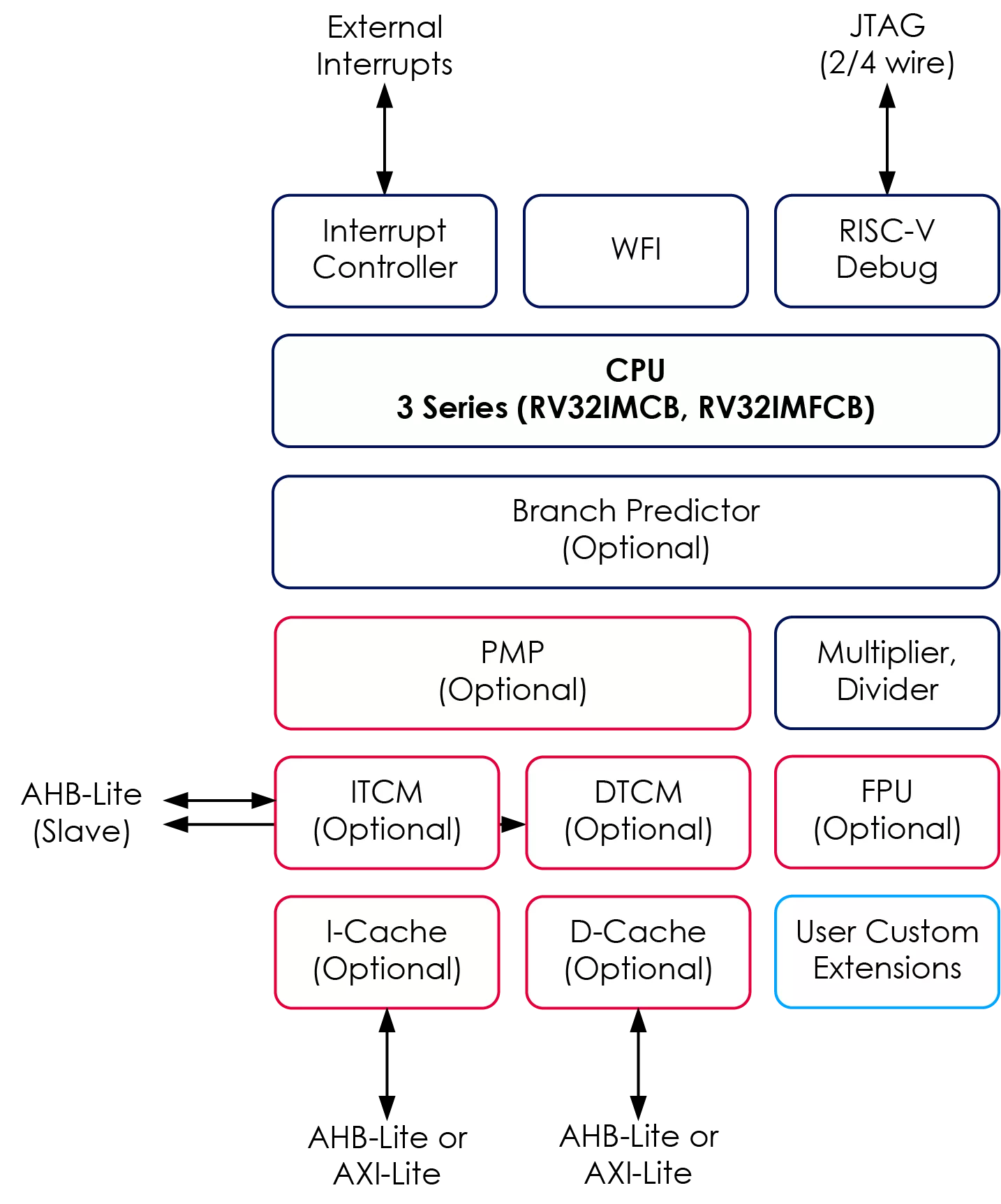
The core includes optional L1 data and instruction caches, optional instruction and data TCM, optional 8 or 16 PMP regions, an interrupt controller and RISC-V Debug module optionally with PC trace.
Like with all Codasip RISC-V cores, it is possible to create custom instructions using Codasip Studio to extend the L30 and to generate corresponding hardware and software development kits.
 

Key features

  • 32-bit RISC-V core
  • Available in two versions:
    • RV32IMC
    • RV32IMCF
  • 32 general purpose registers
  • Either parallel multiplier
  • 3-stage pipeline
  • Dynamic branch predictor
  • RISC-V privilege mode support:
    • Machine, User
  • Internal interrupt controller
    • Up to 256 sources
  • Optional FPU (L30F)
  • Optional instruction and data tightly coupled memories (TCM)
  • Optional 8 or 16 PMP regions
  • Optional L1 data and instruction caches
  • Standard RISC-V CLINT
    • Up to 256 sources
  • Wakeup interrupt controller
  • NMI
  • On-chip debugger
    • RISC-V Debug module
  • 2/4 pin JTAG
  • 2-8 breakpoints/watchpoints

Block Diagram

Benefits

  • Flexibility
    • Wide choice of configuration options.
  • Extensibility
    • Ability to create custom RISC-V extensions to optimise performance
    • Efficient architectural exploration of custom extensions with Studio
    • Automatic HDK and SDK generation from Studio
    • Rigorous verification of modified L30 core using UVM

Applications

  • The L30 is aimed at low- to mid-range embedded applications such as IoT, always on sensors, wireless connectivity, audio, motor control and display control.

What’s Included?

  • Human-readable and structured RTL in either:
    • Verilog
    • VHDL
    • System Verilog
  • Hardware development kit (HDK)
    • Synthesis scripts
    • Simulation testbenches
    • Debug support
  • Software development kit (SDK)
    • LLVM C-compiler
    • Assembler
    • Disassembler
    • Linker
    • Instruction-accurate simulator
    • Cycle-accurate simulator
    • Profiler
  • Option for extending L30
    • CodAL model for Codasip Studio

Specifications

Identity

Part Number
Codasip L30(F)
Vendor
Codasip
Type
Silicon IP

Compute

CPU Architecture
RISC-V

Files

Note: some files may require an NDA depending on provider policy.

Provider

HQ: Germany

Learn more about CPU IP core

A formal-based approach for efficient RISC-V processor verification

In this article, we go through a formal-based, easy-to-deploy RISC-V processor verification application. We show how, together with a RISC-V ISA golden model and RISC-V compliance automatically generated checks, we can efficiently target bugs that would be out of reach for simulation.

Efficient Verification of RISC-V processors

Processor verification, however, is never trivial but requires combining the strengths of multiple verification techniques. This technical paper considers how to efficiently verify a RISC-V processor using a multi-layered approach known as the Swiss cheese model adapted from the world of avionics.

Announcing Arm AGI CPU: The silicon foundation for the agentic AI cloud era

For the first time in our more than 35-year history, Arm is delivering its own silicon products – extending the Arm Neoverse platform beyond IP and Arm Compute Subsystems (CSS) to give customers greater choice in how they deploy Arm compute – from building custom silicon to integrating platform-level solutions or deploying Arm-designed processors.

Frequently asked questions about CPU IP cores

What is Compact RISC-V Processor - 32 bit, 3-stage pipeline, 32 registers?

Compact RISC-V Processor - 32 bit, 3-stage pipeline, 32 registers is a CPU IP core from Codasip listed on Semi IP Hub.

How should engineers evaluate this CPU?

Engineers should review the overview, key features, supported foundries and nodes, maturity, deliverables, and provider information before shortlisting this CPU IP.

Can this semiconductor IP be compared with similar products?

Yes. Buyers can compare this product with similar semiconductor IP cores or IP families based on category, provider, process options, and structured technical specifications.

×
Semiconductor IP