S2C Named Andes Technology’s 2026 Partner of the Year
本月,头部数字EDA企业思尔芯宣布,荣获RISC-V处理器IP领导厂商Andes晶心科技(Andes Technology)颁发的“2026年度最佳合作伙伴”奖项。该荣誉旨在表彰思尔芯在RISC-V生态共建、原型验证平台支撑及联合市场拓展中与Andes晶心深度协同、持续创造客户价值的突出表现。
AndesCore™ AX25 is a compact 64-bit CPU IP core based on AndeStar™ V5 architecture which incorporated RISC-V technology, it is ta…
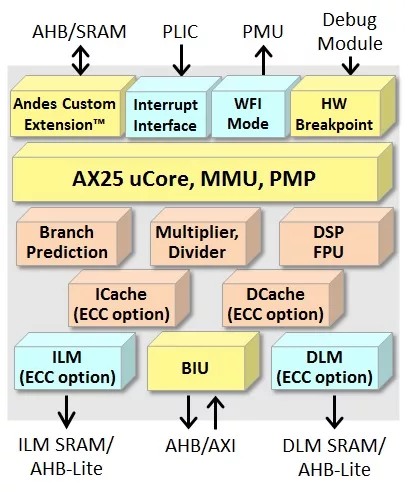
AndesCore™ AX25 is a compact 64-bit CPU IP core based on AndeStar™ V5 architecture which incorporated RISC-V technology, it is tailored for high-performance embedded applications that needs to access address space over 4GB. AX25 also supports the RISC-V P-extension (draft) DSP/SIMD ISA contributed by Andes, single- and double-precision floating point and bit-manipulation instructions, and MMU for Linux based applications. AX25 comes with options, including branch prediction for efficient branch execution, Instruction and Data caches, Local Memories for low-latency accesses, ECC for L1 memory soft error protection, and Andes Custom Extension™ (ACE) to add proprietary instructions to accelerate performance/power consumption critical spots.
AX25’s 5-stage pipeline is optimized for high operating frequency and high performance. Features also includes PLIC and vectored interrupts for serving various types of system events, AXI or AHB 64-bit data bus for addressing up to 64-bit address, PowerBrake, QuickNap™ and WFI mode for low power and power management, and JTAG debug interface for development support.
AndeStar™ V5 Architecture
| Key Features | Benefits |
|---|---|
| RISC-V RV64IMACFDBP instructions |
|
| 64-bit CPU architecture | Enabling software to utilize the memory spaces far beyond the 4G byte limit of 32-bit CPUs |
| RISC-V P-extension (draft) DSP/SIMD instructions with versatile operations | Boost the performance of voice, audio, image and signal processing |
| RISC-V single and double precision floating point instruction | Accelerate the processing of high precision arithmetic |
| RISC-V bit-manipulation instructions, including the Zba, Zbb, Zbc and Zbs extensions | Benefits codes with bit-wise operations |
| Andes Extended Instructions | Andes exclusive performance and functionality enhancements |
| Andes Custom Extension™ (ACE) option to create customized instructions for software acceleration |
|
| 16/32-bit mixable instruction format | For compact code density |
| 32 general-purpose registers | For better code size and performance |
| Machine (M), User (U) and Supervisor (S) Privilege levels | For Linux and advanced operating systems with protection between kernel and user programs |
CPU Core
| Key Features | Benefits |
|---|---|
| 3.55 Coremark/MHz, 2.14 DMIPS/MHz* | Superior performance-per-MHz |
| 5-stage pipeline, with a full-cycle reserved for critical SRAM accesses | Superior performance-efficiency, while allowing for high speeds |
|
Extensive branch prediction features
|
|
|
Memory Management Unit
|
|
| Physical Memory Protection (PMP), 16 regions | Basic read/write/execute memory protection with minimum cost |
| Performance monitors | Program code performance tuning |
| StackSafe™ hardware stack protection |
|
|
Multiplier options
|
Option to choose between speed and area according to application's requirements |
| PowerBrake technology | Performance throttling to digitally reduce power consumption |
| QuickNap™ technology | Fast power-down/wake-up support for caches |
* AndeSight v500, DMIPS/MHZ follow Dhrystone’s no-inline ground rules, best performances
Memory Subsystems
| Key Features | Benefits |
|---|---|
|
I-Cache & D-Cache
|
|
|
ILM & DLM
|
|
| Soft-error protection: ECC or parity for I-Cache and D-Cache, ILM and DLM with SRAM interface | Code and data integrity protection |
| Bus manager port: AHB or AXI with 64-bit data, 32 to 64-bit address, AXI with I/D separate or joint bus | User-selectable bus interface for optimal efficiency |
| Bus subordinate port: AHB with 64-bit data, for ILM/DLM accesses | Efficient data transfer between CPU and SoC managers |
| Core/bus clock ratio of N:1 | Simplified SoC integration |
Platform-Level Interrupt Controller (PLIC)
| Key Features | Benefits |
|---|---|
|
Implements RISC-V PLIC specification
|
Allow individual interrupts to be serviced and prioritized without sharing |
|
Enhanced interrupt features
|
|
Debug Support
| Key Features | Benefits |
|---|---|
| Implements RISC-V debug specifications | Supported by industry debug tool suppliers |
| JTAG Debug Port | Industry-standard support |
| Embedded Debug Module with up to 8 triggers | Flexible configurations to tradeoff between gate count and debugging capabilities |
| Exception redirection support | Entering debugger upon selected exceptions without using breakpoints |
Performance
| Core, Process | AX25 (w/o DSP, FPU), 28HPC+ | AX25 (with DSP, FPU), 28HPC+ |
|---|---|---|
| Frequency (MHz) | 1000 | 1000 |
| Dynamic power (uW/MHz) | 20 | 22 |
| Area (mm2) | 0.111 | 0.209 |
* Configured with cache and MMU. SVT 9-track library, SS corner, 0.81V, -40°C, and with I/O constraint. Power consumption at TT corner, 0.9V, 25°C
Note: some files may require an NDA depending on provider policy.

Compact High-Speed 64-bit CPU for Real-time and Linux Applications is a CPU IP core from Andes Technology Corp. listed on Semi IP Hub.
Engineers should review the overview, key features, supported foundries and nodes, maturity, deliverables, and provider information before shortlisting this CPU IP.
Yes. Buyers can compare this product with similar semiconductor IP cores or IP families based on category, provider, process options, and structured technical specifications.