Vendor: CAST Category: Image Conversion

Baseline JPEG Encoder

This JPEG compression IP core supports the Baseline Sequential DCT modes of the ISO/IEC 10918-1 standard.

Overview

This JPEG compression IP core supports the Baseline Sequential DCT modes of the ISO/IEC 10918-1 standard. It implements an area-efficient, high-performance, hardware JPEG encoder with remarkably low processing latency.  

The JPEG-E-S encoder produces compressed JPEG images and the video payload for Motion-JPEG container formats. It accepts images with 8-bit color samples and up to four color components, in all widely-used color subsampling formats.  

The compact encoder processes one color sample per clock cycle, enabling it to compress multiple Full-HD channels even in low-cost FPGAs. 

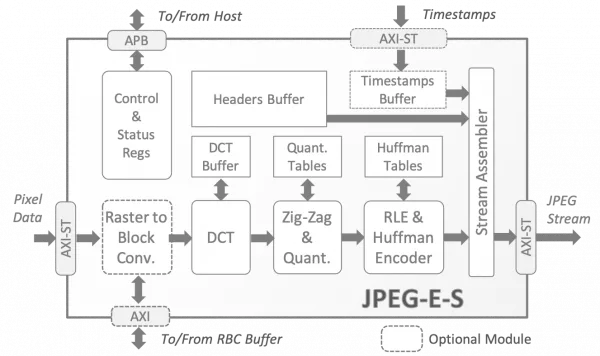
Once programmed, the easy-to-use encoder requires no assistance from a host processor to compress an arbitrary number of frames. SoC integration is straightforward thanks to standardized AMBA® interfaces: AXI Streaming for pixel and compressed data, and a 32-bit APB slave interface for registers access. Users can optionally insert timestamps or other metadata in the compressed stream using a dedicated AXI Streaming interface. 

Customers with a short time to market priority can use CAST’s IP Integration Services to receive complete JPEG subsystems. These integrate the JPEG encoder with video interface controllers, Hardware UDPIP or Transport Stream networking stacks, or other IP cores available from CAST.  

The core is designed with industry best practices, and its reliability and low risk have been proven through both rigorous verification and customer production. Its deliverables include a complete verification environment and a bit-accurate software model. 
Key features

  • Performs Baseline Sequential DCT JPEG encoding of images or video with small silicon area, high performance, and low latency. 
  • Standards Support 
    • ISO/IEC 10918-1 Standard Baseline Sequential DCT mode  
    • Encodes single-frame JPEG images and Motion JPEG payloads 
    • 8-bit per color samples 
    • Up to four color components; any image size up to 64k x 64k  
    • Handles all scan configurations and all JPEG formats  
    • APP, COM, and restart markers 
    • Programmable Huffman and Quantization tables  
  • Rate Control Options 
    • Image: Limits the size of each individual frame 
    • Video: Regulates bit rate over a number of input frames 
  • Interfaces 
    • AXI Streaming I/O data interfaces 
    • APB Control/Status interface 
    • Optional AHB wrapper with DMA capabilities 
  • Performance and Size 
    • One encoded sample per clock cycle 
    • Small silicon footprint (about 70k gates) 
  • Ease of Integration 
    • Automatic program-once/encode-many operation
    • Simple, dedicated timestamps interface  
    • Included bit-accurate software model generates test vectors, expected results, and core programming values 
    • Optional Raster-to-Block Conversion with AXI or standard memory interface to the lines buffer 
  • Format 
    • Available as a targeted FPGA netlist  

Block Diagram

Specifications

Identity

Part Number
JPEG-E-S
Vendor
CAST
Type
Silicon IP

Files

Note: some files may require an NDA depending on provider policy.

Provider

HQ: USA

Learn more about Image Conversion IP core

Understanding - and Reducing - Latency in Video Compression Systems

In the video world, latency is the amount of time between the instant a frame is captured and the instant that frame is displayed. Low latency is a design goal for any system where there is real-time interaction with the video content, such as video conferencing or drone piloting. But the meaning of “low latency” can vary, and the methods for achieving low latency aren’t always obvious. Here we’ll define and explain the basics of video latency, and discuss how one of the biggest impacts in reducing latency comes from choosing the right video encoding.

Understanding - and Reducing - Latency in Video Compression Systems

In the video world, latency is the amount of time between the instant a frame is captured and the instant that frame is displayed. Low latency is a design goal for any system where there is real-time interaction with the video content, such as video conferencing or drone piloting.

Enabling AI Vision at the Edge

Computer vision has made tremendous advances in the last several years due to the proliferation of AI technology. The intersection of big data and massive parallel computing changed the way in which machines are programmed to understand unstructured 2D and 3D data, such as video feeds from cameras.

Nextreme Structured ASICs: An alternative for designing cost-optimized ARM926EJ processor-based embedded systems

Traditional IC design options that embedded system designers have had to choose from include fixed hardware devices such as standalone microprocessors, microcontrollers and ASSPs or configurable hardware devices such as FPGAs and cell-based ASICs. In this paper we present a new design option called Nextreme Structured ASICs which provide embedded system designers with a compelling alternative to custom embedded system design.

Frequently asked questions about image conversion IP cores

What is Baseline JPEG Encoder?

Baseline JPEG Encoder is a Image Conversion IP core from CAST listed on Semi IP Hub.

How should engineers evaluate this Image Conversion?

Engineers should review the overview, key features, supported foundries and nodes, maturity, deliverables, and provider information before shortlisting this Image Conversion IP.

Can this semiconductor IP be compared with similar products?

Yes. Buyers can compare this product with similar semiconductor IP cores or IP families based on category, provider, process options, and structured technical specifications.

×
Semiconductor IP