Overview
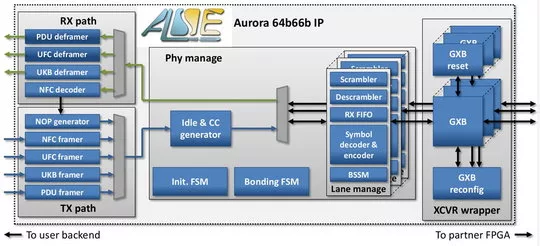
Aurora 64B/66B is a lightweight and open protocol suitable for chip-to-chip, board-to-board and backplane applications using very high speed transceivers.
The ALSE Aurora 64B/66B IP core is a very compact and optimized implementation of this protocol, also developed and verified to ensure full compatibility with the Xilinx core (interoperability has been tested and demonstrated).
This IP targets mainly Intel FPGAs but is available for other vendors, and potentially for ASIC projects.
Compared to the 8B/10B version of the Aurora protocol, the 64B/66B flavor addresses the highest lanes speeds (when 8B/10B typically stops around 6 GBs per lane).
It also offers an effective bandwidth of up to 97%, instead of 80% for 8B/10B.
Our IP therefore provides an efficient way to interconnect Intel and Xilinx FPGAs, or any other chip(ASIC, ASSP, etc …) using the Aurora 64B/66B protocol.
Learn more about Ethernet IP core
This blog post explores how the team verified a 10BASE-T1S automotive ethernet subsystem using a Cadence tools-based multi-platform verification, which unifies simulation, emulation, and formal verification techniques.
Learn how ESUN enhances Ethernet for lossless, predictable AI scale-up networking—cutting overhead, reducing tail latency, and improving efficiency.
Ethernet has evolved significantly from 10 Mbps shared media to today’s multi-hundred gigabit high-speed links. One foundational feature that has enabled this scalability and ease of deployment is Auto-Negotiation (AN).
Ethernet was originally designed for high-speed data transfer and interoperability between devices. However, traditional Ethernet does not provide built-in mechanisms for securing data traffic, such as encryption or authenticity protection. This is where MACsec comes into the picture.
This blog examines what separates truly automotive-grade Ethernet IP from generic implementations across functional safety, time-sensitive networking, security, observability, lifecycle management, and the integration disciplines that only become visible once a program is deep into development.
Rambus, having successfully served the data center, enterprise and infrastructure markets with line rate MACsec and IPsec products (Secure Networking), adds two new solutions for securing UET transport protocol with TSS.