Vendor: Arm Ltd. Category: CPU

Arm Cortex-M4

The Cortex-M4 processor is developed to address digital signal control markets that demand an efficient, easy-to-use blend of con…

Overview

The Cortex-M4 processor is developed to address digital signal control markets that demand an efficient, easy-to-use blend of control and signal processing capabilities. The combination of high-efficiency signal processing functionality with the low-power, low cost and ease-of-use benefits of the Cortex-M family of processors is designed to satisfy the emerging category of flexible solutions specifically targeting the motor control, automotive, power management, embedded audio and industrial automation markets.
Key features

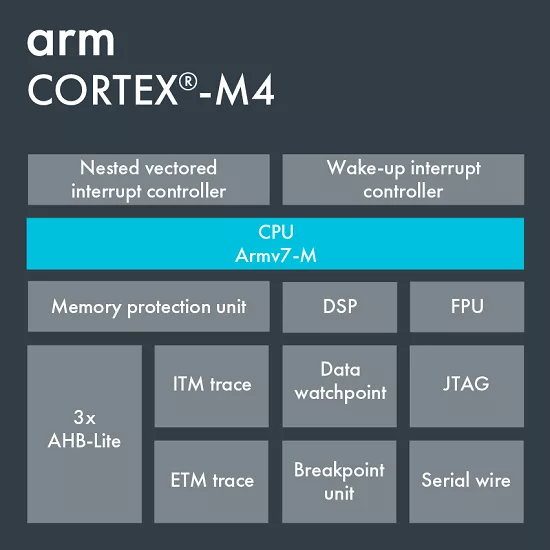
  • SIMD, saturating arithmetic, fast MAC - Powerful instruction set for accelerating DSP applications, built right into the processor. A highly optimised DSP library built using these instructions is available free-of-charge from the Arm website.
  • Powerful debug and non-obtrusive real-time trace - Comprehensive debug and trace features dramatically improve developer productivity. It is extremely efficient to develop embedded software with proper debug.
  • Memory Protection Unit (MPU) - Software reliability improves when each module is allowed access only to specific areas of memory required for it to operate. This protection prevents unexpected access that may overwrite critical data.
  • Integrated nested vectored interrupt controller (NVIC) - There is no need for a standalone external interrupt controller. Interrupt handling is taken care of by the NVIC removing the complexity of managing interrupts manually via the processor.
  • Thumb-2 code density - On average, the mix between 16bit and 32bit instructions yields better code density when compared to 8bit and 16bit architectures. This has significant advantages in terms of reduced memory requirements and maximizing the usage of precious on-chip Flash memory.

Block Diagram

Benefits

  • Gain the advantages of a microcontroller with integrated DSP, SIMD, and MAC instructions that simplify overall system design, software development and debug.
  • Accelerate single precision floating-point operations up to ten times over the equivalent integer software library with the optional Floating-Point Unit (FPU).
  • Develop solutions for a large variety of markets with a full-featured Armv7-M instruction set that has been proven across a broad set of embedded applications.
  • Achieve exceptional 32-bit performance with low dynamic power, delivering leading system energy efficiency due to integrated software controlled sleep modes, extensive clock gating and optional state retention.

Applications

  • Sensor fusion and wearables
  • IoT
  • Signal processing such as power and motor control
  • Audio
  • Connectivity
  • Smart home/enterprise/building/planet

Specifications

Identity

Part Number
Arm Cortex-M4
Vendor
Arm Ltd.
Type
Silicon IP

Compute

CPU Architecture
ARM

Files

Note: some files may require an NDA depending on provider policy.

Provider

HQ: Great Britain

Learn more about CPU IP core

Announcing Arm AGI CPU: The silicon foundation for the agentic AI cloud era

For the first time in our more than 35-year history, Arm is delivering its own silicon products – extending the Arm Neoverse platform beyond IP and Arm Compute Subsystems (CSS) to give customers greater choice in how they deploy Arm compute – from building custom silicon to integrating platform-level solutions or deploying Arm-designed processors.

Top 5 Reasons why CPU is the Best Processor for AI Inference

Advanced artificial intelligence (AI), like generative AI, is enhancing all our smart devices. However, a common misconception is that these AI workloads can only be processed in the cloud and data center. In fact, the majority of AI inference workloads, which are cheaper and faster to run than training, can be processed at the edge – on the actual devices.

Frequently asked questions about CPU IP cores

What is Arm Cortex-M4?

Arm Cortex-M4 is a CPU IP core from Arm Ltd. listed on Semi IP Hub.

How should engineers evaluate this CPU?

Engineers should review the overview, key features, supported foundries and nodes, maturity, deliverables, and provider information before shortlisting this CPU IP.

Can this semiconductor IP be compared with similar products?

Yes. Buyers can compare this product with similar semiconductor IP cores or IP families based on category, provider, process options, and structured technical specifications.

×
Semiconductor IP