Vendor: Roa Logic BV Category: Network-On-Chip

AHB-Lite Multilayer Switch

The Roa Logic AHB-Lite Multi-layer Interconnect is a fully parameterized High Performance, Low Latency Interconnect Fabric soft I…

Overview

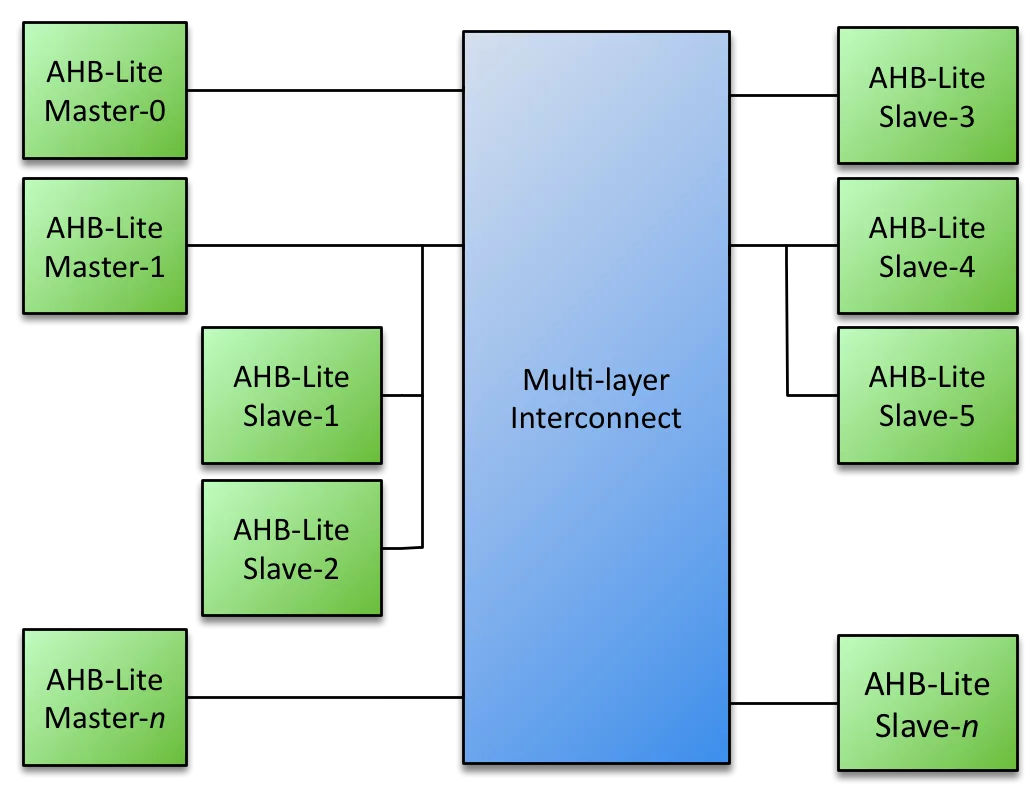
The Roa Logic AHB-Lite Multi-layer Interconnect is a fully parameterized High Performance, Low Latency Interconnect Fabric soft IP for AHB-Lite. It allows a virtually unlimited number of AHB-Lite Bus Masters and Slaves to be connected without the need of bus arbitration to be implemented by the Bus Masters. Instead, Slave Side Arbitration is implemented for each Slave Port within the core.

The Multi-layer Interconnect supports Priority and Round-Robin based arbitration when multiple Bus Masters request access to the same Slave Port. Typically arbitration completes within 1 clock cycle

Key features

  • AMBA AHB-Lite Compatible
  • Fully parameterized
  • Unlimited number of Bus Masters and Slaves
  • Slave side arbitration
  • Priority and Round-Robin based arbitration
  • Slave Port address decoding

Block Diagram

What’s Included?

  • Full Source Code
  • Testbenches
  • Compilation Scripts
  • Documentation

Specifications

Identity

Part Number
AHB-Lite Multilayer Switch
Vendor
Roa Logic BV
Type
Silicon IP

Files

Note: some files may require an NDA depending on provider policy.

Provider

Roa Logic BV
HQ: The Netherlands
Roa Logic BV specialises in the development of Intellectual Property Cores for FPGA and ASIC, with a strong focus on the embedded market. It provides the IP required to build a complete embedded solution, including processors, peripherals, memory, and interfaces.

Learn more about Network-On-Chip IP core

Secure Multi-Path Routing with All-or-Nothing Transform for Network-on-Chip Architectures

Ensuring Network-on-Chip (NoC) security is crucial to design trustworthy NoC-based System-on-Chip (SoC) architectures. While there are various threats that exploit on-chip communication vulnerabilities, eavesdropping attacks via malicious nodes are among the most common and stealthy. Although encryption can secure packets for confidentiality, it may introduce unacceptable overhead for resource-constrained SoCs.

Why verification matters in network-on-chip (NoC) design

In this article, we will dive deeper into a comprehensive methodology for formally verifying an NoC, showcasing the approaches and techniques that ensure our NoC designs are robust, efficient, and ready to meet the challenges of modern computing environments.

SoC design: When a network-on-chip meets cache coherency

Many people have heard the term cache coherency without fully understanding the considerations in the context of system-on-chip (SoC) devices, especially those using a network-on-chip (NoC). To understand the issues at hand, it’s first necessary to understand the role of cache in the memory hierarchy.

Accelerating RISC-V development with network-on-chip IP

In the world of system-on-chip (SoC) devices, architects encounter many options when configuring the processor subsystem. Choices range from single processor cores to clusters to multiple core clusters that are predominantly heterogeneous but occasionally homogeneous.

Network-on-chip (NoC) interconnect topologies explained

Today’s complex system-on-chip (SoC) designs can contain between tens to hundreds of IP blocks. Each IP block may have its own data width and clock frequency and employ one of the standard SoC interface protocols: OCP, APB, AHB, AXI, STBus, and DTL. Connecting all these IPs is a significant challenge.

Frequently asked questions about NoC IP cores

What is AHB-Lite Multilayer Switch?

AHB-Lite Multilayer Switch is a Network-On-Chip IP core from Roa Logic BV listed on Semi IP Hub.

How should engineers evaluate this Network-On-Chip?

Engineers should review the overview, key features, supported foundries and nodes, maturity, deliverables, and provider information before shortlisting this Network-On-Chip IP.

Can this semiconductor IP be compared with similar products?

Yes. Buyers can compare this product with similar semiconductor IP cores or IP families based on category, provider, process options, and structured technical specifications.

×
Semiconductor IP