ZLG Selects CAST CAN XL and TSN IP for Next-Generation Vehicle-Network Development and Test Tools
Standards-compliant IP supports CAN XL tools and deterministic Ethernet switches for OEM R&D, production, and testing
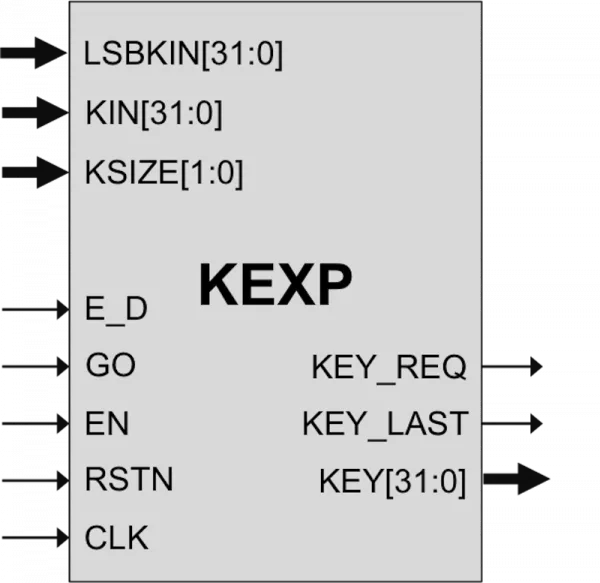
The KEXP IP core performs AES key expansion, and is an option for the AES, AES-P, AES-CCM and AES-GCM cores.
The KEXP IP core performs AES key expansion, and is an option for the AES, AES-P, AES-CCM and AES-GCM cores. It processes 128-bit blocks, and is programmable for 128-, 192-, and 256-bit key lengths.
Two architectural versions are available to suit system requirements. The Standard version (KEXP-P) is more compact and is used with AES cores using a 32-bit datapath. The Fast version (KEXP-F) achieves higher throughput in conjunction with AES cores using a 128-bit datapath.
The KEXP core is a fully synchronous design and has been evaluated in a variety of technologies, and is available optimized for ASICs or FPGAs.
Note: some files may require an NDA depending on provider policy.

AES Key Expander is a Symmetric Crypto IP core from CAST listed on Semi IP Hub.
Engineers should review the overview, key features, supported foundries and nodes, maturity, deliverables, and provider information before shortlisting this Symmetric Crypto IP.
Yes. Buyers can compare this product with similar semiconductor IP cores or IP families based on category, provider, process options, and structured technical specifications.