aTENNuate: Optimized Real-time Speech Enhancement with Deep SSMs on RawAudio
By Yan Ru Pei, Ritik Shrivastava, FNU Sidharth (BrainChip)
Abstract
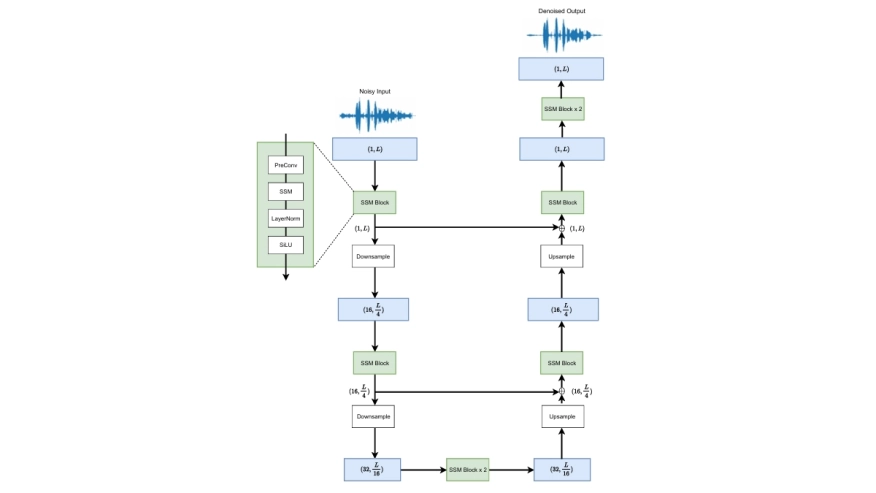
We present aTENNuate, a simple deep state-space autoencoder configured for efficient online raw speech enhancement in an end-to-end fashion. The network’s performance is primarily evaluated on raw speech denoising, with additional assessments on tasks such as super-resolution and de-quantization. We benchmark aTENNuate on the VoiceBank + DEMAND and the Microsoft DNS1 synthetic test sets. The network outperforms previous real-time denoising models in terms of PESQ score, parameter count, MACs, and latency. Even as a raw waveform processing model, the model maintains high fidelity to the clean signal with minimal audible artifacts. In addition, the model remains performant even when the noisy input is compressed down to 4000Hz and 4 bits, suggesting general speech enhancement capabilities in low-resource environments.
keywords: state-space models, autoencoder, denoising, super-resolution, de-quantization
To read the full article, click here
Related Semiconductor IP
- Neuromorphic Processor IP (Second Generation)
- Neuromorphic Processor IP
- Neuromorphic Processor IP
- Ultra low power inference engine
- NASP PPG IP Block
Related Articles
- ASIC Implementation of a Speech Detector IP-Core for Real-Time Speaker Verification
- A Realtime 1080P30 H.264 Encoder System on a Zynq Device
- Understanding the Deployment of Deep Learning algorithms on Embedded Platforms
- Real-Time ESD Monitoring and Control in Semiconductor Manufacturing Environments With Silicon Chip of ESD Event Detection
Latest Articles
- PULSAR-V: I/O-Aware Post-Update Attestation for RISC-V
- PVTSizing 2.0: A Fast and Reliable Analog Circuit Sizing Operator for Agentic EDA Workflows
- An Agentic Python Framework for LLM-Driven UVM Testbench Synthesis with Closed-Loop Compiler Feedback
- Reconfiguring System-Level Protection Through Bounded Delegation in RISC-V MCUs
- SkipLane: Write-Once, Conflict-Free Accumulation for Zero-Skipping CNN Engines on FPGAs