Fault Tolerant Design of IGZO-based Binary Search ADCs
By Paula Carolina Lozano Duarte 1, Sule Ozev 2, Mehdi Tahoori 1
1 Karlsruhe Institute of Technology, Karlsruhe, Germany
2 Arizona State University Tempe, USA
Abstract
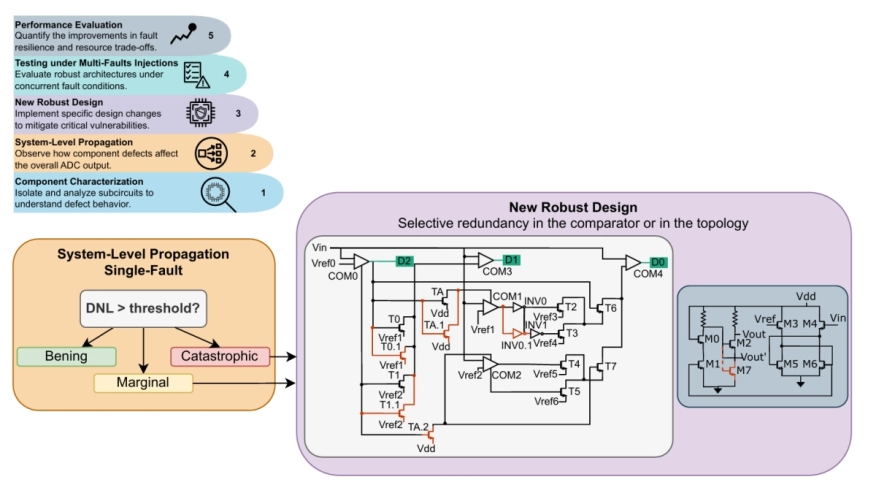
Thin-film technologies such as Indium Gallium Zinc Oxide (IGZO) enable Flexible Electronics (FE) for emerging applications in wearable sensing, personal health monitoring, and large-area systems. Analog-to-digital converters (ADCs) serve as critical sensor interfaces in these systems. Yet, their vulnerability to manufacturing defects remains poorly understood despite unipolar technologies' inherently high defect densities and process variations compared to mature CMOS technologies. We present a hierarchical fault injection framework to characterize defect sensitivity in Binary Search ADCs implemented in n-type only technologies. Our methodology combines transistor-level defect characterization with system-level fault propagation analysis, enabling efficient exploration of both single and multiple fault scenarios across the conversion hierarchy. The framework identifies critical fault-sensitive circuit components and enables selective redundancy strategies targeting only the most sensitive components. The resulting defect-tolerant designs improve fault coverage from 60% to 92% under single-fault injections and from 34% to 77.6% under multi-fault injection, while incurring only 4.2% area overhead and 6% power increase. While validated on IGZO-TFTs, the methodology applies to all emerging unipolar technologies.
Index Terms — Flexible Electronics, IGZO-TFT, Fault Injection, Binary Search ADC, Defect-Tolerant Design, Hierarchical Simulation.
To read the full article, click here
Related Semiconductor IP
- PVT sensor integrated SAR ADC in 12nm
- 12bit 500Msps High Speed General Purpose SAR ADC IP Core
- 12bit 4Gsps SAR General Purpose ADC IP Core
- 16bit 5Msps SAR General Purpose ADC IP Core
- 24-bit 320kHz Bandwidth ADC IP
Related Articles
- An Implementation Study on Fault Tolerant LEON-3 Processor System
- An Outline of the Semiconductor Chip Design Flow
- Understanding the Importance of Prerequisites in the VLSI Physical Design Stage
- Importance of VLSI Design Verification and its Methodologies
Latest Articles
- RFChipAgent: Multi-Agentic AI Flow for Analog/RF Chip Design
- Anechoic: Onsager-Corrected Parallel Annealing for Sub-0.1 ms Dense Max-Cut on an FPGA
- Power, Performance, and Area of HPC-Based Malware Detectors: An FPGA and Open-PDK ASIC Study
- Terracotta: Enabling the Adoption of New DRAM Techniques via a Flexible DRAM Interface and Memory Controller
- A Framework for Accelerating Transformer Inference on RISC-V for Edge AI