Synopsys Advances Agentic AI Chip Design with AMD and Microsoft
Introduces Industry's First Autonomous EDA Workflows on Microsoft Discovery to Accelerate Engineering from Specification to Silicon
- Synopsys is advancing an open, interoperable agentic AI stack for autonomous workflows across the chip design lifecycle.
- Introducing two new agentic EDA workflows, developed in collaboration with Microsoft and used by AMD, available for evaluation on Microsoft Discovery to accelerate chip design.
- Fully-autonomous debug closure workflow initial results demonstrate up to 40% reduction in cycle time
SUNNYVALE, Calif., July 27, 2026 -- Synopsys, Inc. (NASDAQ: SNPS) announced new autonomous agentic AI workflows for chip design, developed in collaboration with Microsoft and available for evaluation on Microsoft Discovery. AI is fundamentally reshaping engineering, and Synopsys is building a comprehensive, open agentic AI stack to increase engineering autonomy and accelerate product design from silicon to systems. This week at the 2026 DAC Chips to Systems Conference, Synopsys is showcasing new fully autonomous workflows powered by AgentEngineer™ technology, extending agentic AI from task automation to long-running engineering execution.
This includes Synopsys autonomous workflows on Microsoft Discovery:
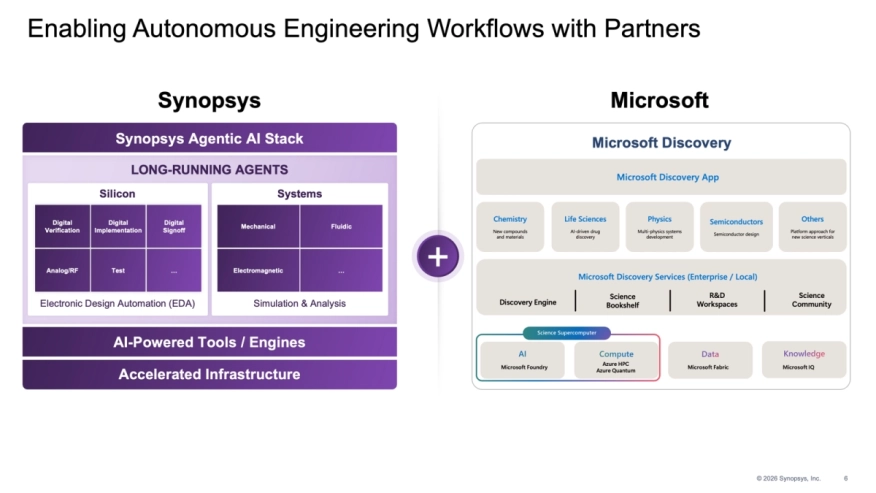 Synopsys fully-autonomous debug closure workflow: A fully autonomous AI-powered verification and root cause analysis (RCA) workflow orchestrated with Microsoft Discovery, brings together domain-specific and task-level agents to identify design failures, automate debug tasks, and accelerate validation— helping engineering teams resolve issues faster and improve silicon quality. Early evaluations show reductions of 25–40% in debug cycle time, saving many weeks of engineering efforts and improving productivity.
- Synopsys fully-autonomous implementation and closure workflow: An autonomous workflow leveraging Synopsys implementation agents and Fusion Compiler on Azure brings together domain-specific and task-level agents to automate implementation quality-of-results (QoR) tuning and closure. Initial results demonstrate improved QoR.
Synopsys, AMD, and Microsoft are enabling AI-powered design workflows that combine large-scale reasoning, domain expertise, and cloud-scale compute to accelerate the development of the next generation of AI infrastructure silicon. Today's milestone builds on the existing collaboration and previously announced agentic specification to RTL workflow, marking the first EDA applications available for evaluation on Microsoft Discovery. Customers can request evaluation access through Synopsys. AMD is actively evaluating the application of autonomous workflows to accelerate the development of their next-generation products.
"AI is reshaping engineering. Together with Microsoft and Synopsys, we're enabling a new generation of AI-assisted design workflows that augment human ingenuity with intelligent automation and optimization," said Alex Starr, AMD Corporate Fellow. "AI driven workflows powered by Discovery and leveraging AI tooling, such as RCA with deep EDA domain knowledge, are a paradigm we see accelerating scaling and deployment, helping improve both design velocity and overall silicon quality."
"We designed Microsoft Discovery to accelerate scientific and engineering innovation with AI, and chip design is an ideal application for Discovery as it addresses one of the most complex engineering challenges on the planet," said Aseem Datar, Corporate Vice President (CVP) of Product Innovation for Microsoft Discovery and Quantum. "We are excited about Synopsys' open, interoperable approach to their agentic platform and the collaborative effort with Synopsys and AMD to make these agentic AI EDA workflows the first available on Discovery."
"As AI-powered systems and hyperscale computing push silicon complexity to unprecedented levels, engineering teams can no longer afford traditional tradeoffs between performance, quality, and development speed," said Ravi Subramanian, Chief Product Management Officer, Synopsys. "Synopsys is addressing this challenge by applying AI capabilities with increasing levels of autonomy to accelerate and transform silicon engineering."
Join Synopsys at the 2026 DAC Chips to Systems Conference
This week at DAC, Synopsys is showcasing AI-powered engineering solutions that enable customers to rapidly design from silicon to system with increased quality, efficiency, precision, and scale. Attendees can visit Synopsys' booth #631 for demonstrations of newly announced autonomous workflows. For a complete list of Synopsys sessions and activities at DAC 2026, visit the Synopsys DAC 2026 event page.
About Synopsys
Synopsys, Inc. (Nasdaq: SNPS) is the leader in engineering solutions from silicon to systems, enabling customers to rapidly innovate AI-powered products. We deliver industry-leading silicon design, IP, simulation and analysis solutions, and design services. We partner closely with our customers across a wide range of industries to maximize their R&D capability and productivity, powering innovation today that ignites the ingenuity of tomorrow. Learn more at www.synopsys.com.
Related Semiconductor IP
- UMC 55nm ULP 3.3V Temperature Sensor
- High-Throughput Multi-Channel DMA Controller
- Configurable Multi-Channel DMA Controller
- Fixed-Channel Multi-Channel DMA Controller
- Verification IP for MIPI SoundWire
Related News
- Synopsys and TSMC Partner to Accelerate AI Systems Innovation with Agentic AI and Advanced Design
- Rambus and ChipAgents Collaborate to Accelerate Chip Design with Agentic AI
- ChipAgents Raises $74M to Scale an Agentic AI Platform to Accelerate Chip Design
- Startup Ricursive to Create an End-to-End AI Model for Chip Design
Latest News
- Alliance for Open Media Sees Rapid AV2 Adoption Across the Video Ecosystem Just Four Months After Release
- Rambus and ChipAgents Collaborate to Accelerate Chip Design with Agentic AI
- Server CPU Shipments Projected to Grow Over 40% YoY in 2027, with Arm-Based Products Continuing to Gain Market Share
- UMC and AP Memory Collaborate to Enable Advanced Power Delivery Solutions for AI and HPC Systems
- Cadence AI Super Agents Enable Nokia to Accelerate Electronic System Design on Millennium M2000 Supercomputer