«Made in Germany» Security Chip Serves as a Root of Trust for Connected Devices
July 06, 2026 -- With the RISC-V Secure Element, the Fraunhofer Institutes for Integrated Circuits IIS, for Applied and Integrated Security AISEC, and for Electronic Microsystems and Solid State Technologies EMFT are introducing a security chip that was designed and manufactured in Germany. The design is based on transparent open-source hardware, integrates post-quantum cryptography, and can be used as a standalone chip or as a system-on-chip component. The goal is to offer companies a trustworthy and customizable trust anchor – with points of contact in the EU – for connected devices and to support them in meeting the requirements of the European Cyber Resilience Act (CRA).

The Fraunhofer RISC-V Secure Element is based on the open hardware design OpenTitan. The widespread accessibility of such open-source hardware builds trust and ensures long-term, secure access to the technology.
Building on this foundation of trust, the participating Fraunhofer Institutes have developed a chip manufactured using the GlobalFoundries 22 nm FDSOI technology in Dresden. Developing and manufacturing the chip in Germany ensures technological sovereignty and transparency across the entire value chain. »Transparency is particularly important when it comes to security. Our goal was therefore to build a chip from publicly available hardware that is designed and manufactured in Germany, in order to ensure end-to-end transparency,« says Andreas Seelos-Zankl, project manager at Fraunhofer AISEC.
Customizable security for many device classes
Another advantage is adaptability: Through close cooperation with the chip manufacturer GlobalFoundries, based in Dresden, variants with specialized accelerators, interfaces, or additional security features can be produced even in small and medium quantities or integrated as a customer-specific root of trust into a larger system-on-chip. This is a key differentiator of the Fraunhofer RISC-V Secure Element: »For large chip manufacturers, it is not economically viable to produce chip variants in small quantities. We can make the necessary customizations and thus enable companies to produce even smaller quantities,« explains Andreas Seelos-Zankl.
In the long term, the Fraunhofer RISC-V Secure Element is intended to help ensure that trusted hardware is integrated into significantly more everyday and industrial devices. To achieve this, the participating Fraunhofer Institutes are continuing their work on developing subsequent chip variants. Dr. Augusto Wankler Hoppe, technical project manager at Fraunhofer IIS, sums up why it is so important to embed security directly into the hardware: »Cybersecurity cannot be added as an afterthought. It must be embedded in the silicon from the very beginning. With our RISC-V Secure Element, we have developed an European hardware root of trust that is capable of withstanding both today’s attacks and the demands of the postquantum era, as well as regulatory requirements such as the Cyber Resilience Act.«
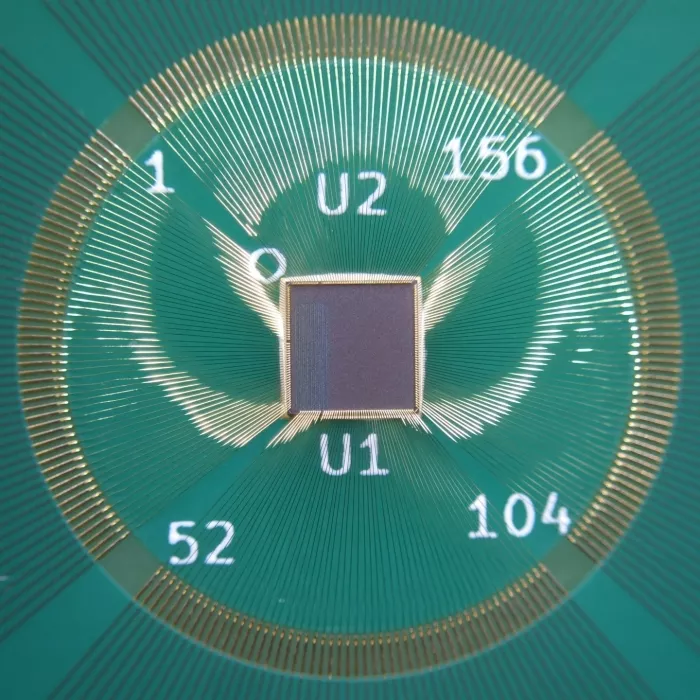
Bonded Chip: The RISC-V Secure Element is mounted on a substrate and electrically connected to it via bond wires.
Combined expertise of the Fraunhofer Institutes IIS, AISEC, and EMFT
Fraunhofer IIS is responsible for the design and implementation of the RISC-V Secure Element within the project. In addition, the institute oversees the entire development process, from architecture and chip design through prototyping and integration to preparation for regulatory requirements.
Fraunhofer AISEC is contributing its many years of research on post-quantum cryptography to the project by implementing and accelerating the algorithms for the Secure Element in hardware in such a way that operations remain in the millisecond range and are practical despite limited computing power. Fraunhofer AISEC’s cybersecurity expertise is also incorporated into all design phases as well as into the security analysis and verification of the Secure Element. Whether open-source hardware can withstand physical attacks and is truly secure can only be determined through laboratory testing. Fraunhofer AISEC will therefore evaluate the physical resilience of the RISC-V Secure Element in its Common Criteria (CC) EAL7 certified hardware security laboratory. Various methods will be used, including side-channel analysis, fault-based attacks, and optical analysis. As a key security testing partner in the OpenTitan project, Fraunhofer AISEC possesses specialized expertise in this area.
In addition, the functionality of the RISC-V Secure Element at the process level is also being thoroughly tested using reverse-engineering analysis methods in the Fraunhofer EMFT’s CC EAL6 certified security laboratory. The methods used include optical and infrared microscopy, as well as a specially developed chip-scanning technique using scanning electron microscopy. These methods achieve resolutions in the nanometer range and make even the smallest structures of the RISC-V Secure Element clearly visible.
Glossary
- Secure element: A hardware component in electronic devices that securely stores sensitive data and security-critical applications and protects them from unauthorized access.
- Open‑Source hardware: Hardware designs whose schematics are publicly available and can be reviewed, used, and modified by third parties.
- Post-quantum cryptography: Cryptographic methods designed to withstand attacks by future quantum computers.
- Cyber Resilience Act: An EU regulation that imposes binding requirements on manufacturers of connected products regarding IT security and the verification of compliance.
- A Hardware-Root-of-Trust (HRoT) is the unchanging, physical security foundation of a computer system.
Fact box: Fraunhofer OpenTitan-based RISC‑V Secure Element
- Participating institutes:
Fraunhofer IIS,
Fraunhofer AISEC,
Fraunhofer EMFT
- Project website with product sheet:
Fraunhofer RISC-V Secure Element
- Participating centers of excellence:
Trusted Electronics Bayern Center (TrEB),
Bayerisches Chipdesign Center (BCDC)
The Fraunhofer Institute for Applied and Integrated Security AISEC is considered one of the world-leading institutions for applied research in cybersecurity. Around 230 highly qualified researchers develop customized security concepts and solutions for commercial businesses and the public sector, boosting the overall competitiveness of clients and partners. Fraunhofer AISEC designs solutions for enhanced data security and effective defense against cybercrimes such as corporate espionage and tampering attacks. The institute's portfolio ranges from embedded and hardware security, automotive and mobile security to security solutions for industry and automation. In addition, the cutting-edge test labs at Fraunhofer AISEC allow for evaluating the security of networked and embedded systems, hardware and software products as well as cloud and web-based services.
As the largest Fraunhofer Institute, Fraunhofer for Integrated Circuits IIS, headquartered in Erlangen, is a global leader in applied research, driving innovation for transformative products and services that shape the digital future. Across seven research divisions, the institute develops forward-thinking solutions that drive technological progress for its national and international partners and clients. Boosting economic competitiveness and contributing to a sustainable future for society – these are the goals by which the institute defines its success. Its strong performance is built on four core areas of expertise: artificial intelligence, microelectronics, data acquisition and analysis, as well as signal processing and data transmission. These competencies are strategically combined to deliver customized solutions for its clients. Fraunhofer IIS gained international recognition for developing the mp3 format. Founded in 1985, the institute employs more than 1,200 people across 12 cities.
Fraunhofer EMFT is focused on applied research in the field of sensor and actuator systems. The approximately 200 employees at the Munich, Oberpfaffenhofen and Regensburg locations bring years of experience and extensive expertise in microelectronics and microsystems technology. Combined with a state-of-the-art technology park for micro- and nanotechnologies, this provides the foundation for cutting-edge research and application-oriented developments in fields such as trusted electronics, quantum technologies and intelligent medical technology. Through this work, the institute contributes to addressing key technologies and strengthening the international competitiveness of Germany and Europe. A particular strength of the institute is the interdisciplinary synergy of its expertise: developments across the full system chain create solutions that enable the effective transfer of research findings into industrial applications. Fraunhofer EMFT is established in Bavaria, Germany, and Europe as a partner for application-oriented research and technology development. It combines scientific excellence with industrial application, thereby contributing to a resilient society.
Related Semiconductor IP
- RISC-V Debug & Trace IP
- RISC-V IOPMP IP
- Gen#2 of 64-bit RISC-V core with out-of-order pipeline based complex
- 64-bit RISC-V core with in-order single issue pipeline. Tiny Linux-capable processor for IoT applications.
- Multi-core capable RISC-V processor with vector extensions
Related News
- Fraunhofer RISC-V Secure Element Accelerates Secure Chip Development After Successful Silicon Validation
- Fraunhofer IIS audio codecs integrated in MIPS Consumer Audio Platform
- Kenwood, Fraunhofer IIS, and STMicroelectronics Demonstrate Prototype of a Digital Radio Mondiale(TM) Receiver
- Frontier Silicon partners with other industry leaders to deliver world's first range of DAB+ radios
Latest News
- Codebat Publishes Development Timeline for Its NIST CAVP-Validated ML-DSA Hardware Engine
- Socionext Expands Agentic AI to Advanced, Large-Scale SoC Physical Design
- MIPI Alliance Announces Board Leadership Appointments
- Qualcomm Wins Key Claims Against Arm, but Damages Total Just $2
- Tenstorrent Announces a $1.5B Series E at a $6.2B valuation