JEDEC® Publishes First Industry-Wide Silicon Photonics Reliability Standard for AI, Datacenter and Telecom Infrastructure
ARLINGTON, Va.-- October 1, 2026 -- JEDEC Solid State Technology Association today announced the release of JESD264: Silicon Photonics Qualification and Reliability Requirements, the first industry-wide standard designed to bring consistent qualification and reliability practices to silicon photonics devices. By establishing a common baseline for testing and manufacturing controls, the standard helps reduce deployment risk and supports broader adoption of silicon photonics in high-speed datacenter, telecommunications and AI networks. Download JESD264 from the JEDEC website.
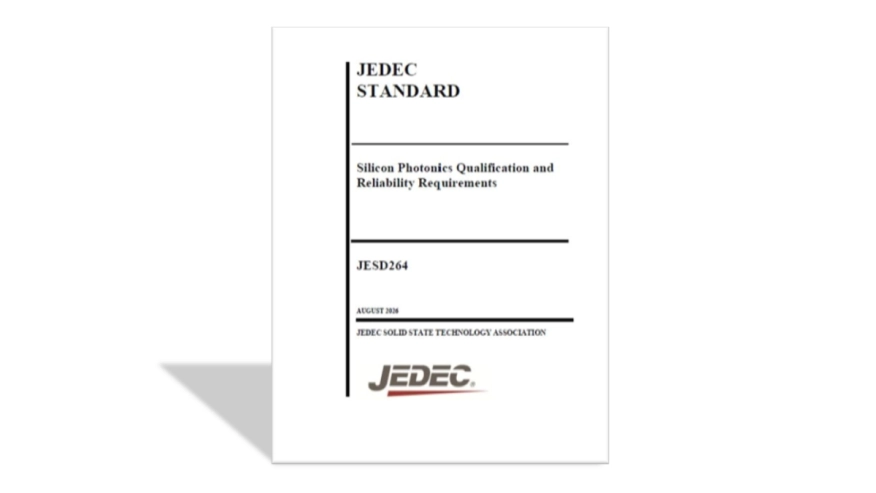 Silicon photonics (SiPh) technology is transforming high-speed connectivity by integrating optical and electrical functions on a single chip. As the technology has moved from research environments into large-scale deployment across datacenter and telecommunications networks, the need for consistent reliability and qualification practices has grown. Unlike traditional CMOS technologies, silicon photonics has lacked a standardized, industry-wide framework for reliability ownership and validation, leading to uncertainty across the supply chain.
JESD264 addresses these challenges by offering a unified framework for qualification and reliability testing across the silicon photonics ecosystem. The standard will help manufacturers, integrators and end users reduce deployment risk while supporting the integration of complex photonic chipsets that include lasers, modulators, photodiodes and passive optical structures. It also establishes clearer reliability responsibilities among foundries, OSATs (Outsourced Semiconductor Assembly and Test) and system developers, helping improve consistency throughout the silicon photonics ecosystem.
Key Features of JESD264:
- Comprehensive reliability protocols for SiPh dies and integrated chipsets.
- Guidelines for component-level qualification, including modulators, photodiodes, and waveguides.
- Clear requirements for assembly processes and laser integration.
- Manufacturing process control and traceability expectations.
Mian Quddus, Chairman of the JEDEC Board of Directors, said: "As AI, cloud computing and high-speed communications continue to drive demand for greater bandwidth and performance, industry standards become increasingly important. JESD264 helps establish the reliability foundation needed for broader silicon photonics adoption, accelerating innovation and strengthening alignment across the industry."
About JEDEC
JEDEC is the global leader in the development of standards for the microelectronics industry. Thousands of volunteers representing nearly 400 member companies work together with more than 100 JEDEC technical committees and task groups to meet the needs of every segment of the industry, manufacturers and consumers alike. The publications and standards generated by JEDEC committees are accepted throughout the world. All JEDEC standards are available for download from the JEDEC website. For more information, visit www.jedec.org.
Related Semiconductor IP
- nQrux® Root of Trust IP
- AXI to UCIe Bridge IP
- UCIe 2.x Controller IP
- SWI3S (SoundWire I3S Interface) Peripheral Controller Core IP
- OpenTitan-based RISC-V Secure Element
Related News
- JEDEC Publishes Update to LPDDR5 Standard for Low Power Memory Devices
- JEDEC Publishes Update to Universal Flash Storage (UFS) Standard
- JEDEC Publishes New DDR5 Standard for Advancing Next-Generation High Performance Computing Systems
- JEDEC Advances Universal Flash Storage (UFS) Removable Card Standard 3.0
Latest News
- Year-to-Date Global Semiconductor Sales Top $1 Trillion Through August
- Xiphera launches nQrux® Root of Trust with Post-Quantum Cryptography
- Skyechip Joins Rapidus Core Ecosystem, Bringing Advanced Silicon IP For AI and HPC to Japan's 2nm Platform
- GUC Monthly Sales Report – September 2026
- Rapidus Unveils “Rapidus CORE”, New Global Ecosystem Framework Supporting the Development and Mass Production of Cutting-Edge Semiconductors