CHERI-Mocha memory-safe compute subsystem is now open
The first open-source implementation of a CHERI-based, Linux-capable compute subsystem enables the evaluation of advanced memory safety based on hardware capabilities
CAMBRIDGE, UK – 26 March, 2026 – lowRISC® is pleased to announce open access to the initial release of the CHERI-Mocha secure enclave design in an open repository. This first major milestone of CHERI-Mocha implements a memory safe 64-bit compute system based on the Linux-capable CVA6-CHERI processor and peripherals. It provides an ideal platform to completely assess CHERI in an OS environment, as well as a reference design for future memory safe SoCs.
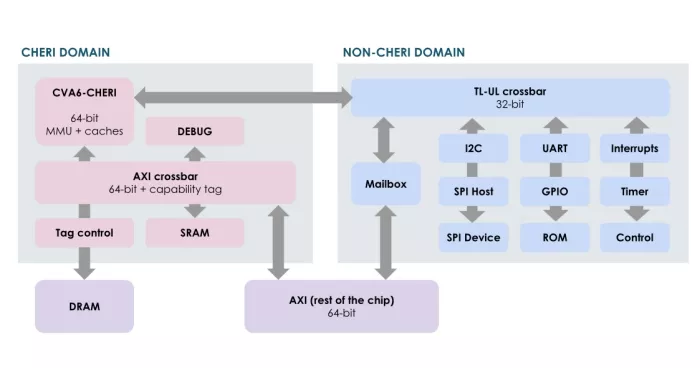
CHERI-Mocha is the main deliverable from the COSMIC project, a collaboration with Capabilities Limited backed by the UK Department for Science, Innovation and Technology (DSIT) and InnovateUK. It is released under an Apache 2.0 license to enable its broadest possible adoption.
The CHERI-Mocha repository is on github.com/lowRISC/mocha. It includes the RTL, continuous integration and regression testing systems, and a verification dashboard that shows the verification state of each of its components. Documentation and demo software are provided to run the design on RTL simulators or the FPGA-based Genesys 2 board.
With the COSMIC project being funded until 2028, its CHERI-Mocha design still has features to be added, and significant effort is still required to complete the design, formal verification and performance optimizations. From now on, this work will continue in the open repository.
“The availability of open silicon designs is critical to enable technology evaluation and deployment,” said Javier Orensanz Martinez, CEO at lowRISC. “CHERI is a fantastic technology for software compartmentalization and memory safety, and we are confident that access to CHERI-Mocha will foster its adoption in future SoCs.”
“Application-class systems capable of running rich operating systems like Linux, are now ubiquitous, and they face incredible pressure from cyber attackers,” said Mike Eftimakis, founding director of the CHERI Alliance. “Every day, new vulnerabilities are discovered in complex OSes, and CHERI could prevent most of them. Providing an open reference design helps SoC design teams worldwide easily integrate CHERI into their system. This approach is a powerful driver for the technology’s adoption, and ultimately leads to safer, more secure devices.”
We are looking for partners to take CVA6-CHERI or CHERI-Mocha to silicon production. If you are interested, please reach out to us: info@lowrisc.org.
Related Semiconductor IP
- nQrux® Root of Trust IP
- AXI to UCIe Bridge IP
- UCIe 2.x Controller IP
- SWI3S (SoundWire I3S Interface) Peripheral Controller Core IP
- OpenTitan-based RISC-V Secure Element
Related News
- Alphawave Semi Unlocks 1.2 TBps Connectivity for High-Performance Compute and AI Infrastructure with 9.2 Gbps HBM3E Subsystem
- CAST Introduces H.264 Video Over IP Subsystem to Simplify Video Streaming Product Development
- Uniquify to Demonstrate World's Fastest DDR Memory Subsystem IP at DesignCon
- Recore Systems releases a many-core processor subsystem IP-on-FPGA
Latest News
- JEDEC® Publishes First Industry-Wide Silicon Photonics Reliability Standard for AI, Datacenter and Telecom Infrastructure
- Orthogone Technologies Launches Ultra-Low-Latency FPGA IP Portfolio for Multi-Industry Deterministic Networking
- TIER IV joins Arm Total Design for Physical AI to accelerate ready-to-use Autoware solutions through Open AD Kit
- SEMIFIVE Signs Turnkey Contract with Mobilint to Develop Robotics AI Chip Under 'K-On-Device AI Semiconductor' Program
- ICTK to Acquire Network Security Firm withnetworks, Expanding from Security Chips into Global Enterprise Security Solutions