CEA-Leti Builds Fully Integrated Bio-Inspired Neural Network with RRAM-Based Synapses & Analogue Spiking Neurons
Functionality of Circuit Presented at IEDM 2019 Was Demonstrated With Handwritten Digits Classification on a Tablet Screen
SAN FRANCISCO – Dec. 13, 2019 – Leti, a technology research institute of CEA Tech, has fabricated a fully integrated bio-inspired neural network, combining resistive-RAM-based synapses and analog spiking neurons. The functionality of this proof-of-concept circuit was demonstrated thanks to handwritten digits classification.
Resistive-RAM (RRAM) is a type of non-volatile random-access computer memory that works by changing the resistance across a dielectric solid-state material.
The research work presented at IEDM 2019 measured a 5x reduction in energy use compared to an equivalent chip using formal coding. The neural network implementation is made such that synapses are placed close to neurons, which enables direct synaptic current integration.
"The entire network is integrated on-chip," said Alexandre Valentian, lead author of the paper, "Fully Integrated Spiking Neural Network with Analog Neurons and RRAM Synapses". "No part is emulated or replaced by an external circuit, as in some other projects. It even was used in a live demo where users could draw digits with their finger on a tablet and it is classified after conversion into a spike train."
Spiking neural networks, also known as third-generation neural networks, are composed of bio-inspired neurons, which communicate by emitting spikes, discrete events that take place at a point in time, rather than continuous values. These networks promise to further reduce required computational power because they use less complex computing operations, e.g. additions instead of multiplications. They also inherently exploit sparsity of input events, since they are intrinsically event-based.
"To date, demonstrations of RRAM-based SNNs have been limited to system-level simulations calibrated on experimental data," the IEDM paper explains. "In this paper, we present for the first time a complete integration of a SNN combining analog neurons and RRAM synapses."
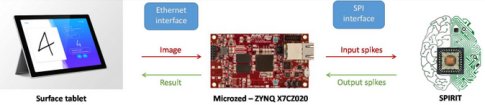
1. Demonstration of live handwritten digits classification
The paper explains that "the test chip, fabricated in 130nm CMOS, shows well-controlled integration of synaptic currents and no RRAM read-disturb issue during inference tasks (at least 750M spikes)."
"Data-centric workloads exhibited by Deep Neural Network (DNN) applications call for circuit architectures where data movement is reduced to a minimum," the paper says. "This has motivated architectures in which memories are spatially located near the computing elements. These memories must be very dense, preferably non-volatile and inserted into the computational dataflow, therefore RRAMs are excellent candidates to this purpose."
The study, which was supported by CEA-List, underscores CEA-Leti's expertise at manufacturing RRAM memories on top of CMOS wafers.
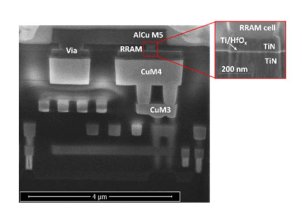
2. SEM cross-section of the RRAM cell monolithically integrated on the top of 130nm CMOS
Related Semiconductor IP
- NPU IP
- JPEG XL Encoder
- I2C Master/Slave Controller Core
- NVMe Validation Test Suite
- Hybrid Memory Cube Verification IP
Related News
- Renesas tapes out spiking neural network chip
- CEA-Leti Paper in Nature Communications Reports First Complete Memristor-Based Bayesian Neural Network Implementation For Real-World Task
- Neurons cast in silicon: AI chip SENNA accelerates spiking neural networks
- CEVA's 2nd Generation Neural Network Software Framework Extends Support for Artificial Intelligence Including Google's TensorFlow
Latest News
- GF unveils roadmap to deliver the world’s most advanced FD-SOI platform for Physical AI
- GlobalFoundries marks Dresden expansion milestone, announces next-generation platform for Physical AI
- TSMC September 2026 Revenue Report
- Lattice Collaborates with Arm to Advance Secure, Adaptable AI Data Center Infrastructure
- ZLG Selects CAST CAN XL and TSN IP for Next-Generation Vehicle-Network Development and Test Tools