Hardware security verification must go beyond functional testing

Imagine you’re an attacker staring at a billion-transistor system-on-chip (SoC). You don’t care whether the design boots Linux, passes simulation, or meets its performance targets. Your objective is far simpler. Find the one flaw nobody thought to look for.
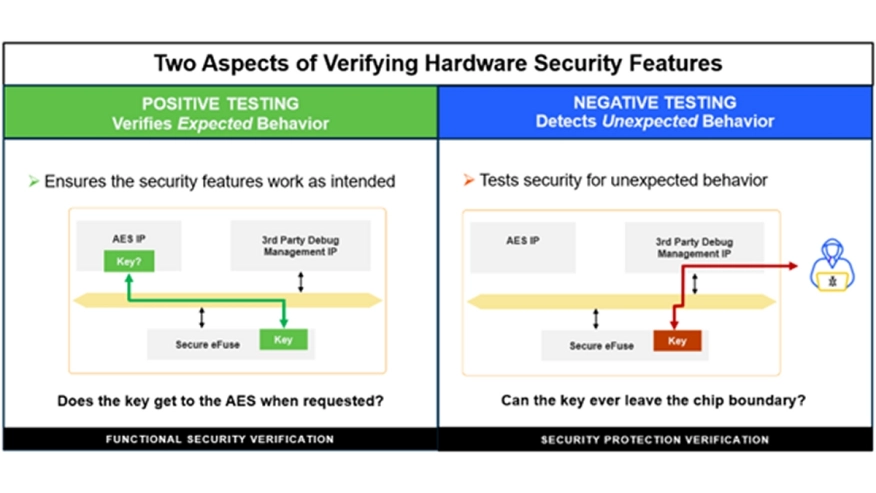 It might be an undocumented debug port or path. Maybe it’s a configuration error between hardware and firmware. Sometimes it’s a perfectly legitimate sequence of operations that exposes sensitive information in a way the original team never anticipated. A single overlooked weakness is all it takes.
Design teams focus on proving that a chip operates according to its intended specifications. Security assurance requires answering a different set of questions to identify the conditions that could violate security objectives. As the above figure illustrates, security verification must test for unexpected data paths that could expose sensitive information, not only confirm that intended paths operate correctly.
Beyond intended behavior
Security verification starts from a different premise. The concern is not whether a protected asset reaches the encryption engine, but whether information associated with that asset can reach an unauthorized destination. A debug interface may unintentionally expose sensitive information, or firmware may fail to clear a memory location after a key has been used. Otherwise, legitimate operations can also interact to create an unexpected path through the system.
Related Semiconductor IP
- UALinkSec Security Module
- ECC Secure Accelerator - High-performance ECC IP with advanced physical security
- 802.11i Wireless Security Cores
- Quantum Safe, ISO 21434 Automotive-grade Programmable Hardware Security Module
- Embedded Hardware Security Module (Root of Trust) - Automotive Grade ISO 26262 ASIL-B
Related Blogs
- Importance Of Hardware Security Verification In Pre-Silicon Design
- Beyond Trusted: What the NSA’s New Guidance Means for Hardware Security
- EDA Must Think Beyond ICs in Automotive Electronics Market, Panel Says
- Best-in-class Security Testing Platform for Side-channel Analysis by Rambus and Riscure
Latest Blogs
- Tape-Out Readiness Checklist: Engineering Decisions That Prevent Costly Respins
- How Cadence DSPs Put In-Cabin AI Audio On-Chip in SemiDrive's X10
- The Fastest Path to Scalable Photonic Systems: Using Proven IP for both PIC and EIC designs
- Building Trusted AI Agents from the Silicon Root of Trust
- Heterogeneous Computing in Space