USB3.1 transceiver IP with PMA and PCS layer
With sophisticated architecture and technology, the USB3.1 transceiver IP with PMA and PCS layer is designed for low power and hi…
Overview
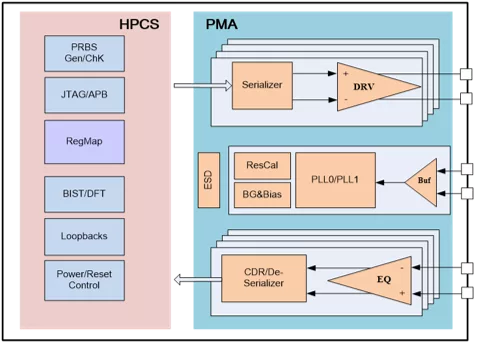
With sophisticated architecture and advanced technology, the USB3.1 transceiver IP with PMA and PCS layer is designed for low power and high performance application. It is highly configurable and can be tightly integrated with the user logic or SOC resources. Data rate for Gen 1 physical layer is 5Gbps, and data rate for Gen 2 physical layer is 10Gbps.
Key features
- Data rate for Gen 1 physical layer is 5Gbps
- Data rate for Gen 2 physical layer is 10Gbps
- 4 Channel per Quad
- Shared high performance LC tank PLL
- Digitally-control-impedance termination resistors
- PLL Frequency Lock detection
- Configurable TX output differential voltage swing
- Built-in TX De-Emphasis
- RX Built-in CTLE and Decision Feedback Equalization
- Support IEEE 1149.1 and 1149.6(AC JTAG) boundary scan
- Built-in self-test(BIST) features for production
- Multiple Loop Back, BIST, and Analog DC Testing
- PRBS (PRBS-7, PRBS-15, PRBS-23, PRBS-31) generator and checker
- Low Power Consumption
- Supports Flip-Chip package
Block Diagram
What’s Included?
- GDSII&CDL Netlist
- Verilog Model
- LEF Layout Abstract(.LEF)
- Liberty Timing Models(.lib)
- Verify Results
- Specification
- Datasheet
- IntegrationGuideline
- Evaluation Plan
- Leading support for package design, SI&PI modeling and production test development
Specifications
Identity
Files
Note: some files may require an NDA depending on provider policy.

Provider
Learn more about Single-Protocol PHY IP core
Design IP Faster: Introducing the C~ High-Level Language
Universal Flash Storage: Mobilize Your Data
Can MIPI and MDDI Co-Exist?
Enter the Inner Sanctum of RapidIO: Part 1
Networking software key to PICMG 2.16 optimization
Frequently asked questions about Single-Protocol PHY IP
What is USB3.1 transceiver IP with PMA and PCS layer?
USB3.1 transceiver IP with PMA and PCS layer is a Single-Protocol PHY IP core from KNiulink Semiconductor Ltd. listed on Semi IP Hub.
How should engineers evaluate this Single-Protocol PHY?
Engineers should review the overview, key features, supported foundries and nodes, maturity, deliverables, and provider information before shortlisting this Single-Protocol PHY IP.
Can this semiconductor IP be compared with similar products?
Yes. Buyers can compare this product with similar semiconductor IP cores or IP families based on category, provider, process options, and structured technical specifications.