Overview
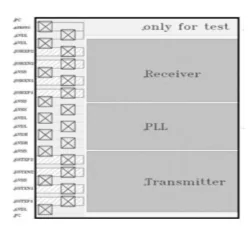
The USB3.1Type-C PHY is a high-speed, SERDES IP with high performance that was created for semiconductors that allow high-bandwidth, low-power data transfers. A specific design for USB 3.1 type-C applications is the USB 3.1Type-C PHY IP. A separate PCS can be provided in addition to the USB 3.1 Type C PHY IP to fulfil the functions of various applications, including elastic buffer, scramble/de-scramble, data encoding/decoding, PRBS generation/checking, registers control, and testing. Depending on the needs of the customer, PCS is offered as a hard macro or a soft macro. The PCS standard will also be made available on its own. PHY functionality is verified by the NC-Verilog simulation tool using a test bench created in Verilog HDL..
Learn more about Single-Protocol PHY IP core
T2M-IP, the global leader in semiconductor IP cores and technology expertise, is proud to announce the immediate availability of its partner's VESA-compliant DisplayPort v1.4 Rx PHY and Controller IP Cores.
T2M announces the availability of its partner’s Bluetooth V6.0 RF Transceiver IP Core in 22nm ULL and 40nm ULP.
Incorporating BroadR-Reach™ technology for Automotive Excellence, this PHY delivers exceptional performance for automotive and industrial applications, providing a superior alternative to traditional BaseT1 solutions.
Designed to meet the evolving needs of next-generation automotive and industrial applications, the CAN XL Controller IP offers superior performance and flexibility while maintaining backward compatibility with previous CAN standards.
T2MIP, a leading provider of semiconductor IP cores, proudly announces the immediate availability of their partner's H.264 and H.265 HEVC Codec IP cores.
T2M-IP is excited to announce that its state-of-the-art USB 3.0 IP, developed in the 22nm ULP (Ultra Low Power) and ULL (Ultra Low Leakage) process technologies, has been successfully licensed to over 10 customers worldwide in the past two years.