Vendor: Cadence Design Systems, Inc. Category: Single-Protocol PHY

USB 2.0 PHY

Proven PHY IP for USB Device, Host, and OTG with small footprint and low active power

Overview

Proven PHY IP for USB Device, Host, and OTG with small footprint and low active power

Architected to quickly and easily integrate into any SoC, the Cadence® USB 2.0 On-The-Go (OTG) PHY IP connects seamlessly to a Cadence or third-party UTMI-compliant controller. The IP provides you with a cost-effective, low-power solution for demanding applications. It offers SoC integrators the advanced capabilities and support that exceed the requirements of high-performance designs and implementations. The Cadence USB 2.0 OTG IP is silicon-proven and has been extensively validated with multiple hardware platforms.

Key features

  • Designed to the USB 2.0 specification, and operates at High Speed (480Mbps), Full Speed (12Mbps), and Low Speed (1.5Mbps)
  • Complies with the UTMI v1.05 specification
  • Multiple reference clock supported from 9.6MHz up to 52MHz
  • 8-bit 60MHz and 16-bit 30MHz parallel interfaces
  • Battery Charging Specification v1.2
  • Supports link power management (LPM)
  • APB and JTAG interface

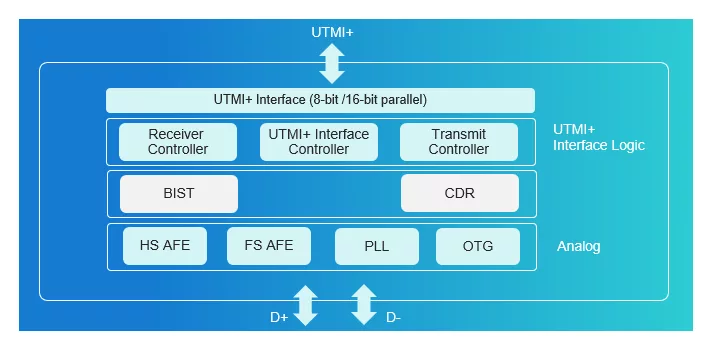
Block Diagram

Benefits

  • Silicon-Proven Solution with USB IF Certification: Mature IP with proven mass production history
  • Low-Power Design Enables Power-Saving Applications: Low active power consumption with small footprint
  • Extensive Test Features Provide Improved Production Testing Experience: Comprehensive test features include datapath loopback, scan, BIST, bypass

Applications

  • Automotive,
  • Communications,
  • Consumer Electronics,
  • Data Processing,
  • Industrial and Medical,
  • Military/Civil Aerospace,
  • Others

What’s Included?

  • Verilog behavioral modules for PHY module
  • Verilog testbench with configuration files and sample tests
  • Liberty timing model
  • Layout abstract in LEF format
  • GDSII with flat netlist for LVS

Specifications

Identity

Part Number
USB 2.0 PHY
Vendor
Cadence Design Systems, Inc.
Type
Silicon IP

Standards & Interfaces

Supported Standards
USB 2.0

Files

Note: some files may require an NDA depending on provider policy.

Provider

Learn more about Single-Protocol PHY IP core

Rethinking AI Infrastructure: The Rise of PCIe Switches

Far from just a functional piece of hardware, PCIe switches are the invisible foundation that accelerates data processing, eliminates bottlenecks, and ensures modern AI systems operate with blazing speed and pinpoint precision.

UALink Under the Hood: Why Full-Stack Verification Wins

Verifying UALink means following a transaction the way the silicon does: down through four layers, out across one, two, or four SerDes lanes at the configured 100G or 200G serial rate, and back again, with its meaning and its bytes both intact. This blog takes that journey one layer at a time, and along the way examines a detail of the data link flit that is easy to overlook and important to get right.

A Look at New Open Standards to Improve Reliability and Redundancy of Automotive Ethernet

To meet the safety and deterministic latency requirements for controlling a car, a new set of open standards is being developed, collectively referred to as “Time Sensitive Networking,” or TSN. These improve the reliability, timing, redundancy, and failure detection ability of Ethernet to the level where it can be applied throughout an automobile. This article describes how Cadence has addressed the hardware requirements of TSN in its Automotive Ethernet Media Access Controller (MAC).

Frequently asked questions about Single-Protocol PHY IP

What is USB 2.0 PHY?

USB 2.0 PHY is a Single-Protocol PHY IP core from Cadence Design Systems, Inc. listed on Semi IP Hub.

How should engineers evaluate this Single-Protocol PHY?

Engineers should review the overview, key features, supported foundries and nodes, maturity, deliverables, and provider information before shortlisting this Single-Protocol PHY IP.

Can this semiconductor IP be compared with similar products?

Yes. Buyers can compare this product with similar semiconductor IP cores or IP families based on category, provider, process options, and structured technical specifications.

×
Semiconductor IP