Arasan to demonstrate the industry's first MIPI SWI3S™ IP at the MIPI Member meet in Taipei
Arasan provides a Total SWI3S™ IP Solution including the SWI3S™ PHY which will be available on multiple foundry nodes 22nm and below.
The USB 2.0 OTG IP Core is compliant with the OTG Supplement Rev.
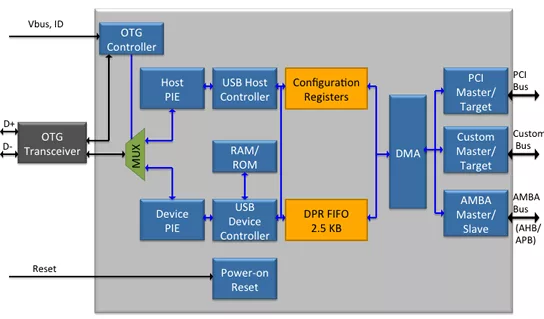
The USB 2.0 OTG IP Core is compliant with the OTG Supplement Rev. 1.0a. The USB 2.0 OTG core supports both Host Controller, Device Controller and OTG functionality. When operating as a host (A-device), it supports 480 Mbit/s in High Speed (HS) mode, 12 Mbit/s in Full Speed (FS) mode, and 1.5 Mbit/s in Low Speed (LS) mode. When operating as a peripheral (B-device), it supports HS and FS modes.
Session Request Protocol (SRP) and Host Negotiation Protocol (HNP) are managed by the SRP/HNP Control Logic. SRP allows a B-device to request an A-device to turn on Vbus to start a session. HNP allows two connected dual-role devices to change roles and eliminates the needs for the user to switch cable connections. The Vbus Control Circuit supports: a) the generation of data-line pulsing and Vbus pulsing methods when initiating the SRP as a Bdevice, b) the detection of both pulsing methods when acting as an A-device, and c) the sourcing of a minimum of 8 mA on Vbus. The Vbus Control Circuit also handles the pull-up and pull-down connections to D+ and D- during host/device role switching. The SRP/HNP Logic and Vbus Control Circuit control the operating mode of an USB port as either a host or peripheral. The Arasan USB 2.0 OTG port requires an external USB 2.0 transceiver with a standard UTMI interface.
The USB 2.0 OTG IP Core offers a high level of flexibility, allowing designers to implement the USB 2.0 OTG port with a wide selection of processor interfaces. AHB, PCI, and Custom buses are available to provide a high-speed connection to the USB interface.
The USB 2.0 OTG IP Core is augmented by the availability of the Arasan OTG Software Stack that supports host driver, device driver, class of devices, and Linux operating system.
Arasan is the among the industry’s first providers of USB IP with the launch of its USB 1.1 Device IP in 1996 and the industries ONLY provider to offer a Total USB 2.0 IP Solution which includes its USB 2.0 Host IP Core, USB 2.0 Device IP Core, USB 2.0 Hub IP, USB 2.0 OTG IP, the USB 2.0 PHY IP and software for multiple OS.
Note: some files may require an NDA depending on provider policy.

USB 2.0 OTG IP Core is a USB IP core from Arasan Chip Systems Inc. listed on Semi IP Hub.
Engineers should review the overview, key features, supported foundries and nodes, maturity, deliverables, and provider information before shortlisting this USB IP.
Yes. Buyers can compare this product with similar semiconductor IP cores or IP families based on category, provider, process options, and structured technical specifications.