Vendor: Arasan Chip Systems Inc. Category: USB

USB 2.0 OTG Dual Role Device (DRD) Controller

The Arasan USB 2.0 OTG DRD IP Core is compliant with the OTG Supplement Rev.

Overview

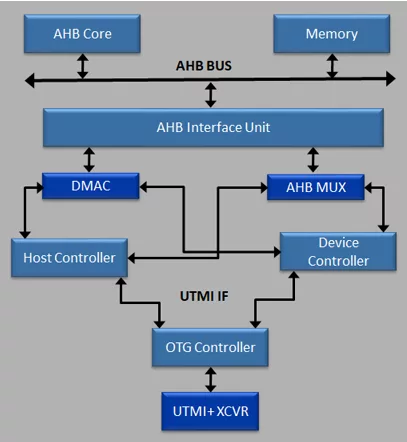
The Arasan USB 2.0 OTG DRD IP Core is compliant with the OTG Supplement Rev. 1.0a. The USB 2.0 OTG DRD core supports the Host Controller, Device Controller, and OTG functionality. It supports Hi-Speed (480 Mbps), Full Speed (12 Mbps), and Low Speed (1.5 Mbps) (USB 2.0 Speeds) specifications. AHB interface is available to provide a high-speed connection to the USB interface.

Session Request Protocol (SRP) and Host Negotiation Protocol (HNP) are managed by the SRP/ HNP Control Logic. SRP allows a Peripheral (B-device) to request a Host (A-device) to turn on Vbus to start a session, while HNP allows two connected dual-role devices to change roles and eliminates the need for the user to switch cable connections. The Vbus Control Circuit supports the generation of data-line pulsing and Vbus pulsing methods when initiating the SRP as a B-device, the detection of both pulsing methods when acting as an A-device, and the sourcing of a minimum of 8 mA on Vbus. The Vbus Control Circuit also handles the pull-up and pull-down connections to D+ during host/device role switching. The SRP/HNP Logic and Vbus Control Circuit control the operating mode of a USB port as either a host or a peripheral. The Arasan USB 2.0 OTG port requires an external USB 2.0 transceiver with a standard UTMI interface.
Key features

  • Compliant with OTG Supplement Rev. 1.0a
  • USB 2.0 Compliant
  • Supports 480 Mbit/s (HS), 12 Mbit/s (FS), and 1.5 Mbit/s (LS)
  • Supports Session Request Protocol (SRP) and Host Negotiation Protocol (HNP)
  • Supports data-line pulsing and Vbus pulsing as A-device or B-device
  • High/Full speed support using 8/16-bit UTMI/ULPI interface
  • USB transaction protocols are handled by hardware
  • Minimum 8 mA Vbus and over 500 ma sourcing to peripherals with 5 V external power supply
  • Suspend/resume support for power management
  • 32-bit AHB bus Interface
  • Master DMA implementation for each endpoint
  • UTMI+ PHY Interface Clock: 30/60 MHz
  • Configurable up to 15 Tx and Rx endpoints
  • Configuration options: Bulk, Control, Isochronous, Interrupt
  • Configurable dual port RAM shared between endpoints

Block Diagram

What’s Included?

  • RMM-compliant synthesizable RTL design in Verilog
  • Easy-to-use test environment
  • Synthesis scripts
  • Technical documents
  • Simulation scripts

Specifications

Identity

Part Number
USB 2.0 OTG Dual Role Device (DRD) Controller
Vendor
Arasan Chip Systems Inc.
Type
Silicon IP

Files

Note: some files may require an NDA depending on provider policy.

Provider

Learn more about USB IP core

SuperSpeed USB 3.0: Ubiquitous Interconnect for Next Generation Consumer Applications

To address the bandwidth limitations of the USB 2.0 interface, the USB Implementers Forum (USB-IF) released the SuperSpeed USB 3.0 specifications in November 2008. The USB 3.0 specification provides a maximum bandwidth of up to 5Gbps while limiting power consumption. In this white paper we present the features of the USB 3.0 protocol, discuss the new usage models it enables and compare it with some of the existing interface standards popular in the market today.

eUSB2V2: Trends and Innovations Shaping the Future of Embedded Connectivity

In an era defined by rapid technological advancement, embedded interfaces must evolve to meet the demands of smaller form factors, lower power budgets, and diversified use cases. Among these interfaces, eUSB2V2 (Embedded USB 2.0 Version 2) has emerged not just as a legacy-support PHY, but as a strategic enabler of robust, low-power connectivity across next-generation systems-on-chip (SoCs).

Frequently asked questions about USB IP cores

What is USB 2.0 OTG Dual Role Device (DRD) Controller?

USB 2.0 OTG Dual Role Device (DRD) Controller is a USB IP core from Arasan Chip Systems Inc. listed on Semi IP Hub.

How should engineers evaluate this USB?

Engineers should review the overview, key features, supported foundries and nodes, maturity, deliverables, and provider information before shortlisting this USB IP.

Can this semiconductor IP be compared with similar products?

Yes. Buyers can compare this product with similar semiconductor IP cores or IP families based on category, provider, process options, and structured technical specifications.

×
Semiconductor IP