Vendor: Synopsys, Inc. Category: Single-Protocol PHY

USB 2.0 femtoPHY - TSMC 40ULP25 x1, OTG, Type-C

The USB 2.0 Type-C IP solution for IoT applications includes controllers and PHYs optimized for cost-sensitive and energy-efficie…

USB 2.0 TSMC 40nm ULP View all specifications

Overview

The USB 2.0 Type-C IP solution for IoT applications includes controllers and PHYs optimized for cost-sensitive and energy-efficient IoT edge applications.

Based on the USB 2.0 IP that has been certified more than 90 times and integrated in thousands of SoCs, the DesignWare USB 2.0 Type-C IP cuts silicon area by up to 50% compared to competitive offerings, saving on average $0.03 per die.

To extend battery life, the USB IP uses 30% lower active power compared to competing solutions and near 0W of standby power. The DesignWare USB 2.0 Type-C IP supports the Unified Power Format (UPF) standard, which speeds implementation and testing of power domains. For the fastest, most efficient development, the IP eliminates the 80% of standard USB 2.0 configuration options that are not essential to IoT systems.

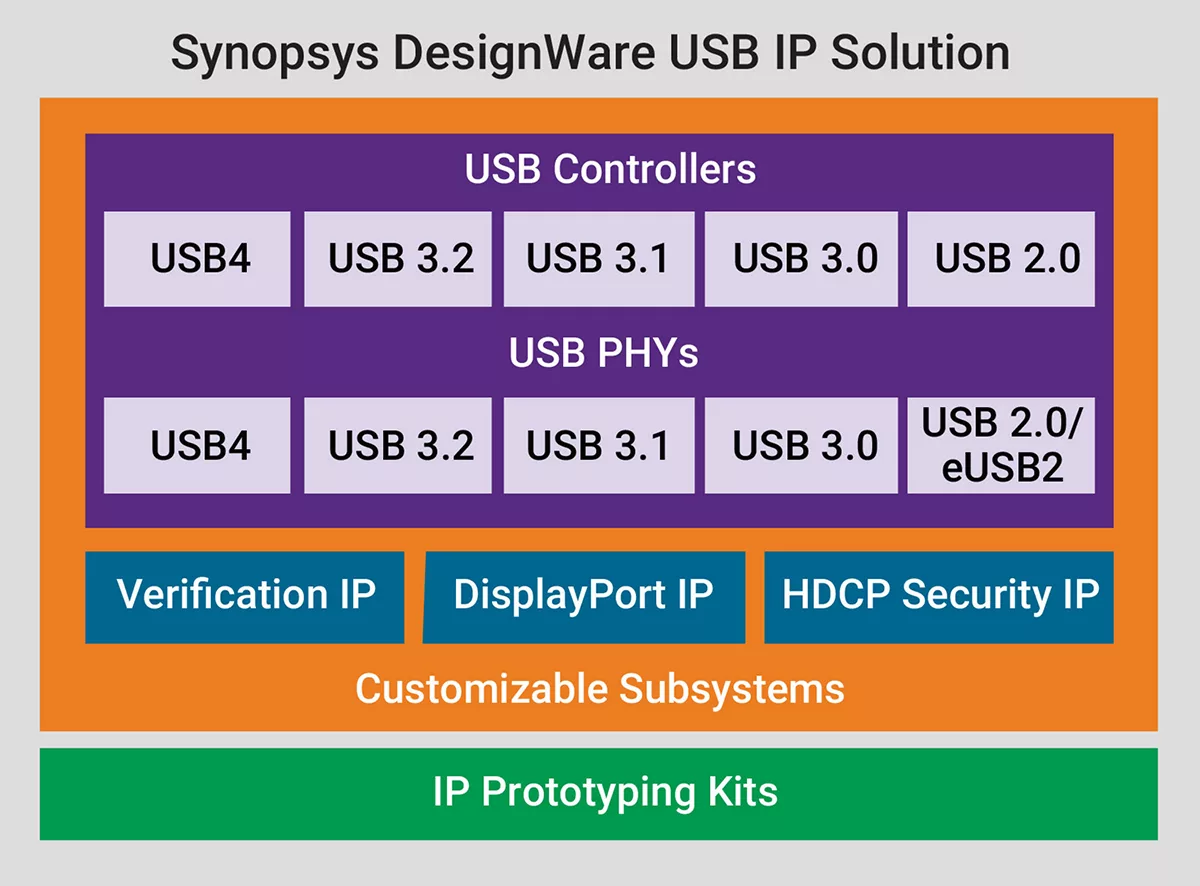
In addition to the DesignWare USB 2.0 Type-C Controllers and PHYs, the vendor offers USB IP prototyping kits, IP software development kits and verification IP to enable early software development, reduce IP integration risk and speed time-to-market.

Key features

  • Saves on average $0.03 per die with 50% smaller USB silicon area than competing solutions
  • Extends battery life with near 0W standby power consumption and 30% lower active power
  • Saves months of implementation and verification effort with simplified configuration options
  • Supports USB 2.0 Hi-Speed, Full Speed, and Low Speed
  • Backwards compatible with USB 1.1 operating at 1.5 Mbps (Low- Speed) and 12 Mbps (Full-Speed)
  • Can be used in HS On-the-Go, Dual Role, Host and Device applications
  • Supports the Battery Charging v1.2 specification
  • Supports USB Type-C™ connector standard

Block Diagram

Silicon Options

Foundry Node Process Maturity
TSMC 40nm ULP

Specifications

Identity

Part Number
dwc_usb2_type-c_iot
Vendor
Synopsys, Inc.
Type
Silicon IP

Standards & Interfaces

Supported Standards
USB 2.0

Files

Note: some files may require an NDA depending on provider policy.

Provider

Learn more about Single-Protocol PHY IP core

Accelerating the Development of TLM-2.0 Models Using Model Authoring Kits (MAKs)

Model authoring kits (MAKs) enable the rapid development of transaction-level models, TLMs, of a given functionality or protocol. MAKs include base functionalities that are common to all models independent of the RTL implementation in a well-structured way, allowing for maximum reuse. The DesignWare System-Level Library provides MAKs for UART and USB. Taking the example of a USB 2.0 EHCI controller model using MAKs, this paper explains the significant design time reduction that can be achieved.

Industry 1st CXL 4.0 Verification IP: Transforming AI and HPC Systems

Synopsys continues to lead innovation with the industry’s first commercially available CXL 4.0 Verification IP (VIP). This comprehensive solution supports the full 128 GT/s data rate, IO throttling, and streamlined port negotiation, equipping designers to validate and optimize their products for the future.

Low Power Analysis and Verification of Super Speed Inter-Chip (SSIC) IP

In our current work, we focus on the low power analysis and verification challenges and the methodology used to verify low power design. The power-gating feature that we term Hibernation brings in significant power savings to Synopsys SSIC IP Controller. The verification tests the functionality of the Controller before, during and after hibernation state. The low power analysis will showcase the power savings achieved in SSIC IP with and Without Hibernation.

Frequently asked questions about Single-Protocol PHY IP

What is USB 2.0 femtoPHY - TSMC 40ULP25 x1, OTG, Type-C?

USB 2.0 femtoPHY - TSMC 40ULP25 x1, OTG, Type-C is a Single-Protocol PHY IP core from Synopsys, Inc. listed on Semi IP Hub. It is listed with support for tsmc.

How should engineers evaluate this Single-Protocol PHY?

Engineers should review the overview, key features, supported foundries and nodes, maturity, deliverables, and provider information before shortlisting this Single-Protocol PHY IP.

Can this semiconductor IP be compared with similar products?

Yes. Buyers can compare this product with similar semiconductor IP cores or IP families based on category, provider, process options, and structured technical specifications.

×
Semiconductor IP