Arasan to demonstrate the industry's first MIPI SWI3S™ IP at the MIPI Member meet in Taipei
Arasan provides a Total SWI3S™ IP Solution including the SWI3S™ PHY which will be available on multiple foundry nodes 22nm and below.
The Universal Flash Storage 3.1 (UFS 3.1) is a simple but high-performance, serial interface primarily used in mobile systems, be…
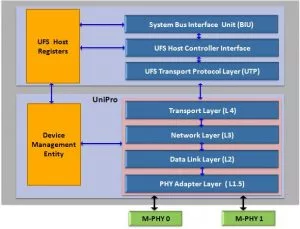
The Universal Flash Storage 3.1 (UFS 3.1) is a simple but high-performance, serial interface primarily used in mobile systems, between host processing and nonvolatile eXecute-In-Place (XIP) or mass storage memory devices.
Mobile phones, UMPC, DSC, PMP are some of the typical applications for UFS Host Controller IP. The majority of these applications require mass storage and bootable storage memory with an option for an external card.
The IP incorporates the latest UFS Host Controller Interface (HCI) version 3.1. Arasan’s MIPI M-PHY® HS-G4 IP is available in GDSII format for a variety of process technologies and MIPI UniProSM version 1.8 link layer with support for multi-lane operation and the optional Unified Memory Architecture (UMA) implementation.
Note: some files may require an NDA depending on provider policy.

UFS 3.1 host is a UFS Controller IP core from Arasan Chip Systems Inc. listed on Semi IP Hub.
Engineers should review the overview, key features, supported foundries and nodes, maturity, deliverables, and provider information before shortlisting this UFS Controller IP.
Yes. Buyers can compare this product with similar semiconductor IP cores or IP families based on category, provider, process options, and structured technical specifications.