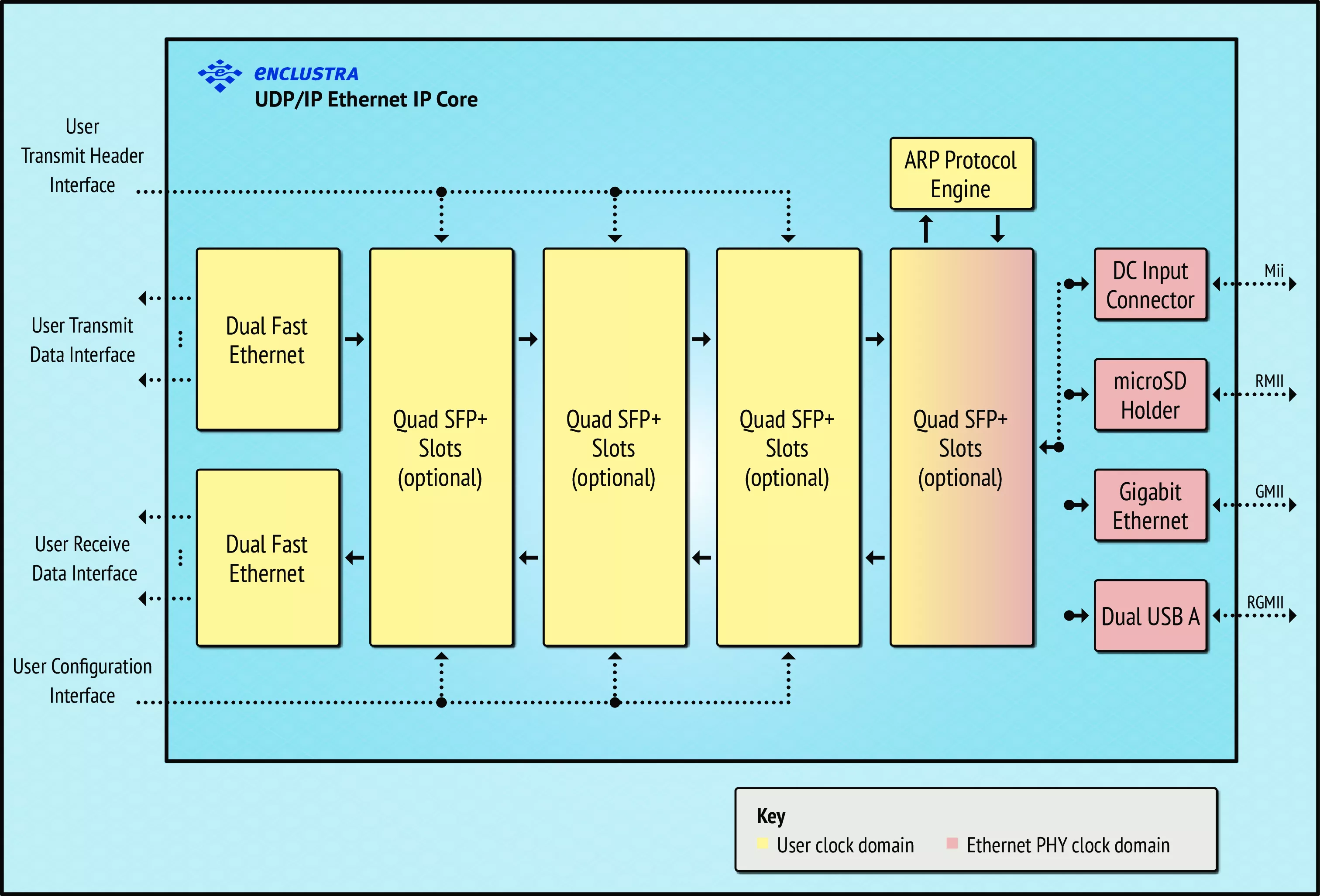
Overview
Enclustra's UDP/IP Ethernet IP core easily enables FPGA-based subsystems to communicate with other subsystems via Ethernet, using the UDP protocol. The IP core is highly configurable and optimally implemented for the use in current Altera® and Xilinx® FPGA architectures. It provides a simple to use interface to the user logic, and supports the common media independent interfaces MII, RMII, GMII and RGMII. With its 8-bit wide transmit and receive interfaces running at 125 MHz, the IP core is able to operate at full 1 Gbit/sec wire speed. 100 Mbit/sec and 10 Mbit/sec operation is also supported.
Learn more about Ethernet IP core
Learn how ESUN enhances Ethernet for lossless, predictable AI scale-up networking—cutting overhead, reducing tail latency, and improving efficiency.
Ethernet has evolved significantly from 10 Mbps shared media to today’s multi-hundred gigabit high-speed links. One foundational feature that has enabled this scalability and ease of deployment is Auto-Negotiation (AN).
Ethernet was originally designed for high-speed data transfer and interoperability between devices. However, traditional Ethernet does not provide built-in mechanisms for securing data traffic, such as encryption or authenticity protection. This is where MACsec comes into the picture.
This blog examines what separates truly automotive-grade Ethernet IP from generic implementations across functional safety, time-sensitive networking, security, observability, lifecycle management, and the integration disciplines that only become visible once a program is deep into development.
Rambus, having successfully served the data center, enterprise and infrastructure markets with line rate MACsec and IPsec products (Secure Networking), adds two new solutions for securing UET transport protocol with TSS.
Ultra Accelerator Link (UA Link) standard has been specified to enable the creation of systems comprised of multiple nodes targeting AI applications.